

Hyundai Ioniq Recall 303: Rear Suspension Fasteners
Hyundai recall update
Hyundai recall 303 covers certain 2025 IONIQ 5 and 2026 IONIQ 9 electric SUVs whose rear suspension fasteners may loosen and detach. NHTSA campaign 26V314000 lists 172 vehicles potentially affected. The remedy begins with an inspection; replacement hardware and a rear alignment depend on what that inspection finds.
Updated October 16, 2026
Which vehicles does campaign 303 cover?
Hyundai’s May 18, 2026 recall filing identifies the following U.S.-market vehicles assembled by Hyundai Motor Group Metaplant America. Model year and assembly date are different fields: a 2026 model can have been built in 2025.
| Model and model year | Potentially involved | Assembly window in the filing |
|---|---|---|
| 2025 IONIQ 5 | 138 | December 10, 2024–July 10, 2025 |
| 2026 IONIQ 9 | 34 | March 25–July 23, 2025 |
The total of 172 describes vehicles potentially involved, not confirmed failures or the number still unrepaired. The assembly windows help describe the population; they do not establish that every vehicle built during those periods is included. Check the individual VIN.
What can go wrong with the fasteners?
Hyundai says specific rear suspension fasteners may not have received sufficient tightening torque during supplier manufacturing. They can loosen over time; a nut or bolt may eventually detach. Loose or missing hardware can reduce vehicle stability or control and increase crash risk.
The filing identifies rear suspension noise and vibration as possible warnings. Report those concerns when contacting Hyundai, but do not use a test drive to decide whether the hardware is secure. Noise alone cannot establish which fastener is involved, and a quiet drive does not replace the campaign’s inspection.
Inspection, replacement and alignment are separate steps
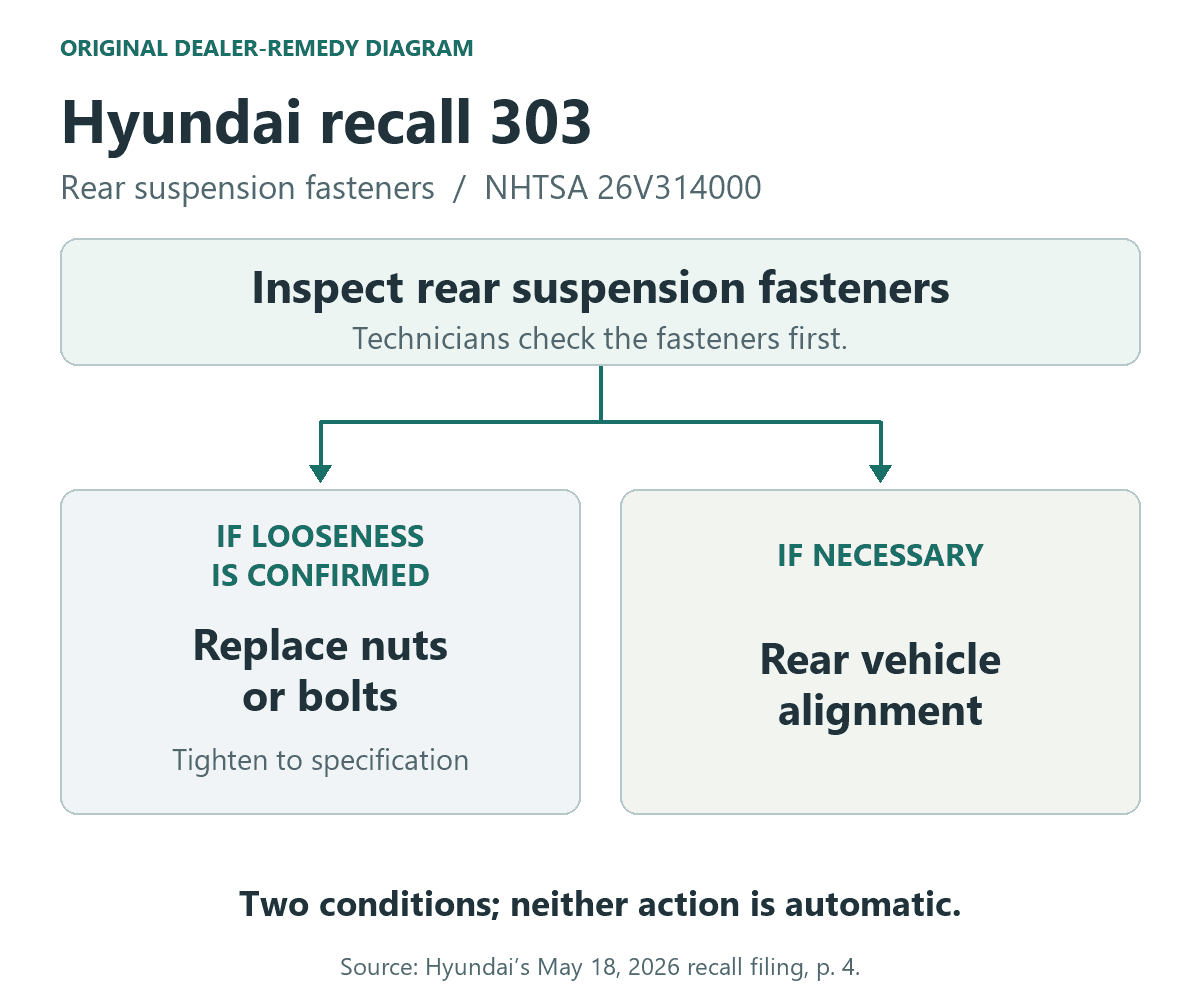
The manufacturer’s repair description is more specific than simply “replace the suspension fasteners”:
- Technicians inspect the rear suspension fasteners.
- If loosened fasteners are confirmed, they replace the nuts or bolts and tighten them to specification.
- They perform a rear vehicle alignment if necessary.
This is not a promise that every included vehicle needs the same hardware replacement or an alignment. The filing says the fasteners themselves are unchanged; the remedy checks and addresses tightening torque. It also says the recall work is free for affected vehicles regardless of whether Hyundai’s New Vehicle Limited Warranty still covers them.
July 17 remains a planned date in the checked record
The current NHTSA record still describes owner letters as expected to be mailed July 17, 2026. That wording does not confirm a completed mailing, an owner’s receipt or a repaired vehicle. Ask Hyundai for the latest campaign instructions for the VIN rather than treating the old forecast as a current appointment or parts-availability promise.
Check the VIN, then the campaign-specific paperwork
Use Hyundai’s recall and service-campaign lookup with the 17-character VIN, or contact Hyundai customer service at 855-371-9460. Identify campaign 303 or NHTSA 26V314000 so the discussion concerns this rear suspension recall.
For a vehicle with previous work, request the repair order showing the VIN, campaign inspection and any replacement or alignment performed. A general alignment invoice does not by itself document campaign 303. NHTSA’s VIN search shows unrepaired recalls and excludes completed recalls, so an open-recall search and a dated repair record answer different questions.
0 comment(s) so far on Hyundai Ioniq Recall 303: Rear Suspension Fasteners