

Hyundai Recall 299: Tucson and Elantra Airbag Sensors
Hyundai recall update
Hyundai recall 299 concerns impact sensors that may delay airbag deployment in certain Tucson and Elantra vehicles. NHTSA lists 2,931 vehicles potentially affected and now reports that owner letters were mailed June 11, 2026. The useful checks are whether the campaign applies to the VIN, what work is required and whether that work is documented as complete.
Updated October 16, 2026
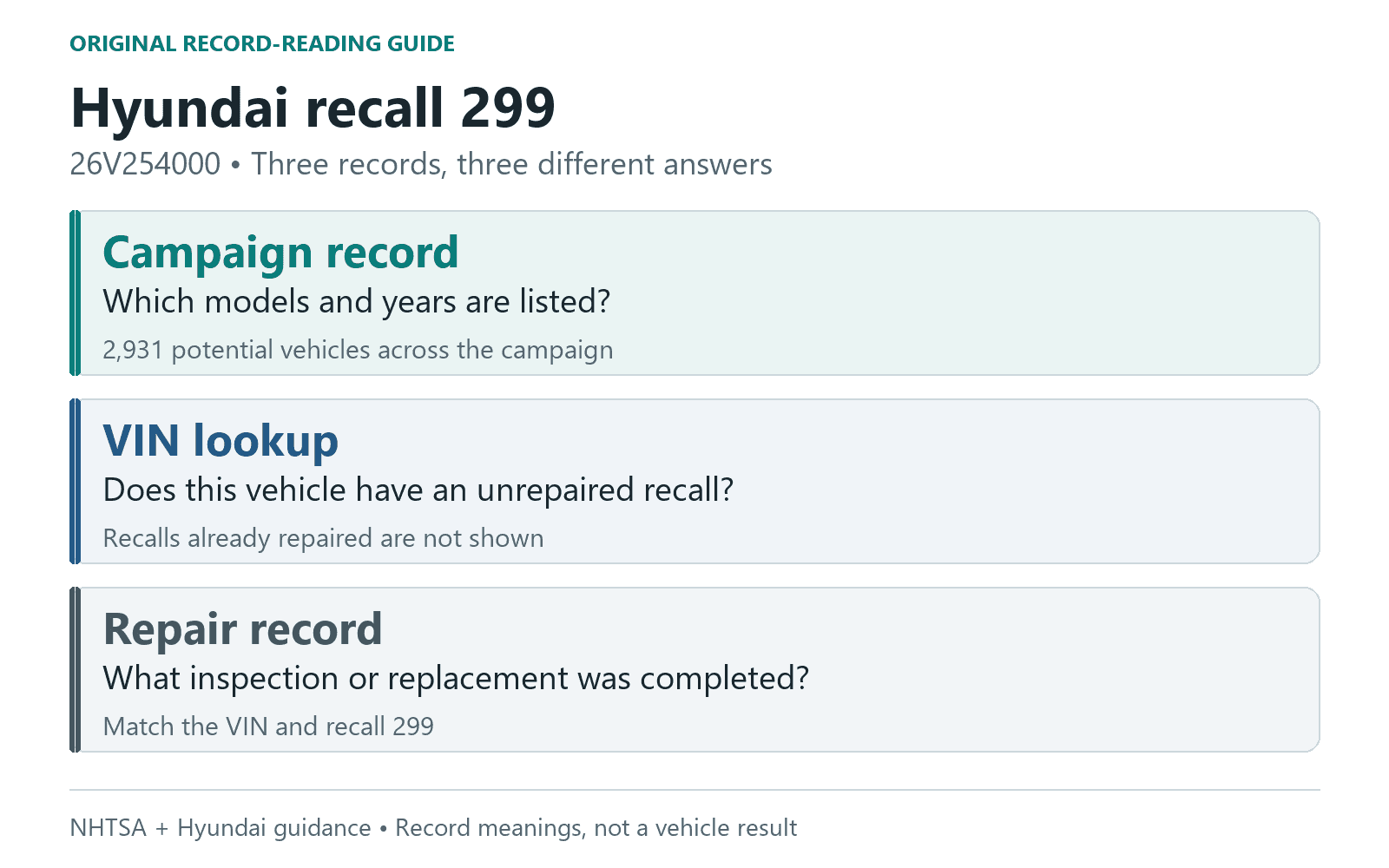
Which vehicles does recall 299 cover?
The current NHTSA campaign record, checked October 16, 2026, lists these U.S. model-year groups. Hyundai calls the action recall 299; NHTSA identifies it as 26V254000.
| Model | Model year |
|---|---|
| Hyundai Tucson | 2026 |
| Hyundai Tucson Hybrid | 2026 |
| Hyundai Tucson Plug-In Hybrid | 2026 |
| Hyundai Elantra | 2026 |
| Hyundai Elantra N | 2025 |
NHTSA reports 2,931 vehicles potentially affected across the campaign. That is one total, not a separate count for each row. Use the actual VIN to determine whether this recall applies rather than deciding from the vehicle’s badge or model year.
What is wrong with the sensors?
NHTSA describes B-pillar impact sensors that may have been misassembled. The defect can delay airbag deployment; airbags that do not deploy as intended increase the risk of injury in a crash.
The campaign description identifies a potential manufacturing defect. It does not establish the condition of an individual sensor or explain every airbag warning. A warning-light observation, or the absence of one, should not replace the VIN check and applicable recall procedure.
Inspection does not always mean replacing both sensors
NHTSA’s remedy calls for dealers to inspect the impact sensors and replace them as necessary, without charge. Hyundai’s May 2026 technical bulletin 26-01-045H explains the distinction: technicians check left and right sensor IDs against specified replacement targets. In that procedure, an ID match determines whether a sensor needs replacement.
The bulletin names Elantra, Elantra N, Tucson Hybrid and Tucson Plug-In Hybrid vehicles. Its vehicle list is narrower than the current campaign record, which also names the Tucson. Do not apply its production-date table or another powertrain’s procedure to a car by assumption. Ask Hyundai which current instructions apply to the exact VIN.
Hyundai describes a dealer procedure using diagnostic equipment and repair documentation. Leave sensor handling to the applicable professional procedure. When collecting paperwork, ask whether the work order records an inspection alone or inspection and replacement.
The current mailing date is June 11, 2026
This article was first published May 4, 2026. An earlier version listed June 19 as an expected notice date. NHTSA’s record now says owner notification letters were mailed June 11, 2026. A reported mailing does not establish that a particular owner received a letter, that an appointment is available today or that the vehicle has been repaired.
Check the VIN, then keep the completion record
Use NHTSA’s VIN recall lookup and identify both recall numbers when contacting Hyundai. The campaign record says involved VINs became searchable April 22, 2026. Hyundai’s listed customer-service number is 855-371-9460. Confirm eligibility, the applicable remedy and appointment or parts arrangements for that vehicle.
NHTSA’s VIN search does not show recalls already repaired and can omit some newly announced recalls while VINs are being identified. For a used car, compare the lookup with a repair order identifying this campaign, the VIN, service date and work completed. A zero-open-recall result alone is not a complete repair history or mechanical inspection.
0 comment(s) so far on Hyundai Recall 299: Tucson and Elantra Airbag Sensors