

AAA’s EV and Hybrid Weather Test: What the Costs Mean
Efficiency research
Updated October 16, 2026
Cold weather reduced efficiency in both groups of vehicles in AAA’s May 2026 laboratory study, and the electricity rate reversed which group had the lower modeled energy cost. At 20°F, the three battery-electric vehicles averaged a 35.6% reduction in MPGe from the 75°F baseline; the three conventional hybrids averaged a 22.8% reduction in MPG. The results describe six tested vehicles under controlled conditions, rather than a winter penalty to apply to every EV or hybrid.
What AAA actually tested
The electric group consisted of a 2025 Chevrolet Equinox EV LT FWD, 2025 Ford Mustang Mach-E Premium Extended Range AWD and 2025 Tesla Model Y Long Range RWD. The hybrids were a 2026 Honda CR-V Sport Touring Hybrid AWD, 2025 Hyundai Tucson Blue Hybrid AWD and 2025 Toyota Prius Nightshade FWD. These were different vehicles with different equipment, rather than matching electric and hybrid versions of the same model.
AAA used a four-wheel chassis dynamometer in a temperature-controlled test cell at 20°F, 75°F and 95°F. Cabin climate control was set to 72°F in automatic mode. The team modified SAE procedures to include these temperatures and climate-control use. AAA explicitly warns that its resulting economy and range values should not be compared with EPA-published ratings.
The electric vehicles underwent battery-depletion testing; the hybrids were not run to zero range. The report’s 39.0% average cold-weather reduction in calculated EV range therefore has no directly comparable hybrid-range result. It is also different from the 35.6% MPGe efficiency reduction. Keeping those measures separate prevents a useful test from becoming a misleading range rule.
The price of the same energy matters
AAA priced its measured results using assumptions dated March 27, 2026: $3.978 per gallon for gasoline, $0.1745 per kWh for residential electricity and $0.418 per kWh for commercial charging. Those are the study’s inputs, not current prices or a quote from a particular charging station.
| Test temperature | EVs, residential rate | EVs, commercial rate | Hybrids, gasoline |
|---|---|---|---|
| 75°F baseline | $55.64 | $133.28 | $95.51 |
| 20°F cold | $87.75 | $210.21 | $123.95 |
| 95°F hot | $62.42 | $149.53 | $108.53 |
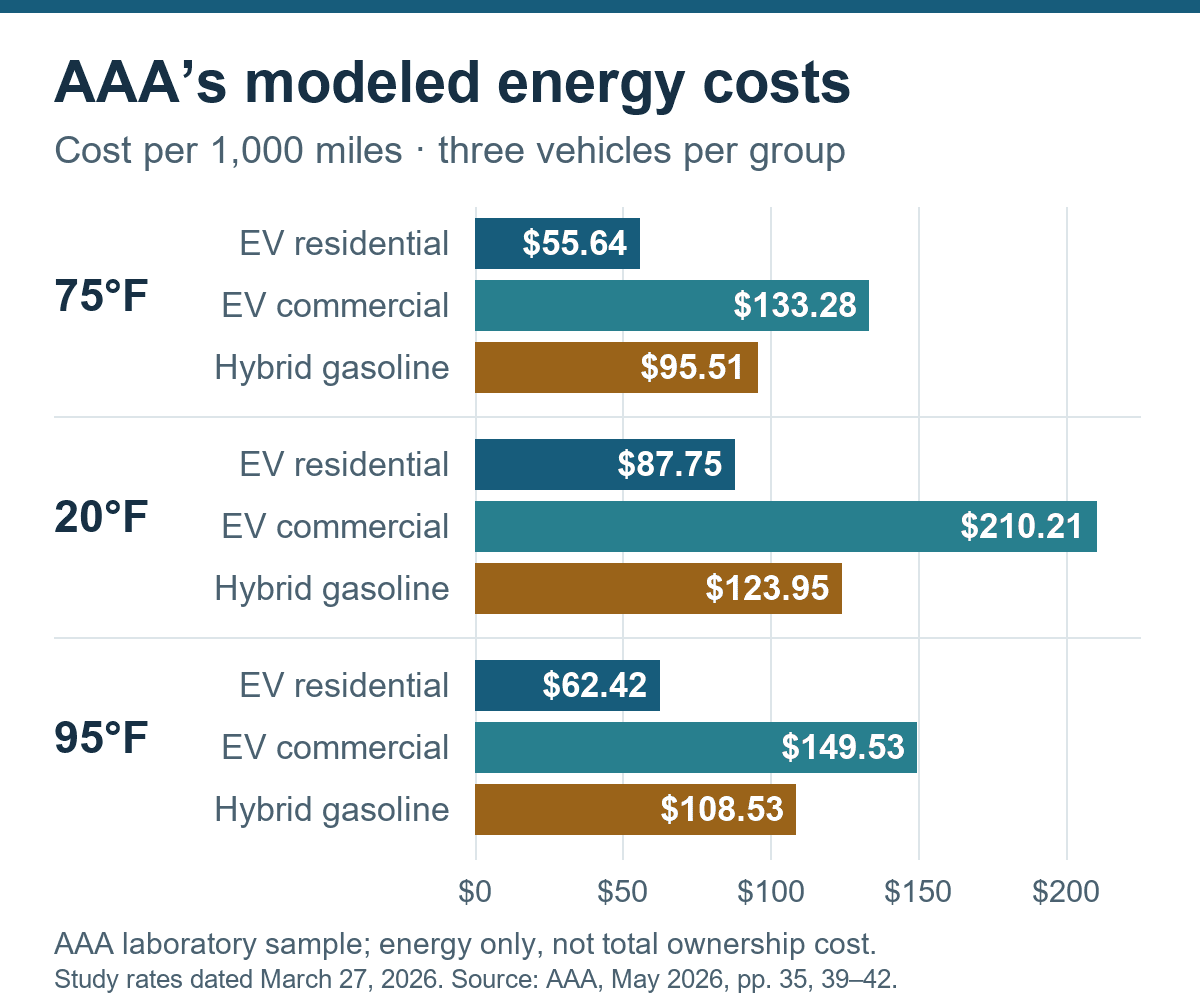
Under those assumptions, the electric group’s modeled cost was below the hybrid group’s at the residential rate and above it at the commercial rate at all three temperatures. That is an energy-price result for this sample, not a universal finding that one powertrain is cheaper to own.
The comparison also separates two sources of change. Moving from 75°F to 20°F raised the electric group’s modeled cost by $32.11 per 1,000 miles at the residential rate, or $76.93 at the commercial rate. The hybrid group rose by $28.44. The same measured electric-vehicle demand was priced two ways; a higher tariff did not cause the vehicles to consume more energy.
Turn the results into a useful personal comparison
MPG and MPGe are efficiency measures, rather than prices. EPA explains MPGe as distance traveled using energy equivalent to that in a gallon of gasoline. Electricity consumption in kWh per 100 miles is a separate way to connect usage with a price per kWh. A range figure answers another question: how far the vehicle can travel under the stated conditions.
For your own comparison, start with where charging would actually happen and the applicable rate. The Department of Energy notes that residential costs depend on equipment and when and how long charging occurs; some utilities offer time-of-use rates. Home charging also requires suitable electrical capacity and equipment. AAA’s residential scenario does not establish that every household can use that rate or install that setup.
Then consider how much driving occurs in cold or hot weather and what the specific vehicle’s documented charging and thermal-management instructions say. Do not simply subtract AAA’s group-average range loss from an EPA window-sticker estimate: the report’s modified laboratory method and small, mixed fleet do not support that calculation.
The study is most useful as a demonstration of two questions to ask together: how temperature changes energy use, and what the energy will cost where you obtain it. Purchase price, installation, insurance and other ownership expenses still need a separate comparison; they are not included in this energy-cost table.
0 comment(s) so far on AAA’s EV and Hybrid Weather Test: What the Costs Mean