

Trunk Won’t Open: Latch, Key Fob, Or Wiring?
Cargo access
A trunk that will not unlatch and a power liftgate that will not rise are different problems. Start by identifying which action failed. The latch, remote control, security settings and powered opening system do different jobs, so “the trunk is broken” is too broad a reason to buy a replacement part.
Updated October 16, 2026
Separate release from opening
The control you press and the mechanism at the lid are also separate. A remote transmitter is an input to the vehicle, rather than a direct mechanical link to the latch. Comparing the permitted normal controls helps describe whether the concern follows one input or the whole opening operation.
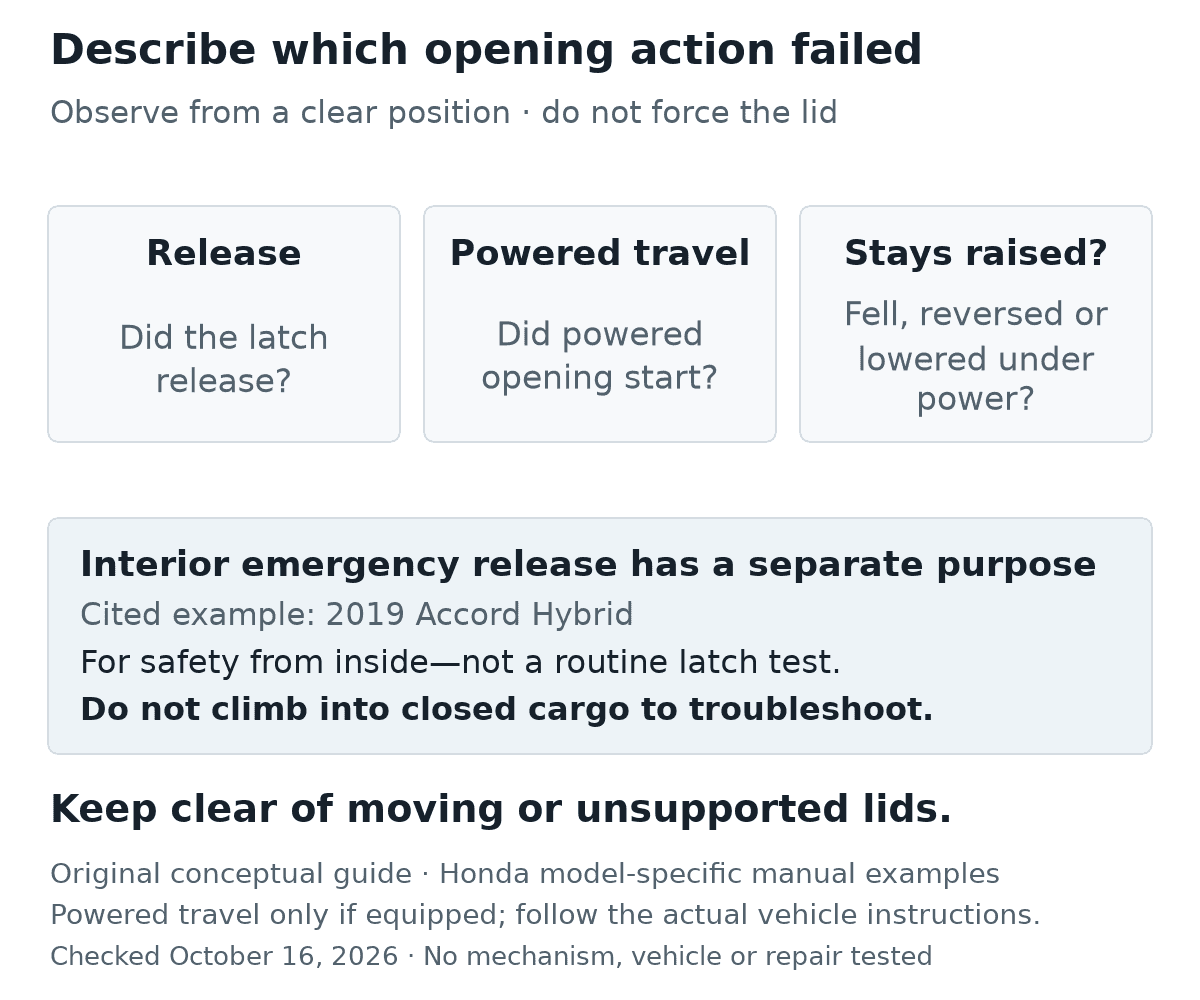
A release command tells the latch to let go. A powered liftgate also needs a system that moves the door through its travel. A lid can unlatch without lifting normally, or remain securely latched because a release command is disabled. An open lid that falls under its own weight is also different from one that lowers under power. Keep that behavior separate from a failed release when describing the complaint.
Keep people clear of a moving liftgate. Do not work beneath a lid that will not remain open, or force it upward or downward to overcome a fault. Use the manual for the actual model and equipment to establish whether manual operation is permitted and how it is performed.
Check the intended operating conditions
Confirm that you are using a release method the vehicle actually has, with the required unlocking and key conditions. If the remote fails, compare another normal release control only as the owner’s manual permits. A click establishes that something responded; it does not show that the latch released fully or that the wiring is good.
Security settings can deliberately disable several controls at once. The 2025 Honda Accord manual, for example, describes an optional trunk main switch that disables the remote release, trunk-lid button and dashboard opener. That is an equipment-specific example, not a switch location to assume on every Honda or every car.
For a powered-tailgate example, the 2021 Honda CR-V manual, page 155, specifies opening and closing with the transmission in Park and warns against pushing or pulling while the tailgate moves automatically. Those instructions apply to models with that equipment; they are not permission to force a stuck lid.
Follow the applicable manual rather than a universal online reset sequence. Disconnecting a battery or repeatedly operating an obstructed gate is not a general repair.
Describe what happens when you press the control
| Observed behavior | Useful distinction |
|---|---|
| One release control fails, another works | Compare that input’s settings and operation before condemning the whole latch. |
| Every normal release is inactive | Check the documented lockout and operating conditions before assuming all switches failed. |
| The latch responds but the lid stays closed | Release, mechanical movement and powered lifting still need separate checks. |
| The lid opens but will not stay raised | Keep clear; record whether it falls, reverses or lowers under power. |
Emergency release is a separate safety feature
The 2019 Accord Hybrid manual, page 180, describes an interior emergency trunk opener as a way to open the trunk from inside for safety. That is not an instruction to climb into a closed cargo compartment to troubleshoot a latch. Emergency and backup access differ by vehicle; use the exact manual or obtain assistance if ordinary access is unavailable.
Before disassembly, establish which command reaches the latch and whether the latch can move correctly. A repairer may need to check the relevant switch input, power supply, wiring and mechanical operation, or the powered-liftgate system if equipped. Ask which finding explains the failure, rather than accepting a remote battery, latch and lift motor as interchangeable guesses.
If the lid cannot close and latch securely, resolve that before driving. The Honda manual specifically warns against driving with the trunk open because exhaust gas can enter. A temporarily accessible cargo space does not establish that the vehicle is ready for normal use.
0 comment(s) so far on Trunk Won’t Open: Latch, Key Fob, Or Wiring?