

Parking Brake Stuck: Release Conditions and Diagnosis
Parking brake diagnosis
Updated October 16, 2026
A parking brake that will not release needs more than a guess about a cable or switch. Separate a failed automatic-release action, a warning message and a vehicle that remains physically held back. Those observations can involve different conditions and hardware. Do not use engine power to force the vehicle against an applied brake.
Describe what “stuck” means
Tell the repairer whether the hand lever or pedal will not return, an electric switch produces no apparent response, a warning remains on, or the vehicle feels held back after an attempted release. Record the exact message and whether the behavior began after battery trouble or brake work. An indicator, sound or control movement alone does not establish that the parking brake has fully released.
If there is smoke, a burning smell, abnormal braking or resistance to moving, stop the attempt and arrange assistance. Do not touch a wheel or brake to judge its temperature, jack up the vehicle, disconnect a cable or try a moving release test. An assistance provider needs to know that the brake may still be applied before arranging recovery.
Manual and automatic release have different conditions
The 2021 gasoline Honda CR-V manual provides one specific example. Its electric parking brake needs vehicle power, and the manual says a dead 12-volt battery prevents applying or releasing it. Automatic release has separate conditions, including the driver’s seat belt, running engine and transmission position; some warning states prevent it.
A missed automatic release therefore does not by itself establish a seized cable or failed motor. This Honda example is not a release procedure for another vehicle. Use the exact model-year instructions and messages; do not improvise a jump-start, switch sequence or emergency-release method from a general article.
An electric switch does not identify the mechanism
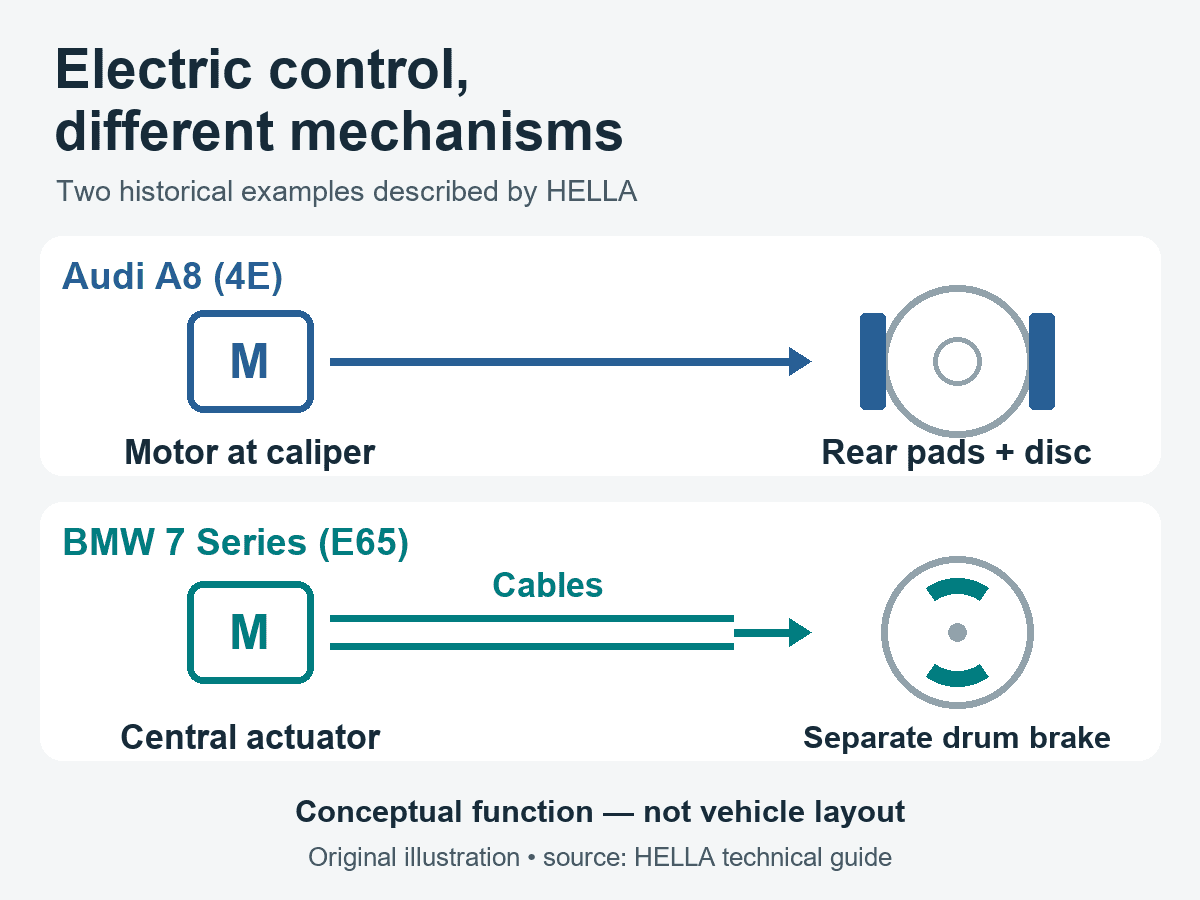
HELLA’s technical explanation contrasts two designs. Its Audi A8 (4E) example uses motors at the rear calipers, while its BMW 7 Series (E65) example uses an electric actuator and cables to operate separate drum brakes. An electrically controlled parking brake can therefore still have cables. These historical examples do not identify the arrangement in the reader’s vehicle.
The relevant diagnostic question is where the release failed: the required control conditions, the electrical command and power supply, or the mechanical holding parts. HELLA describes workshop checks of fault memory, actual switch states, actuator operation and mechanical condition. A stored code or a silent motor is a finding to interpret, not automatic authorization to replace the switch or caliper.
Warnings need the vehicle’s own instructions
The 2025 U.S. Wrangler manual describes a center-console hand lever. It says the parking-brake light does not show the degree of application and warns that a light remaining on after release indicates a brake-system malfunction needing immediate service. That warning does not identify a cable as the cause.
Honda’s manual separately directs an immediate inspection for specified red/amber brake-warning combinations, including a safe stop when the warnings persist. A lever returning or one light going out is not general clearance to drive with drag, other brake warnings or abnormal braking.
Ask what confirmed the repair
Request the identified system, the recorded fault and the work performed. The repairer should explain which control or component failed and how the specified release and holding functions were checked afterward. Clearing a warning or fitting a part is different from confirming the original problem has been resolved. Keep that explanation with the original symptom notes.
0 comment(s) so far on Parking Brake Stuck: Release Conditions and Diagnosis