

ChargePoint Express Solo: What 600 kW Means for Drivers
EV charging
Updated October 16, 2026
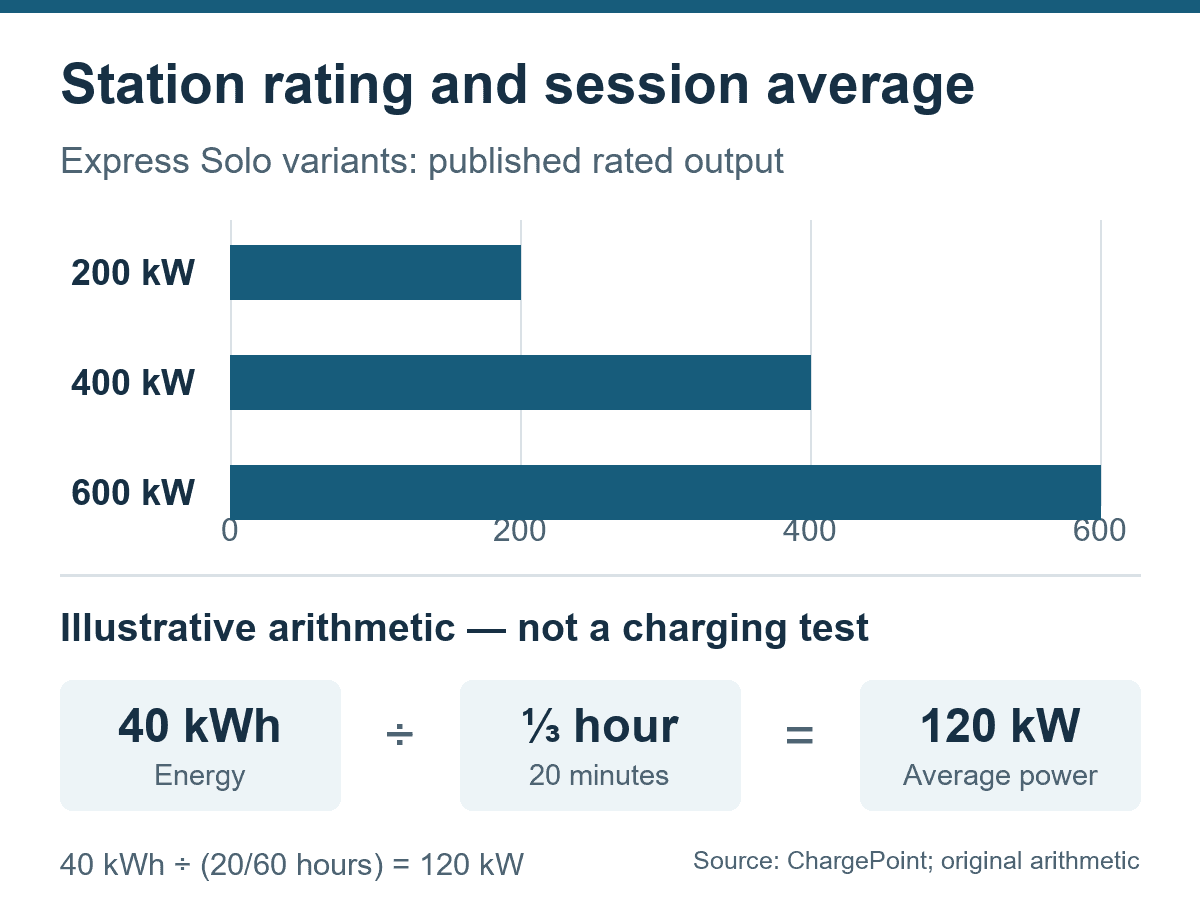
ChargePoint’s Express Solo offers a higher charging ceiling, but its headline number is not a prediction for your next stop. The company’s current North American product page lists 200-, 400- and 600-kilowatt versions. A driver still needs to know which equipment is installed, whether the vehicle can use it and how much power the battery accepts during that particular session.
What the Express Solo rating means
The Solo is a standalone station within the Express system developed by ChargePoint and Eaton. ChargePoint says one Solo can charge two vehicles simultaneously. Its advertised maximum and the number of connected vehicles describe different things: two occupied ports do not establish that each vehicle is receiving the station’s full rated output.
| Published feature | What a driver should check |
|---|---|
| 200, 400 or 600 kW Solo variant | The installed station’s rating, rather than the family’s highest number |
| Two vehicles on one Solo | Available session power; simultaneous charging is not a per-car maximum guarantee |
| Omni Port with CCS1 and NACS | The actual connector and the vehicle’s supported connection |
The broader product page also describes paired stations and distributed equipment. Those configurations have separate power and port arrangements. A specification for the larger system should not be read as the capability of every standalone Solo or every site carrying the ChargePoint name.
Peak power and time spent charging are different measures
Kilowatts measure the rate of energy transfer; kilowatt-hours measure the energy delivered. A brief high reading can coexist with a much lower average across a stop. As a purely mathematical example, receiving 40 kWh over 20 minutes represents an average of 120 kW. That is not a measured Express Solo result or a charge-time estimate for a particular car.
The Department of Energy identifies battery state of charge, capacity and type, vehicle charging capability, station output and electrical service among the factors affecting charging time. The equipment and the vehicle have to work within their respective limits. Moving a car to a higher-rated station does not, by itself, increase the car’s own maximum acceptance rate.
For a useful vehicle comparison, look for a documented charging interval, its starting and ending battery percentages, and the conditions attached to it. A manufacturer’s 10–80% claim answers a different question from the time required to reach a full battery. Neither should be replaced with an estimate based solely on the charger’s largest printed number.
Check the connection and the route
ChargePoint describes Omni Port as providing CCS1 and NACS connections. That is a hardware claim, rather than proof that every vehicle, adapter or charging location has been checked. Confirm the vehicle’s approved connection and the equipment at the intended stop. Connector access is one part of planning; the installed output and the expected charging interval are separate parts.
The Department of Energy’s Alternative Fueling Station Locator can search by location or map a route. Its page says the default view shows available, publicly accessible stations and provides filters to expand the search. Use the actual route and station details as a starting point, then check the charging operator’s information for the stop you plan to use. A product announcement does not establish that an Express Solo has been installed there.
The useful advance is greater flexibility in charging hardware. The useful buying decision remains more specific: match the car’s charging requirements to real stops on the journeys you make, and compare the expected session rather than a headline peak.
0 comment(s) so far on ChargePoint Express Solo: What 600 kW Means for Drivers