

Car Hesitates When Accelerating: Common Diagnostic Paths
Acceleration and vehicle response
A car that hesitates when you press the accelerator can be describing several different events: an engine stumbling, a delay before power arrives, or engine speed rising without the expected increase in road speed. Separating those experiences is more useful than starting with a list of parts to replace.
Updated October 16, 2026
The timing matters too. Hesitation with a cold engine, after it has warmed up or during one ordinary acceleration can lead to different checks. Describe the event that occurred; do not make repeated hard acceleration attempts to reproduce a potentially unsafe loss of power.
First separate the engine response from the vehicle response
| Observation during normal use | Question it helps frame | Limit |
|---|---|---|
| Engine feels uneven or stumbles | Is combustion or engine control irregular? | The feeling alone does not identify an ignition or fuel part |
| A delay, followed by a smooth response | When does the delay occur relative to the pedal input? | A delay is not automatically a failed transmission |
| Engine speed rises more than expected | How does that compare with road speed and normal transmission behavior? | RPM alone does not prove slipping |
| Warning light or reduced-power message appears | What exact message and operating condition were recorded? | A warning identifies a diagnostic path, not necessarily the replacement part |
| Stability or traction indicator blinks at the same time | Was engine output being limited by that system? | Match the vehicle and indicator; the light does not identify an engine or transmission fault |
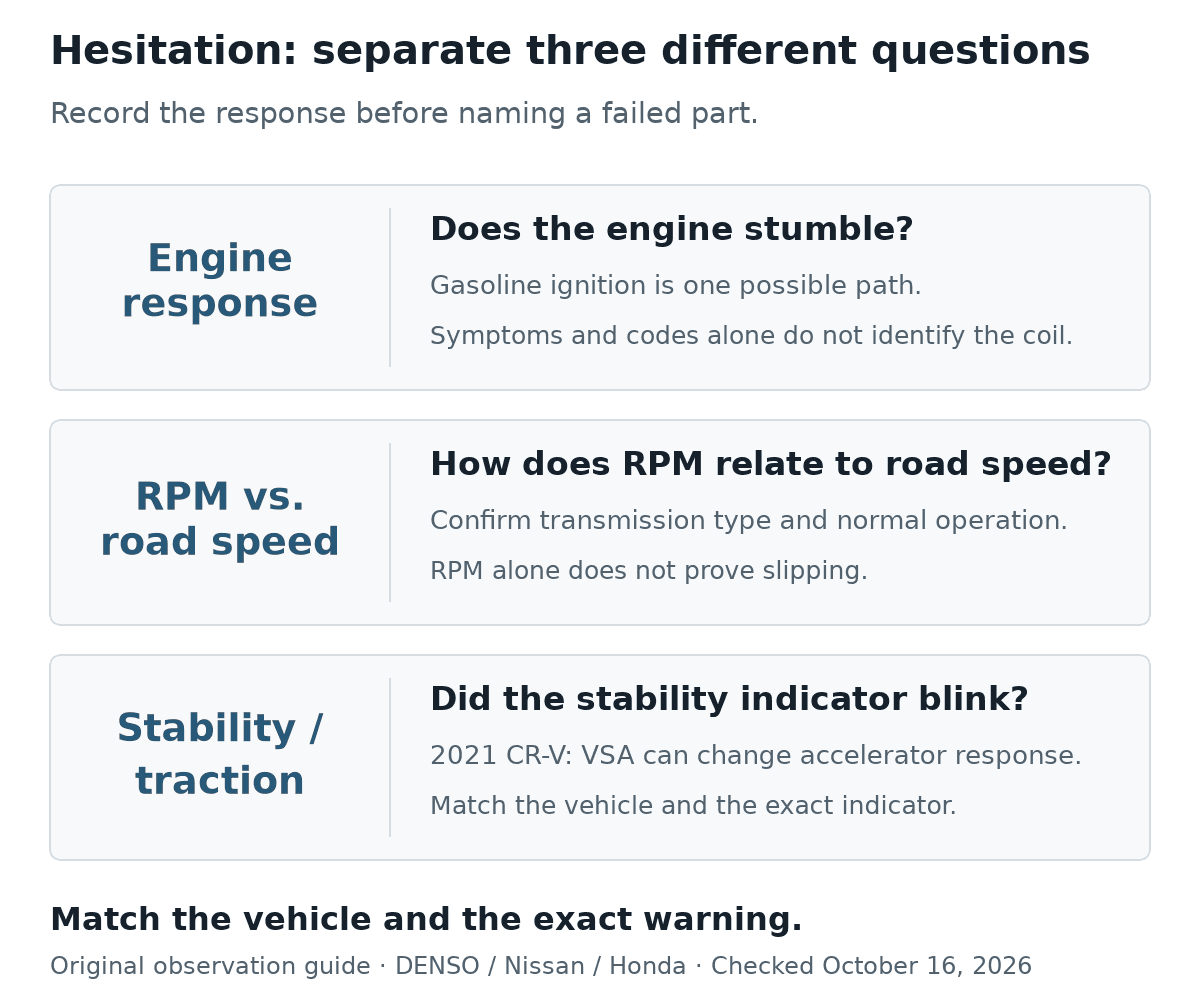
A continuously variable transmission can produce a different engine-speed pattern from a stepped automatic. Nissan’s Xtronic explanation describes its pulley-controlled ratios and programmed shift feel. Compare a new change with the car’s established behavior instead of treating every sustained RPM increase as a failure. Our guide to CVT noises and RPM changes separates unfamiliar operating feel from symptoms that need diagnosis.
Reduced response can also be a control-system intervention
The 2021 Honda CR-V manual says VSA can regulate engine output and apply individual brakes. When it activates, accelerator response may change and its indicator blinks. That is a model-specific explanation, not proof that every hesitation is traction control. The same manual calls for an immediate check if the VSA indicator stays on. Our stability-control warning guide explains the distinction between intervention and a persistent fault.
On a gasoline engine, a weak spark is one possible path
An ignition coil supplies the high voltage needed for a spark plug to ignite the mixture. DENSO’s ignition troubleshooting guidance lists misfiring and hesitation among possible symptoms of a coil problem, but also notes that fault codes can have causes elsewhere in the system.
That distinction prevents an expensive shortcut: a misfire-related code does not, by itself, establish that every coil needs replacement. The application, electrical supply, connections and associated components need checking. DENSO’s coil-failure analysis also stresses finding the underlying cause before installing a replacement.
This spark-ignition explanation should not be applied to a diesel as though it had the same ignition hardware. Identify the engine and transmission before comparing another owner’s repair story with your own car.
Air measurement is another separate question
On engines equipped with one, a mass-air-flow sensor measures incoming air so the control system can calculate fuel delivery. DENSO’s MAF guidance explains that a damaged or contaminated sensor can contribute to hesitation, irregular idle or stalling. It also notes that some performance problems may occur without a stored fault code.
Those possibilities do not make sensor cleaning a universal first repair. The sensing elements are delicate, and DENSO warns that cleaning can cause damage or provide only a temporary improvement. Correct air-filter fit and the condition of the intake system belong in the investigation. Unplugging a sensor to see whether the car “feels better” is not a substitute for a confirmed finding.
A warning light can change the priority
Follow the exact owner’s manual if the engine-warning light flashes or the car displays a reduced-power instruction. For example, the 2021 CR-V manual identifies a blinking engine lamp while driving as detected misfiring and instructs the driver to park safely away from flammable items and stop the engine until it cools. Consult the matching manual for the complete response; this example is not a universal restart or drive-on procedure.
When arranging diagnosis, provide the warning text, whether the engine was cold or warm, and what changed in speed or smoothness. Keep existing diagnostic information available rather than clearing codes first. The useful result is an explanation connecting the observed fault to the proposed repair, rather than a speculative replacement list labeled a tune-up.
0 comment(s) so far on Car Hesitates When Accelerating: Common Diagnostic Paths