

Cooper Automotive: Oil, Brake and Tire Service Questions
Service Preparation
Updated October 16, 2026
An oil change, a brake concern and a tire visit begin with different questions. Bring the vehicle’s exact year, engine, mileage, maintenance history and any warning messages. A clear request helps distinguish scheduled work from a problem that needs investigation, before a list of replacement parts takes over the conversation.
Use the service location, then define the job
Cooper Automotive’s contact page identifies its service center at 1025 Eastern Blvd, Clarksville, IN 47129, with phone (812) 914-8288. It lists oil-change, brake and tire service paths. Confirm the work requested and appointment arrangements directly; a service-page heading does not describe everything included in an individual visit.
An oil-change label is not a maintenance schedule
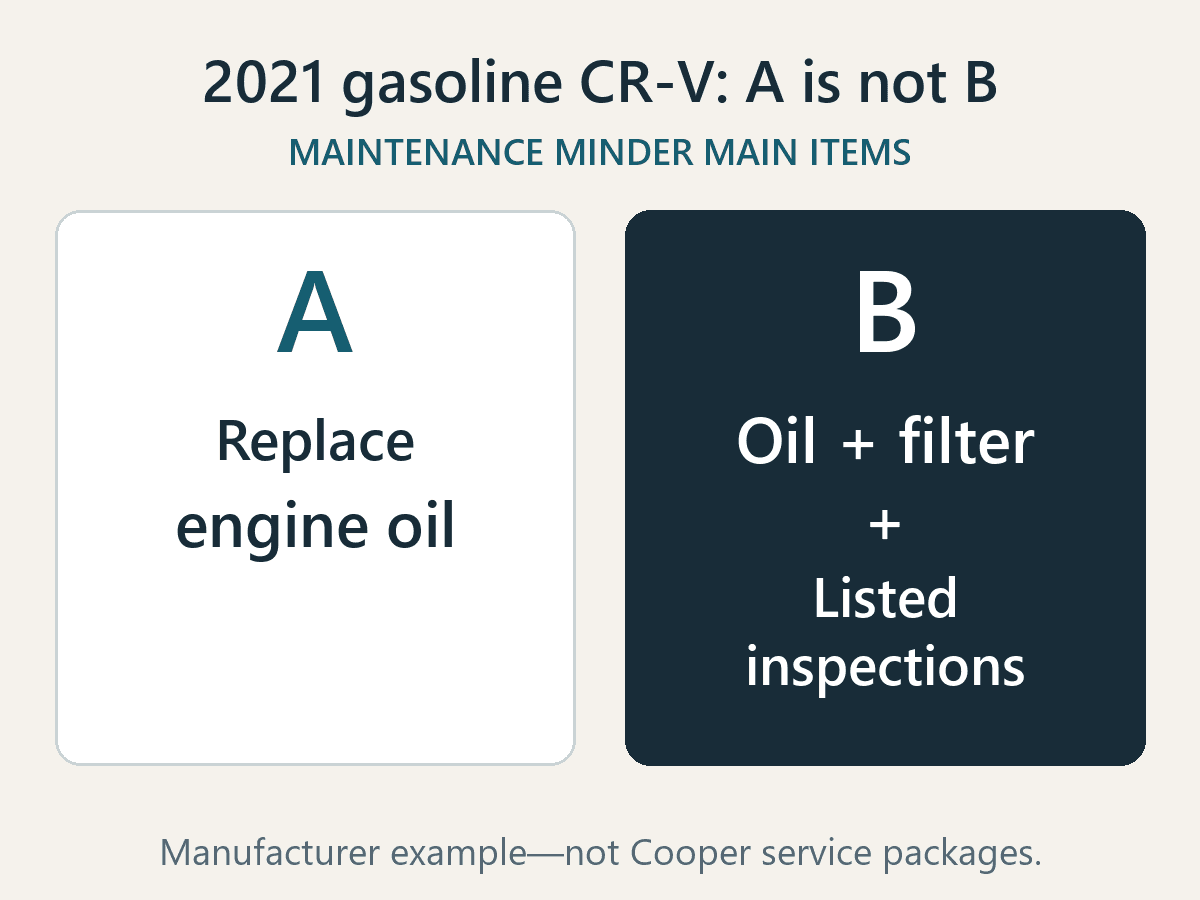
Start with the correct owner’s manual and maintenance record. In the 2021 gasoline Honda CR-V manual, Maintenance Minder item A means replace engine oil. Item B adds the oil filter and specified inspections, including front and rear brakes. Recording the displayed code is more useful than assuming every oil visit includes the same inspection.
The manual also specifies the oil grade and certification. That CR-V example calls for premium-grade 0W-20 detergent oil with an API Certification Seal. Choosing among “conventional,” “blend” and “synthetic” package names does not replace checking the vehicle’s actual oil requirements.
A scheduled visit and an oil replacement can also fall at different intervals. The 2025 Toyota Camry maintenance guide uses 5,000-mile or six-month visits, while its ordinary oil-and-filter entry is 10,000 miles with a 12-month time limit. Its additional oil changes depend on the specified special operating conditions and primarily driving under those conditions. Apply the guide for the actual vehicle, rather than transferring either example to another car.
Make a brake recommendation specific
Describe a noise, warning or change you have already noticed, including when it happens. For a replacement recommendation, ask which wheel and component were checked, what measurements or findings prompted the recommendation, and which vehicle-specific limit applies. A pad, disc, hydraulic component and fluid service are different line items.
Brake-fluid timing belongs to the vehicle’s schedule too. The CR-V manual has a separate item 7 and a three-year fallback when that reminder has not appeared within 36 months of its reset. That is a scoped manufacturer instruction, rather than a standing 30,000-mile fluid-flush rule for every car.
Separate rotation, balancing and alignment
A tire rotation request is different from asking someone to investigate vibration or unusual wear. Michelin’s explanation distinguishes alignment, which adjusts wheel angles, from balancing, which corrects uneven weight distribution in the tire-and-wheel assembly. One service does not establish that the other was needed or performed.
Bring the existing tire specifications and describe where a vibration was felt or where wear was observed. Ask what the inspection found and which work addresses it. There is no need to recreate a vibration on the road for this preparation.
Before agreeing to additional work, ask for the proposed items and their basis: the applicable schedule or an observed condition. Keep the completed record with the date, mileage, oil specification, inspections and parts actually supplied. That provides a useful service history without treating a generic package name as proof of every check.
0 comment(s) so far on Cooper Automotive: Oil, Brake and Tire Service Questions