

Used Family SUVs: Compare Seats, Child Seats and Cargo
Family Vehicle Fit
Updated October 16, 2026
A useful used family SUV has room for the people, child restraints and luggage carried together. A maximum cargo number or a third-row badge cannot answer that on its own. Two models from a family-SUV shortlist—the 2021 Honda CR-V and 2021 Chevrolet Traverse—show why the exact seating configuration matters more than a blanket “best” label.
Start with the seats that must stay occupied
Write down the actual combination: two adults and two rear-facing seats, for example, or two adults, a harnessed seat and two older passengers. Then consider the trip that exposes the compromise. School pickup may need an accessible buckle; a vacation may require every passenger seat and a stroller at the same time.
Neither the number of children nor the SUV’s size automatically determines the right number of rows. Three child restraints may not fit across a particular bench, while a three-row layout may leave an awkward route to an occupied rear seat. These are configuration and fit questions, rather than conclusions that follow from a model’s reputation.
One model name can hide a cargo difference
Honda’s U.S. 2021 CR-V specifications list five seats, but different cargo volumes for the gasoline and hybrid versions. The EX examples below use the same published rear-seat-up/rear-seat-down categories.
| Configuration | Rear seat up | Rear seat down |
|---|---|---|
| Gasoline EX | 39.2 | 75.8 |
| Hybrid EX | 33.2 | 68.7 |
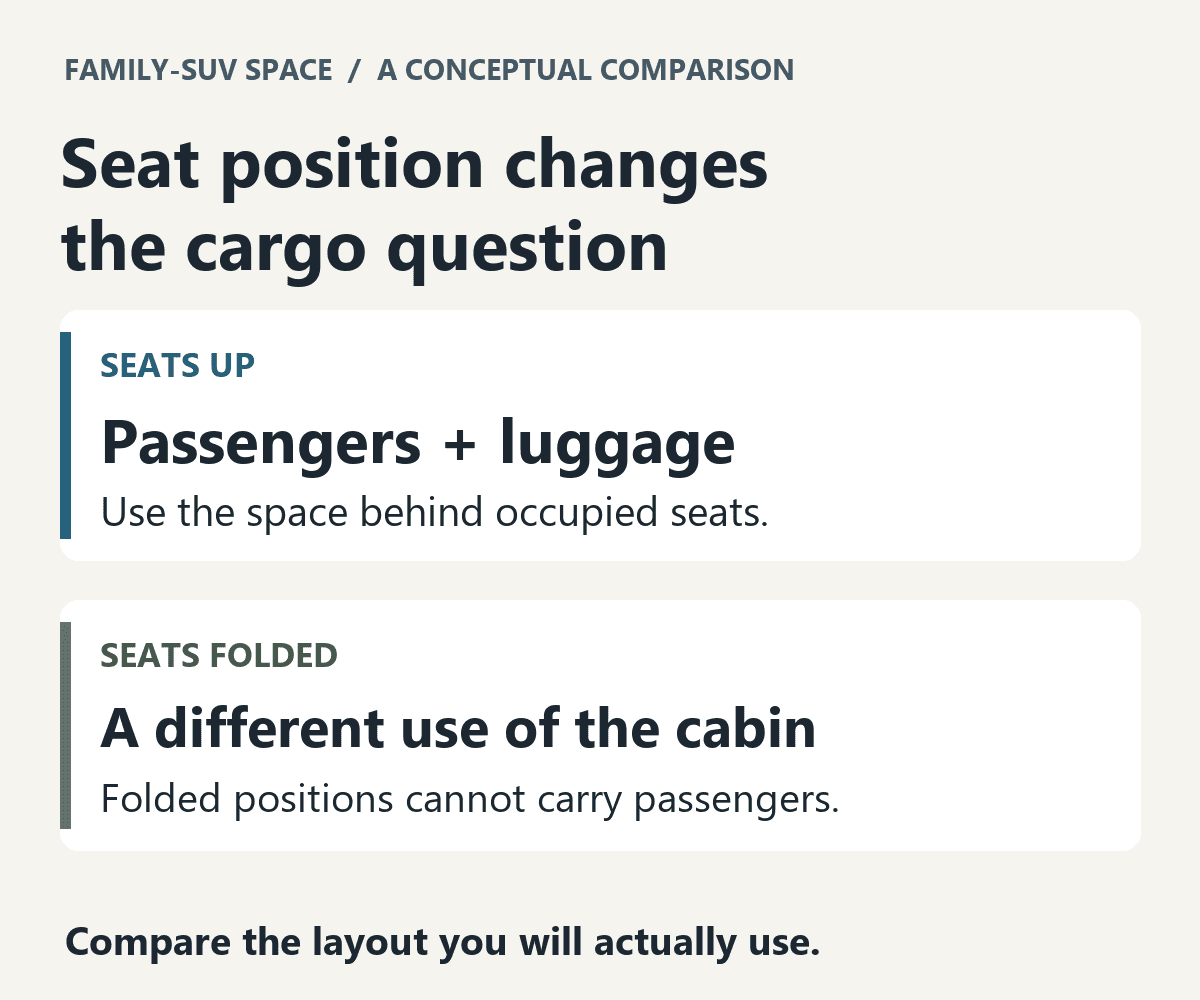
The seats-down figure describes a different use from carrying rear passengers. For a family trip, start with the space left behind the occupied seats, then check the stroller’s folded shape, the hatch opening and the remaining luggage. A volume figure does not establish whether a tall folded stroller can stand upright or whether everything fits below the rearward sightline.
A third row adds an access problem to solve
The 2021 Traverse owner’s manual distinguishes a second-row 60/40 bench from captain’s chairs. Its anchor diagrams show another important distinction: the bench has lower anchors at the outer positions and top-tether anchors at all three positions; the third row has top-tether anchors, without lower anchors shown there.
That makes “it has LATCH” too vague a description for planning several child restraints. Identify the intended seating position and the approved attachment method for each seat. The number of seat belts, lower-anchor pairs and tether anchors are different pieces of information.
Third-row entry also has model-specific limits. Chevrolet permits the second-row passenger-side seat to move with a forward-facing restraint installed using LATCH, but says to remove the child before moving the seat. A rear-facing restraint must be removed before that movement. This is a reason to read the access section with the intended layout in mind, rather than assume any installed seat can remain undisturbed.
Check the restraint and the vehicle together
NHTSA recommends choosing a restraint for the child’s age and size that also fits the vehicle. Both the restraint instructions and vehicle manual matter. A broad claim that an SUV is “great for three car seats” leaves out the seat models, attachment methods and passenger arrangement needed to judge that claim.
The 2021 gasoline CR-V manual, for instance, illustrates a center lower anchor and warns against attaching two child seats to one anchor. A generous-looking bench does not authorize improvising attachment points. Qualified car-seat installation assistance can help resolve a fit or instruction question.
Keep the final comparison concrete: which seats remain usable, how passengers reach them and what cargo remains with those seats occupied. For a used example, compare its equipment with the correct-year manual and check its VIN for unrepaired safety recalls.
0 comment(s) so far on Used Family SUVs: Compare Seats, Child Seats and Cargo