

IIHS Rates Crash-Avoidance Systems on Commercial Vans and Pickups
What the tests measure
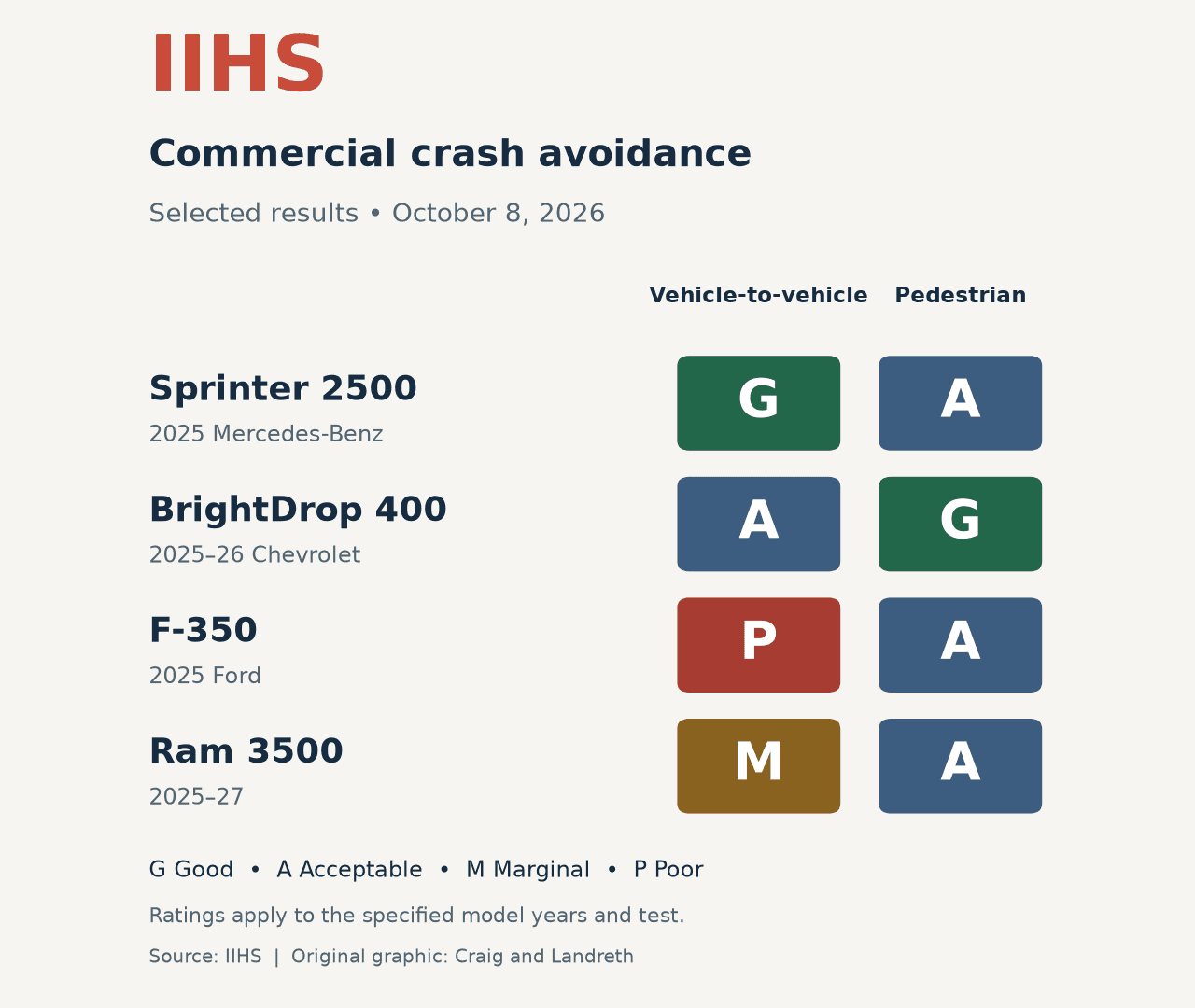
On October 8, 2026, IIHS published its first vehicle-to-vehicle and pedestrian crash-avoidance ratings for commercial vehicles. The initial group included cargo vans and Class 3 pickups, with model years ranging from 2025 to 2027 depending on the vehicle. The results help shoppers compare driver-assistance performance, but they describe the specific tested systems and configurations, not every vehicle wearing the same model name. See the IIHS release and its test descriptions for the boundaries of each rating.
The vehicle-to-vehicle test evaluates forward collision warning and automatic emergency braking with several targets and speeds. The pedestrian evaluation checks the system’s response to defined pedestrian scenarios. These are separate tests and can produce different grades for the same vehicle. A Good pedestrian score does not imply a Good vehicle-to-vehicle score, and neither rating describes every aspect of crash protection, visibility, handling, or driver behavior.
The first results vary by test
In IIHS’s first set, the 2025 Mercedes-Benz Sprinter 2500 earned Good for vehicle-to-vehicle prevention and Acceptable for pedestrian prevention. The 2025–26 Chevrolet BrightDrop 400 earned Acceptable in the vehicle-to-vehicle test and Good in pedestrian prevention. The 2025 Rivian RCV-Delivery 500 earned Marginal for vehicle-to-vehicle prevention and Good for pedestrian prevention. IIHS reported that marginal and poor ratings were common in the initial group, while each of the two tests had at least one Good performer.
The model-year range matters. The broader tested list includes 2025–27 versions of some commercial vans and pickups, and the rating can depend on equipment, build date, or system configuration. Before applying a result to a vehicle, confirm its exact year and the applicable row in the current IIHS commercial ratings. Do not copy a score across trims or years unless the organization’s listing explicitly includes them.
How shoppers can use a rating
Start with how the vehicle will be used: local deliveries, highway driving, job-site access, or carrying passengers. Then compare both crash-avoidance grades for the exact versions under consideration and check whether the relevant safety features are standard or optional. IIHS’s vehicle-to-vehicle grade measures one capability; its pedestrian grade measures another. If you are comparing a pre-owned work truck, this is a reason to confirm the precise configuration while reviewing used truck options and the equipment listed for each vehicle.
Federal NHTSA star ratings provide a separate view based on that agency’s New Car Assessment Program. They are not interchangeable with IIHS crash-avoidance grades. A practical review uses both sources where available, checks open recalls by VIN, and confirms that systems work as intended. For the general vehicle condition, a history report and inspection can provide information that crash-avoidance ratings do not. The inspection checklist describes other condition checks; it does not replace a safety-system check.
Questions to ask before choosing
Ask which warning and automatic-braking features are installed on the exact vehicle, whether they are standard on that trim, and whether the vehicle has any warning lights or calibration concerns. Check that sensors and cameras are unobstructed and ask for service records if repairs affected the front end, windshield, or driver-assistance equipment. If the vehicle needs ordinary maintenance or a general inspection, see the scope of Cooper Automotive’s service work and confirm in advance whether a particular diagnostic is offered.
0 comment(s) so far on IIHS Rates Crash-Avoidance Systems on Commercial Vans and Pickups