

Thermostat Problems: Engine Runs Hot Or Too Cold
Engine cooling
A coolant thermostat helps an engine warm up and then controls how much coolant can travel through the radiator. A fault can leave an engine running too cold as well as too hot. Understanding that regulating job explains why a low temperature gauge and weak cabin heat can belong to the same investigation, while an overheating warning needs immediate attention.
Updated October 16, 2026
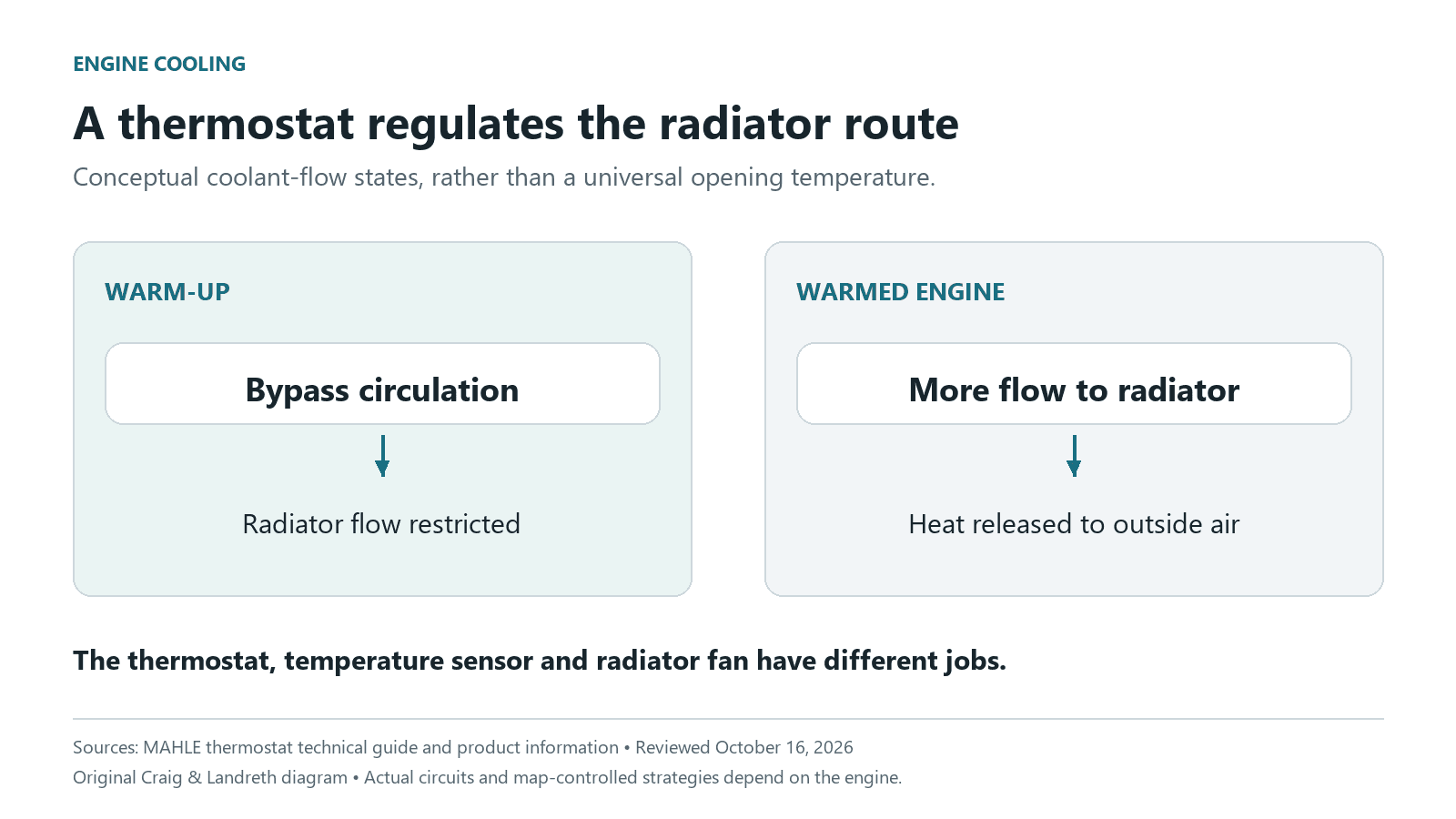
The thermostat controls a route, rather than making coolant cold
In the conventional arrangement illustrated in MAHLE’s thermostat technical guide, a cold engine circulates coolant through a smaller bypass loop. Restricting the radiator route helps the engine reach its intended operating temperature. As it warms, the thermostat opens the route through the radiator, where heat can pass to outside air.
The opening is a regulating action, rather than a universal on/off temperature that applies to every car. Different engines have different coolant circuits, and auxiliary circuits may be controlled separately. A number found for another engine is therefore a poor basis for deciding that your temperature reading is wrong.
Why stuck open and stuck closed behave differently
MAHLE describes the two opposite failure modes: an always-open thermostat can allow too much cooling, while one that stays closed can prevent adequate radiator cooling. Its product range also includes map-controlled thermostats. These add electrical heating to the operating element so the engine controller can influence coolant regulation under different loads and operating conditions.
That distinction matters when interpreting a repair recommendation. The thermostat, its electrical control on applicable designs, the temperature sensor and the radiator fan perform related but different jobs. Replacing a mechanical valve cannot resolve every fault in that system.
| Observed pattern | Useful distinction |
|---|---|
| Engine remains unusually cool | Actual slow warm-up versus an inaccurate displayed temperature. |
| Engine temperature rises too far | Coolant circulation, radiator airflow and temperature regulation each need consideration. |
| Cabin air is weak or cool | Not enough heat reaching the heater versus not enough air moving through it. |
| A thermostat-related fault is reported | The specific engine’s hardware and control strategy, rather than another model’s opening temperature. |
A gauge reading needs context
HELLA’s cooling-system diagnostic guide starts by checking whether the indicated temperature is plausible. Its overheating checks then include coolant quantity, radiator airflow, fan operation, thermostat opening and pump operation. For an engine that will not warm up, it also considers a fan that runs continuously. Those are separate paths through the same system, rather than a reason to replace all of those parts.
Cabin heat adds another layer. In an engine-coolant heater, hot coolant must reach the heater core, and cabin air must move across it and through the selected outlets. A blocked heater core, an air-distribution problem or a blower fault can leave the cabin uncomfortable even when the engine temperature is normal. Turning the temperature control up cannot correct missing airflow.
Overheating changes the next step
Do not continue driving simply to see whether a hot engine eventually cools itself. The 2024 Super Duty manual, for example, directs the driver to stop safely, switch off and allow cooling when its high-engine-temperature message appears. Follow the warning and stopping instructions for your vehicle.
Keep the pressure cap closed while the cooling system is hot. A proper repair also needs the correct coolant and the vehicle’s filling procedure; replacing the thermostat is only part of the job. Our explanation of what coolant condition and specification actually tell you separates those requirements from judging a fluid by its color.
0 comment(s) so far on Thermostat Problems: Engine Runs Hot Or Too Cold