

Brake Fluid And Coolant: Why Fluid Condition Matters
Fluids and maintenance
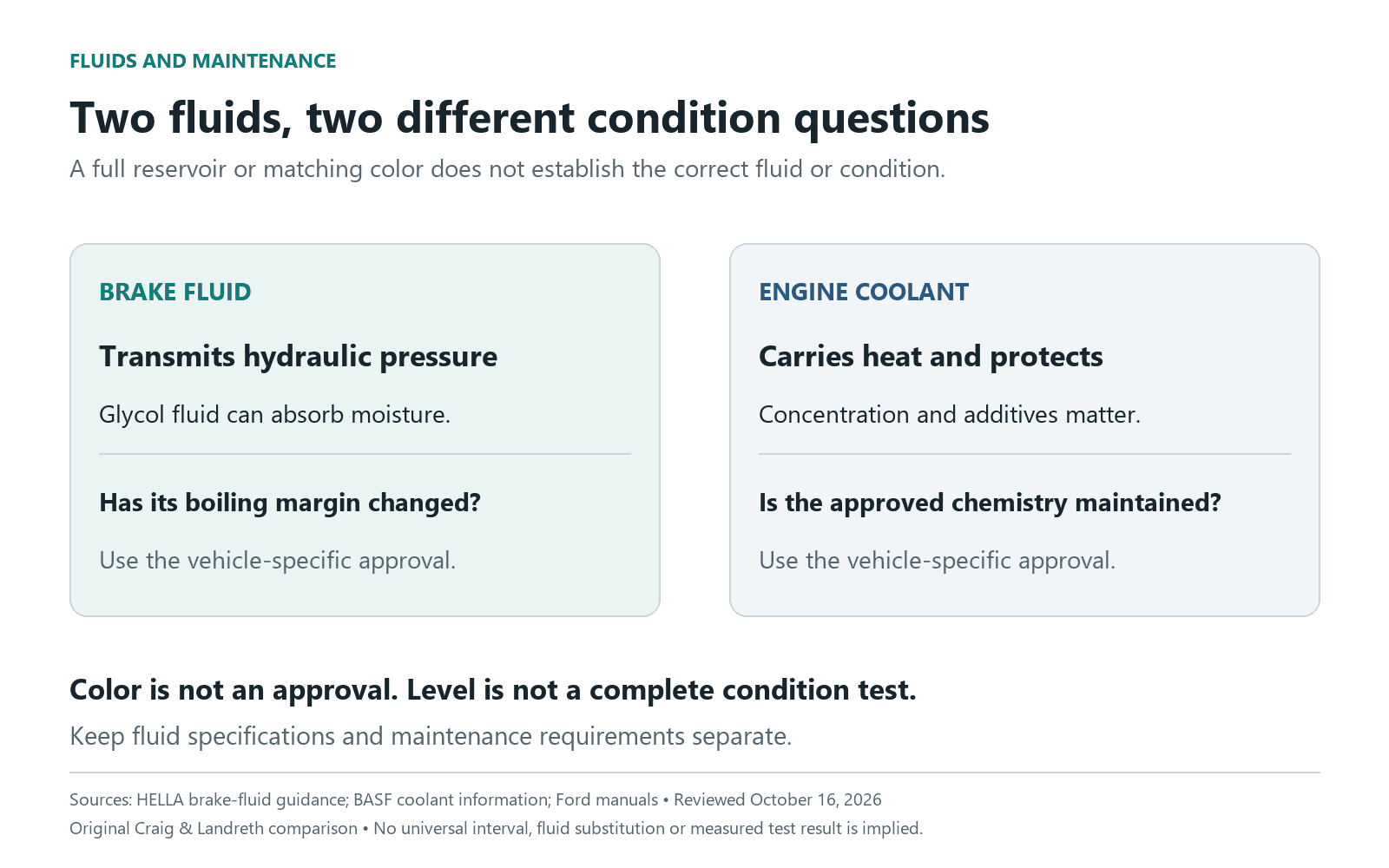
Brake fluid transmits force through a hydraulic braking system. Engine coolant carries heat and helps protect the cooling circuit. Both can look normal while an important property has changed, and neither can be judged by its level or color alone. The useful question is which specification and maintenance requirement applies to each separate system.
Updated October 16, 2026
What brake fluid has to withstand
Glycol-based brake fluids such as DOT 3, DOT 4 and DOT 5.1 absorb moisture over time. HELLA explains that this lowers their boiling point. Under enough heat, vapor can form; unlike liquid, vapor compresses, interfering with the hydraulic pressure needed for braking.
A dark appearance can warrant investigation, but color does not establish water content or boiling point. Equally, a soft pedal is not proof that old fluid is the cause: air, leaks or problems following work on the system can produce a similar complaint. A change in braking performance needs assessment, rather than assuming that a routine fluid change alone will resolve it.
The approval matters as well as the DOT label
The 2024 Explorer manual’s 3.3-liter hybrid specifications, for example, call for DOT 4 low-viscosity fluid or an equivalent meeting Ford WSS-M6C65-A2. That is more specific than simply buying a bottle marked “brake fluid.” The example is not a recommendation to use that product in another vehicle.
Viscosity affects how fluid moves through modern brake-control systems, particularly when cold. A higher DOT number does not automatically make a product a suitable upgrade. Use the approval required for the actual vehicle, keep the fluid clean and dry, and keep petroleum products and other automotive fluids out of the brake reservoir.
| Question | Brake fluid | Engine coolant |
|---|---|---|
| Primary job | Transmit hydraulic braking pressure. | Carry heat and protect the cooling circuit. |
| Condition concern | Moisture can reduce the boiling margin. | Concentration and protective additives matter. |
| What appearance cannot establish | Actual water content or boiling point. | Chemistry, compatibility or manufacturer approval. |
| Service basis | Vehicle-specific fluid approval and maintenance instructions. | Vehicle-specific coolant approval, concentration and change schedule. |
Coolant does more than resist freezing
BASF describes coolant additives that protect against corrosion and deposits. Deposits can obstruct narrow passages and reduce heat transfer; corrosion protection is therefore part of cooling performance, not an optional extra. Protective additives can also degrade, which is one reason an adequate reservoir level does not settle whether service is due.
The same source cautions that color does not reveal a coolant’s chemical or technical properties. A matching color is not proof of compatibility, and a different color is not enough information to choose a substitute. Read the manufacturer’s approval and the product label together.
Checking is different from topping up
Ford’s 2024 E-Series coolant instructions call for checking level and concentration with the engine cold, using the approved coolant, and avoiding incompatible mixtures. They warn against opening a hot cooling system and against non-specified sealants or additives. Follow your own manual’s requirements; a universal mixture recipe is not a substitute.
A brake-fluid level change also deserves an explanation. As brake pads wear, the caliper pistons extend and more fluid remains at the wheel brakes; leaks are another possibility. Repeatedly topping up can obscure the reason for a falling level. Treat a brake warning, leakage or changed pedal response as a system problem requiring attention.
For maintenance planning, keep the two services separate. Compare the actual brake-fluid and coolant entries in the vehicle’s schedule, including time limits where listed. Neither a recent oil change nor a full reservoir establishes that these other tasks have been completed.
0 comment(s) so far on Brake Fluid And Coolant: Why Fluid Condition Matters