

Catalytic Converter Symptoms: Codes and Restricted Flow
Exhaust diagnosis
Updated October 17, 2026
A catalyst-efficiency code and a loss of power answer different diagnostic questions. Before replacing a converter, separate its emissions performance, exhaust restriction and the engine conditions feeding it.
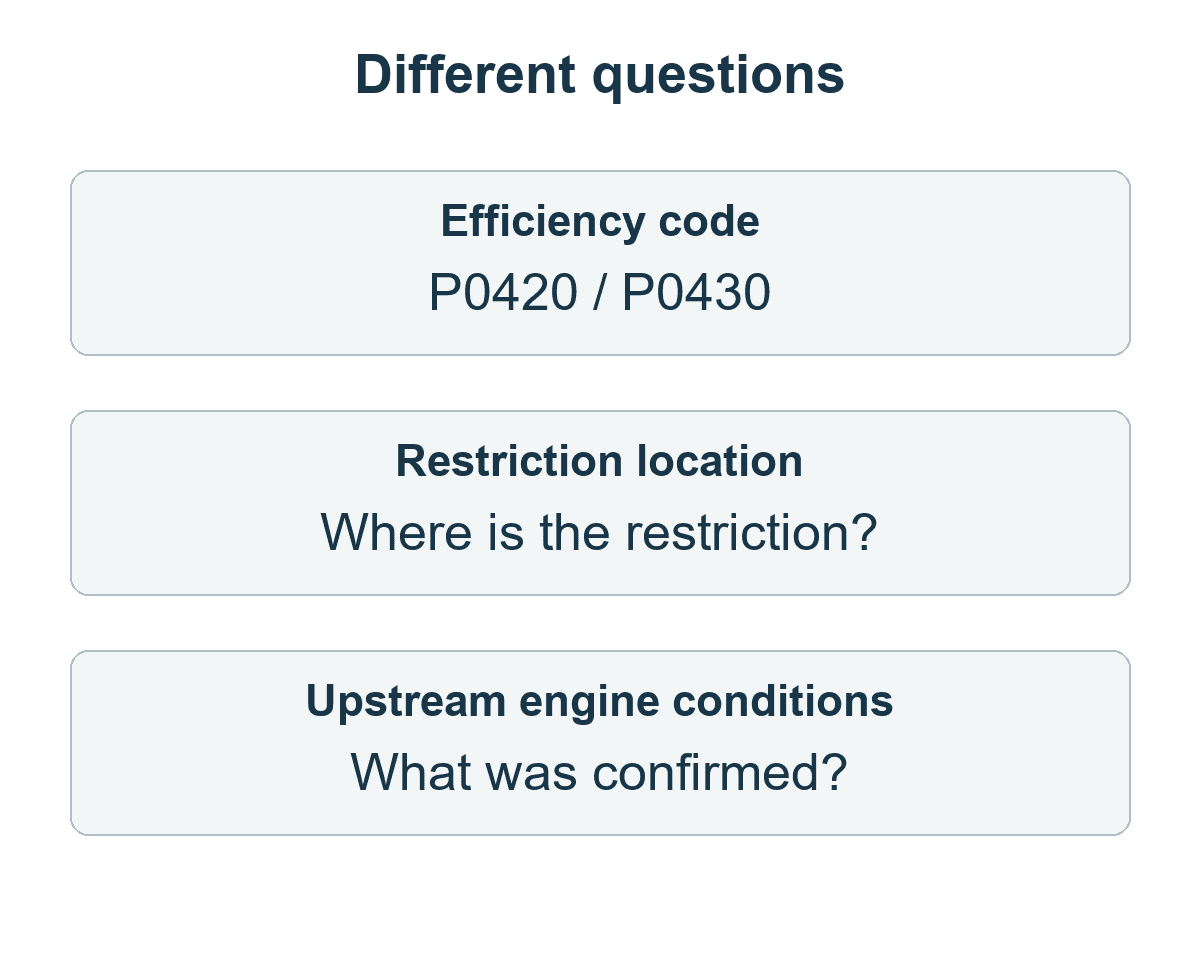
An efficiency code is not a restriction measurement
Walker’s diagnostic guide identifies P0420 and P0430 as catalyst-system efficiency codes for the respective banks. It also explains why engine problems, exhaust leaks or oxygen-sensor behavior can affect the finding. A code alone does not establish that the converter is physically blocked or that replacing it will resolve the cause.
Ask whether the findings concern emissions conversion, a leak or sensor problem, or an engine condition such as oil or coolant consumption. Those are different repair questions even when the dashboard complaint sounds the same.
Restricted flow needs evidence of its location
Walker’s testing discussion distinguishes locating an exhaust restriction from evaluating catalyst operation. A restriction can be elsewhere in the exhaust, including a muffler or resonator. A vacuum reading can also be affected by valve or ignition timing, so it does not identify the converter by itself.
Temperature comparisons have limits, too: pipe construction, corrosion and heat transfer affect readings. A temperature difference alone cannot establish that a converter needs replacement. The useful repair explanation identifies what was measured, where the restriction was found and which vehicle-specific specification was used.
A flashing warning has its own response
For the blinking misfire warning during operation, the 2021 gasoline Honda CR-V manual directs a safe stop away from flammable objects and engine shutdown for cooling. Follow your own vehicle’s warning instructions and obtain assistance; do not recreate the event to investigate the exhaust. Our misfire symptoms and flashing-warning context explains that distinction further.
0 comment(s) so far on Catalytic Converter Symptoms: Codes and Restricted Flow