

Car Heater Not Working: Warmth, Airflow or Distribution?
Cabin heat
Updated October 17, 2026
“No heat” can mean air that stays cold, barely moves or reaches the wrong outlets. Describe which problem you actually have before discussing a thermostat, heater core or control repair.
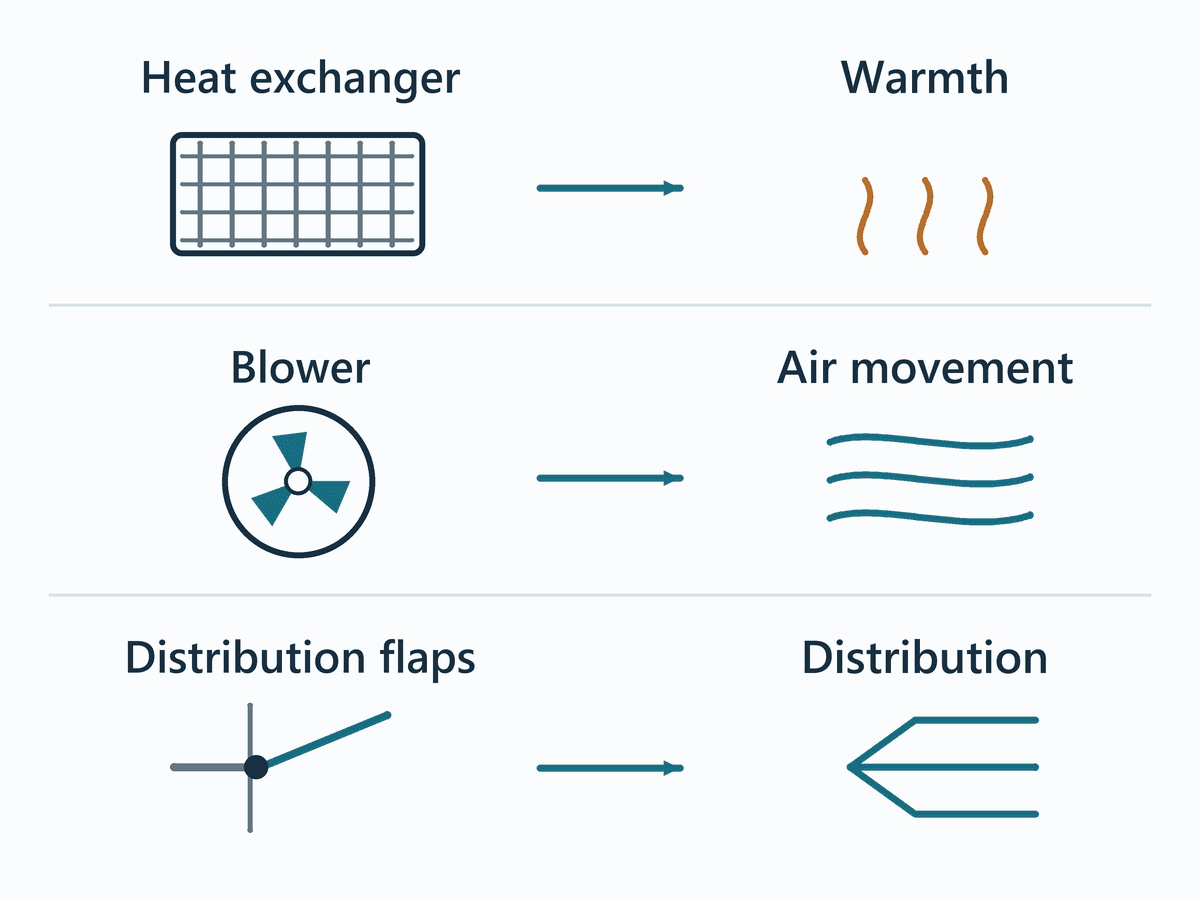
Separate warmth from air movement
HELLA’s workshop guidance treats engine/coolant warmth, heat-exchanger flow and heating-valve operation as separate questions from blower operation, filter/duct airflow and flap distribution. Cold air does not isolate a thermostat; weak airflow does not establish a blocked heater core.
Useful observations include whether air reached the windshield, face or footwell outlets, whether both sides felt alike, and whether the complaint was weak flow or low temperature. Report any temperature warning or recent cooling-system work. Ask the repairer whether the finding concerned heat reaching the exchanger, air passing through it, or air reaching the selected outlets. Those are different explanations for the same short complaint.
A heater-core recommendation needs supporting evidence
In its 2013 EC-024 technical bulletin, Valeo describes returned heater cores that showed no failure after inspection. The loss of cabin heat was attributed elsewhere: heater-circuit blockage, a fitted control valve or a mixer flap. Its second page also discusses trapped air after low coolant or a coolant change.
That history makes the timing of a heat complaint useful. If it began after cooling-system work, include the repair order and when the change was noticed. Ask what supports replacing the core rather than addressing a circulation or control issue. The bulletin is workshop guidance, not evidence that every car has a valve or needs a flush. Do not touch hot hoses or operate bleed valves to investigate it.
A filter finding answers an airflow question
The Kia manual’s climate-filter chapter explains that accumulated dust or pollutants can reduce vent airflow and contribute to moisture on the inside of the windshield, even with outside air selected. It separately calls for a system check when airflow suddenly decreases. Kia ties filter maintenance to its schedule and notes that dusty or rough-road use can require more frequent attention.
Describe whether the airflow change was gradual or sudden and whether window clearing changed with it. If a filter is recommended, ask what inspection found and how that accounts for the airflow complaint. A filter recommendation alone does not establish why well-flowing air remains cold. Use the filter schedule and equipment information for the actual vehicle; this chapter is not a universal replacement interval or proof that replacing a filter will restore heat.
Recognize control behavior and visibility limits
The 2021 gasoline Honda CR-V manual notes that automatic climate control may delay the fan to avoid cold air. Equipped dual-temperature settings can differ by side. When parked, record the settings already selected and compare them with the equipped system’s manual. A brief automatic delay and a continuing blower or one-sided complaint deserve different descriptions. The manual also says a manually selected function takes priority while unrelated functions can remain under automatic control.
Honda requires clear window visibility before driving; poor defogging is more than a comfort complaint. It also warns of scalding coolant from a hot cooling system. Do not open a hot cap. If heat loss accompanies overheating, follow the vehicle’s overheating warning instructions and seek assistance, rather than continuing to investigate the cabin controls.
0 comment(s) so far on Car Heater Not Working: Warmth, Airflow or Distribution?