

Wiper Blades And Visibility: Simple Checks That Matter
Visibility and wet-weather preparation
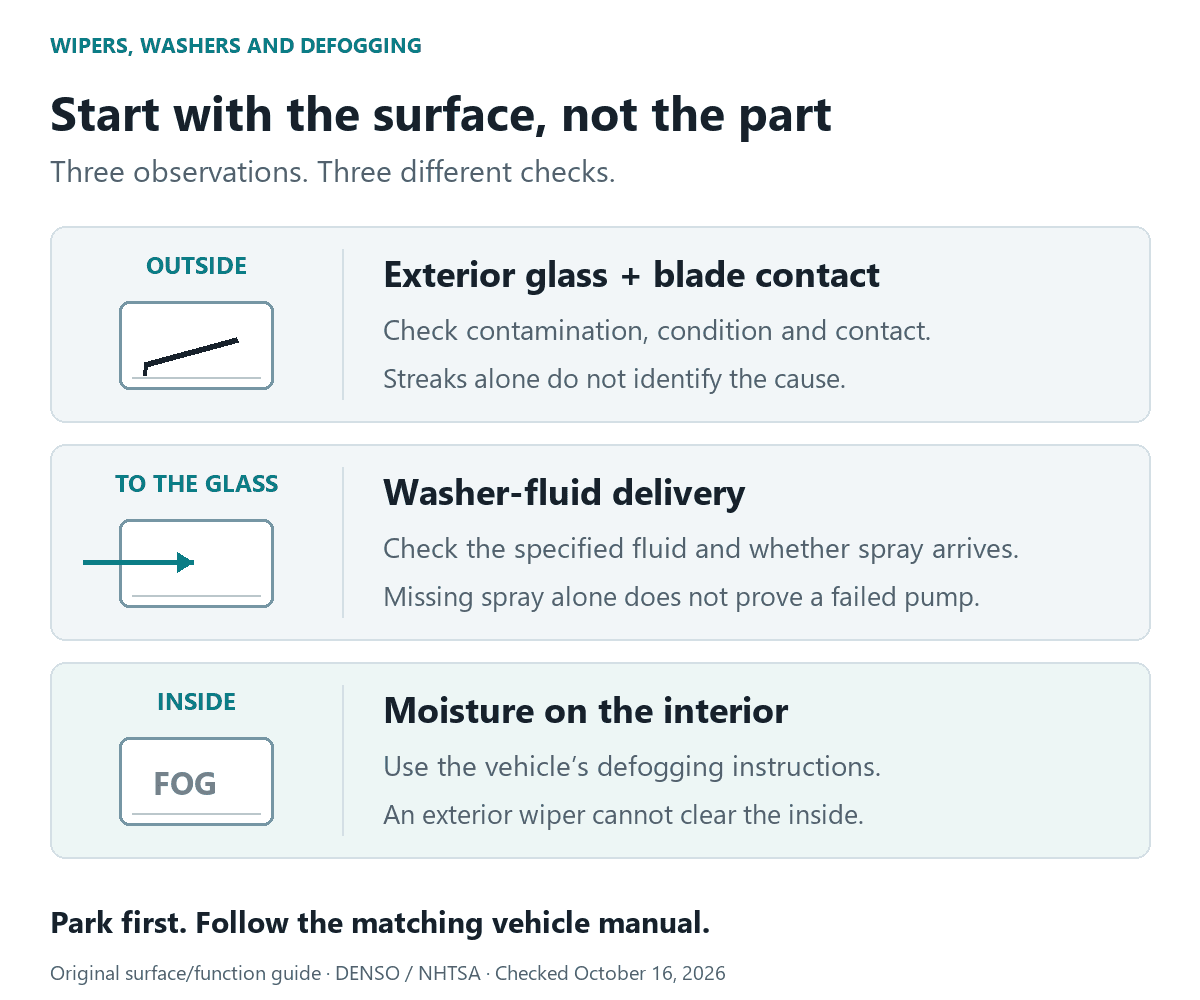
A wiper that leaves a streak, a washer that delivers no fluid and a windshield that fogs on the inside need different checks. Start by identifying what remains on the glass after a pass. Buying another pair of blades will not resolve every visibility problem.
Updated October 16, 2026
Make these observations while parked, with the windshield clear of ice and the wipers free to move. If you cannot maintain a clear view while driving, find a safe place to stop. Do not wait for a downpour to discover whether a suspected problem has gone away.
Separate streaks from missed areas
In its wiper troubleshooting guidance, DENSO explains that material on the rubber edge can interrupt contact with the windshield. Cleaning the blade edge and glass with suitable products can therefore matter before replacement. Persistent streaks after cleaning, or visibly split and deformed rubber, require further attention.
| Observation | Useful distinction |
|---|---|
| Narrow marks follow a wiping pass | Inspect the glass and rubber edge for contamination or damage. The marks alone do not identify the cause. |
| A patch remains unwiped | Check blade condition and contact. A new blade cannot establish that the arm or fit is correct. |
| The blade jumps or chatters | DENSO identifies glass or blade contamination and possible arm alignment as separate considerations. |
| No washer fluid reaches the glass | This is a fluid-delivery question, separate from the blade’s ability to clear water. |
| Moisture is inside the windshield | Check the vehicle’s defogging instructions; an exterior wiper cannot clear the interior surface. |
Follow the vehicle manual before lifting an arm or changing a blade, including any required service position. Do not bend an arm to copy an online angle adjustment. If the arm, linkage or blade contact appears wrong, have the mechanism checked rather than treating a new blade as confirmation that everything is aligned.
Check the washer and defogger separately
Confirm that the reservoir contains the specified washer fluid and that the spray reaches the intended area. A weak or missing spray does not, by itself, prove a failed pump. The washer-fluid delivery guide explains why the fluid, hoses, outlets and actual system layout need separate consideration.
Defogging is a third task. Use the instructions and controls for your vehicle, then check whether the inside glass clears. Record whether the issue is missing airflow, air that does not clear the moisture, or a recurring film on the glass. That description is more useful than asking for wiper replacement when the obstruction is inside.
Free ice before operating the wipers
DENSO’s winter guidance warns that a blade frozen to the glass can tear when operated, while an icy windshield is abrasive to the wiping edge. It also advises against pouring kettle-hot water onto cold glass because the abrupt temperature change can damage it. Use the vehicle’s prescribed de-icing procedure; do not force a frozen blade loose with the wiper switch.
NHTSA’s winter preparation guidance calls for working defrosters and wipers, replacement of worn blades and suitable winter washer fluid. Check the fluid’s temperature rating and the vehicle’s requirements before freezing weather. Fluid that was adequate during a warm-weather trip may be inappropriate for the next conditions.
Judge the result on the glass
After permitted cleaning or a correctly fitted replacement, follow the vehicle manual to check wiping and washer operation while stationary. Include the rear wiper if equipped. Keep any further investigation focused on what remains: streaking, missed contact, poor spray or interior moisture. The result to look for is a clear view, not merely a new part on the receipt.
0 comment(s) so far on Wiper Blades And Visibility: Simple Checks That Matter