

Windshield Washer Not Spraying: Fluid, Pump, Or Nozzles?
Visibility and washers
A washer system has two jobs: move cleaning fluid to the glass and spread it where the wipers can use it. When nothing comes out, the useful first distinction is whether fluid is missing, trapped somewhere along that route, or never being pumped. A working wiper arm does not answer that question; wiping and spraying are separate functions.
Updated October 16, 2026
Follow the fluid, from reservoir to glass
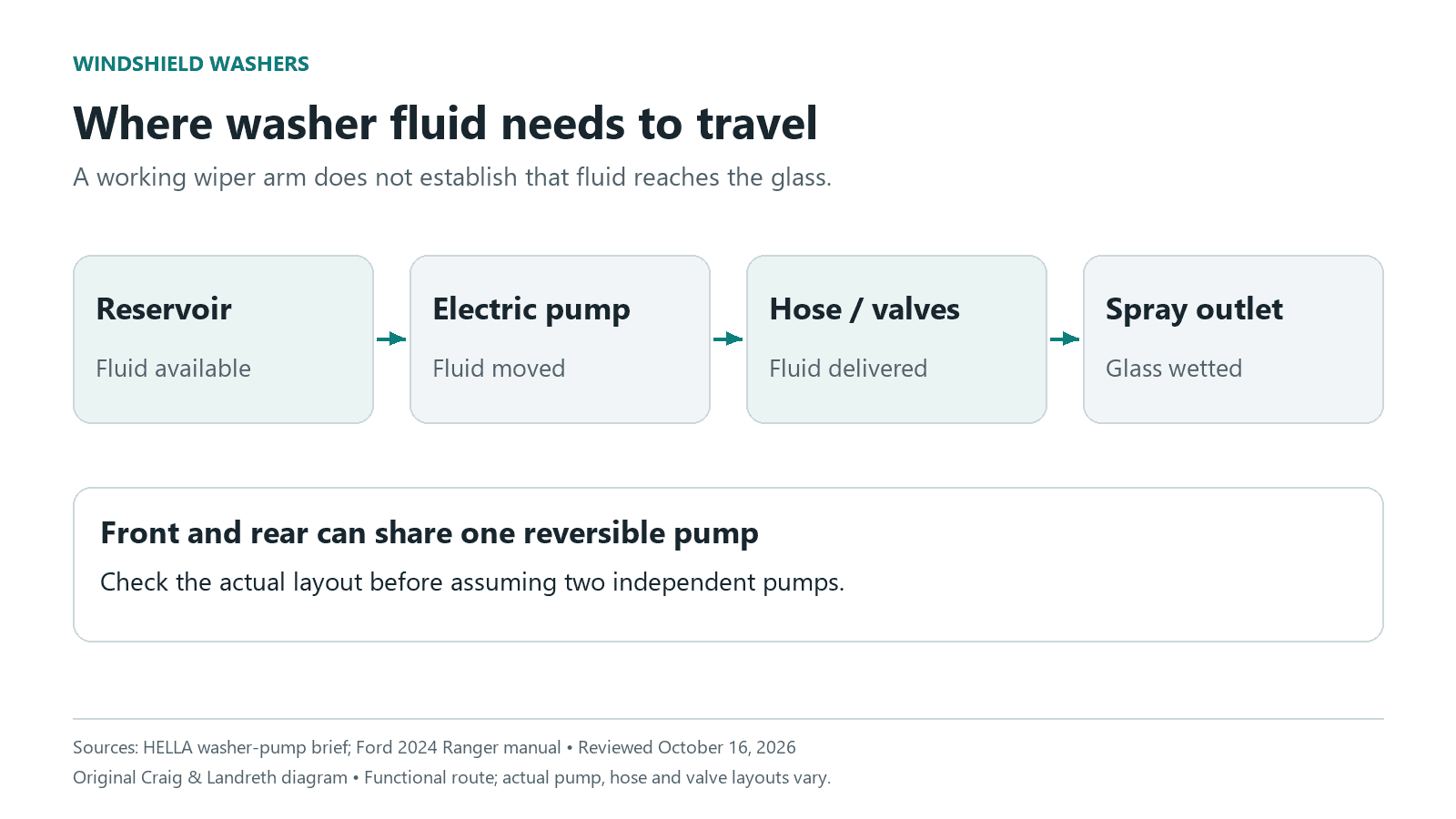
The basic route is a reservoir, an electric pump, hoses and spray outlets. Seals keep fluid inside the system, while valves can keep it from draining backward. HELLA’s washer-pump technical brief identifies failures along that entire route, including a damaged tank, a leaking pump seal, contaminated hoses and blocked outlets. Buying a pump before locating the interruption can miss the actual problem.
Front and rear washers do not necessarily have separate motors. Some vehicles use one pump whose direction reverses to feed either outlet. That makes a working rear washer useful information, but it does not establish that the front circuit has its own good pump. The vehicle’s actual layout matters.
| What happens | What to distinguish |
|---|---|
| Nothing sprays at either end | Reservoir contents, freezing and the pump’s electrical supply are different possibilities. |
| A motor can be heard, but the glass stays dry | A sound is not a flow test: fluid may be escaping or unable to reach an outlet. |
| One outlet sprays normally | Compare the separate hose and outlet routes; do not assume two independent pumps. |
| The reservoir empties unusually quickly | Fluid loss needs locating, rather than repeated refills that conceal it. |
Cold-weather fluid is a specification, not a color
Check the bottle’s temperature rating and the vehicle’s fluid requirements before a cold spell. A summer cleaner and a winter product are not interchangeable merely because both are sold as washer fluid. For example, Prestone labels its AS253 winter fluid for protection down to minus 34 degrees Fahrenheit and separately identifies a summer Bug Wash product. That is a product-specific rating, not a guarantee for whatever mixture is already in a reservoir. That particular formula is not sold in California; choose a locally available product that also meets the vehicle’s requirements.
Adding an appropriate winter fluid to a frozen system does not instantly establish that the hoses and outlets are clear. Avoid holding the washer command in an attempt to force spray through. Ford’s 2024 U.S./Canadian Ranger manual warns that operating with an empty reservoir can overheat the pump. It also calls for antifreeze protection in cold conditions. Those warnings are a reason to resolve the fluid problem before repeatedly operating the motor.
A spray problem and a wiping problem can coexist
Fluid arriving on the windshield does not mean the blades are clearing it effectively. In the same Ranger manual, Ford identifies dirty, worn or damaged blades as possible sources of streaks and smears. Separate a dry windshield from one that gets wet but remains smeared; they call for different attention. Inspect and clean blades only as the vehicle manual directs, rather than adjusting the washer outlets to compensate for damaged rubber.
With the vehicle parked, a brief observation of where fluid appears can help describe the problem: on the windshield, underneath the reservoir, along a visible hose, or nowhere at all. Keep hands clear of moving wipers. Avoid probing unfamiliar spray outlets with a needle or altering a fan-shaped jet without model-specific instructions. If road spray or salt would prevent a clear view, restore effective washing and wiping before that drive.
0 comment(s) so far on Windshield Washer Not Spraying: Fluid, Pump, Or Nozzles?