

Tire Checks Before a Road Trip: Pressure, Tread, Damage
Owner Guide
Updated October 16, 2026
Check tires before loading the car for a road trip, with enough time to resolve a pressure loss or damaged tire. A useful check has three separate parts: pressure, tread and condition. Passing one does not establish that the other two are acceptable, and a dashboard without a tire warning is not a complete inspection.
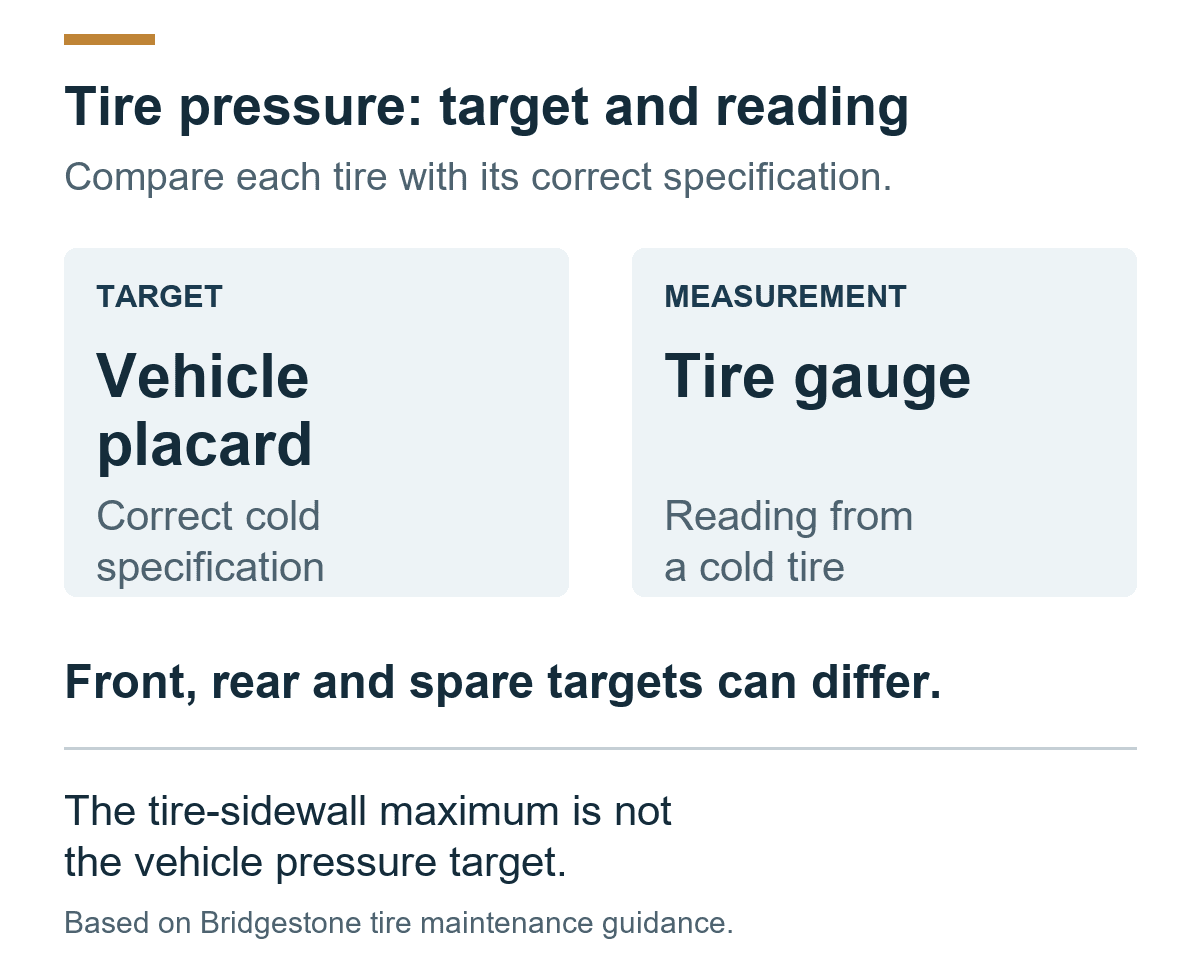
Use the vehicle’s cold-pressure specification
Find the tire-information label and the instructions for your vehicle before using a gauge. The recommended pressure belongs to the vehicle and tire configuration; the maximum pressure molded into the tire is not the target. Front and rear specifications may differ, and a spare may have its own requirement. Do not assume one pressure applies to every tire.
Bridgestone’s tire-safety manual defines cold tires as having been parked for at least three hours or driven less than a mile at moderate speed. Planning the check before setting off avoids trying to interpret pressures after a long drive. The manufacturer’s instructions remain the reference for the particular vehicle.
Ford’s 2024 Super Duty manual provides an important warning: driving warms tires and normally raises pressure, so air should not be bled from hot tires simply to reach the cold specification. This is a model-specific manual example, not a universal hot-pressure correction. A tire at the cold target while hot can still be underinflated when it cools.
Measure tread and inspect the whole visible tire
Look across the tread rather than judging only the easy-to-see outer edge. Uneven wear needs attention even when one measurement looks adequate. Bridgestone calls for replacement when tread reaches 2/32 inch or exposed cords are present. That threshold is not a promise of good wet-road performance, and it should not be presented as every jurisdiction’s legal rule.
Inspect for cuts, cracks, bulges and other visible damage. Michelin notes that an impact can cause internal damage even when remaining tread looks acceptable. A quick driveway check cannot establish what is happening inside a tire. Persistent vibration, a change in handling or evidence of impact needs professional evaluation before the trip.
The broader tire-replacement guide explains how tread, manufacturing age and damage lead to different decisions. Age is especially easy to overlook on a lightly used vehicle or spare: the date code describes manufacture, not the date the tire was bought or fitted.
Include the spare or mobility equipment
Check what the vehicle actually carries: a spare, a temporary spare, an inflator kit or another arrangement. Follow its instructions and limitations. A spare that has never touched the road still needs attention to pressure and age. Do not copy the road-tire specification onto it or assume it supports the same speed, distance and loading.
Before loading luggage, confirm that required equipment is present and accessible. Packing over the spare or inflator may make a roadside problem harder to manage. This check establishes preparedness; it does not establish that a damaged tire is repairable or that a mobility kit is suitable for every puncture.
Resolve problems before treating the car as trip-ready
Ford’s manual also explains that its pressure warning does not replace proper tire-pressure maintenance; it activates for significant underinflation or a system malfunction. A recurring pressure loss needs its cause identified. Repeatedly adding air is not evidence that the tire, valve or wheel is sound, especially after impact or operation at very low pressure.
Record each tire’s cold pressure and any wear or damage finding, then compare with the correct instructions. If a tire has been run flat, is visibly damaged or will not retain pressure, get qualified advice rather than using a quick inflation as clearance for a long drive. The purpose of the pre-trip check is to find a problem while there is still time to address it.
0 comment(s) so far on Tire Checks Before a Road Trip: Pressure, Tread, Damage