

Suspension Noise: Evidence Behind a Repair
Suspension
Updated October 17, 2026
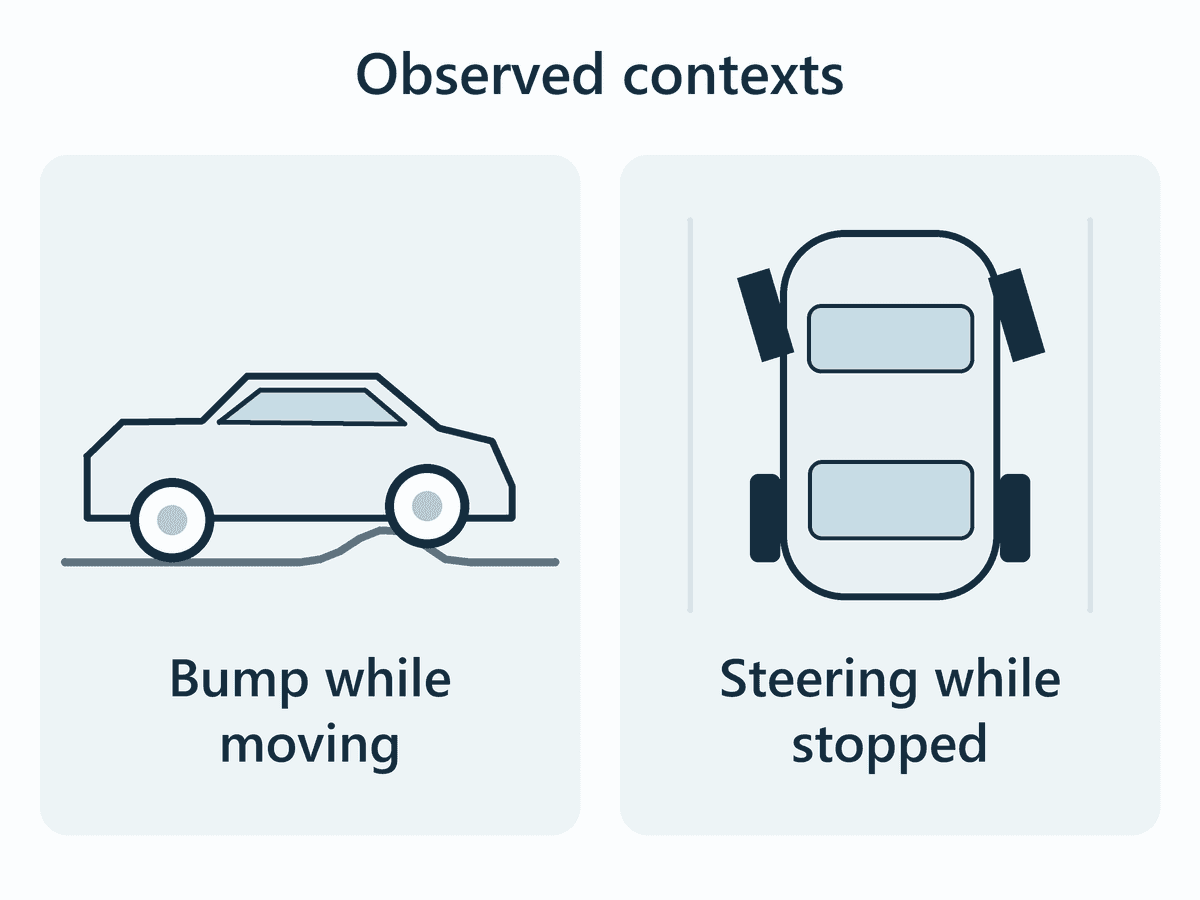
A clunk over a bump, a stationary steering pop and a vibration felt through the seat need different explanations. Describe the circumstances before agreeing to a suspension parts list.
A new damper and its attachments are separate questions
If the noise began after shock or strut replacement, bring the repair order and say whether it is the same complaint or a new sound. Monroe’s post-replacement guidance identifies loose or worn mounting parts as a possible explanation for a metallic clunk. A mount or bushing can appear tight while allowing movement.
Ask which attachment was inspected and what movement or wear was found. Monroe distinguishes the upper mounting plate in a strut bump-noise investigation from the bearing assembly in a turning-noise investigation. That distinction makes “the strut is noisy” an incomplete explanation. It does not make either part the diagnosis for your vehicle.
A bulletin must match the vehicle and the complaint
Ford bulletin 26-2242, dated May 18, 2026, illustrates why the circumstances matter. It covers certain North American 2020–2025 Explorers built on or before January 28, 2025. The possible concern is upper-strut-mount washer movement under steering loads.
Its procedure applies to a front suspension click/pop or visible movement while the vehicle is stationary and steering. Ford expressly excludes noises while driving over bumps, uneven pavement or other road inputs, even during low-speed turns. Ford directs evaluation of both front mounts, not automatic replacement of both. Ask which applicability criteria and inspection finding match your complaint. The bulletin does not automatically authorize parts replacement or change warranty coverage.
A moving-turn knock raises a different question
A turning noise can also lead the technician toward the driveline. GKN’s LÖBRO workshop guidance describes cornering knocks associated with wear inside a constant-velocity joint. These joints transfer torque from the differential to the wheels. That is a reason to investigate a moving-turn complaint, not a rule that every click requires an axle.
A boot and the joint it protects also need separate findings. GKN calls for thorough joint inspection when a boot is changed. GKN distinguishes wheel-side from transmission-side joints; ask which location the inspection identified. If the estimate lists a boot or a complete shaft, ask what the inspection established about the joint itself. Our clicking while turning guide develops that distinction. Report only what you already noticed; leave deliberate reproduction, lifting and under-vehicle inspection to trained professionals.
Separate wheel vibration from a suspension parts decision
Tell the repairer whether you heard a noise, felt a repeated shake, or experienced both. Michelin distinguishes alignment from balancing: alignment concerns wheel angles, while balancing concerns weight distribution in the rotating tire-and-wheel assembly. One service is not simply another name for the other.
Michelin also notes that cupped tread can accompany imbalance or worn shocks. The pattern therefore needs interpretation rather than an automatic parts order. If an estimate includes alignment, balancing and suspension work, ask which finding supports each operation and which complaint each is intended to address. Keep any angle readings and tire-condition findings with the repair order. Existing uneven tread wear does not disappear merely because an adjustment was made. Ask how the condition of those tires affects the proposed work and what will be reassessed afterward.
0 comment(s) so far on Suspension Noise: Evidence Behind a Repair