

Clicking When Turning: CV Joints and Steering Clues
Owner Guide
A clicking noise when turning needs a description before it needs a parts order. Whether the vehicle was moving, where the sound seemed to come from and whether steering changed are useful clues. CV joints are one possibility, but a click does not identify a failed axle or establish that the vehicle is safe to keep driving.
Updated October 16, 2026
Why a CV joint may enter the diagnosis
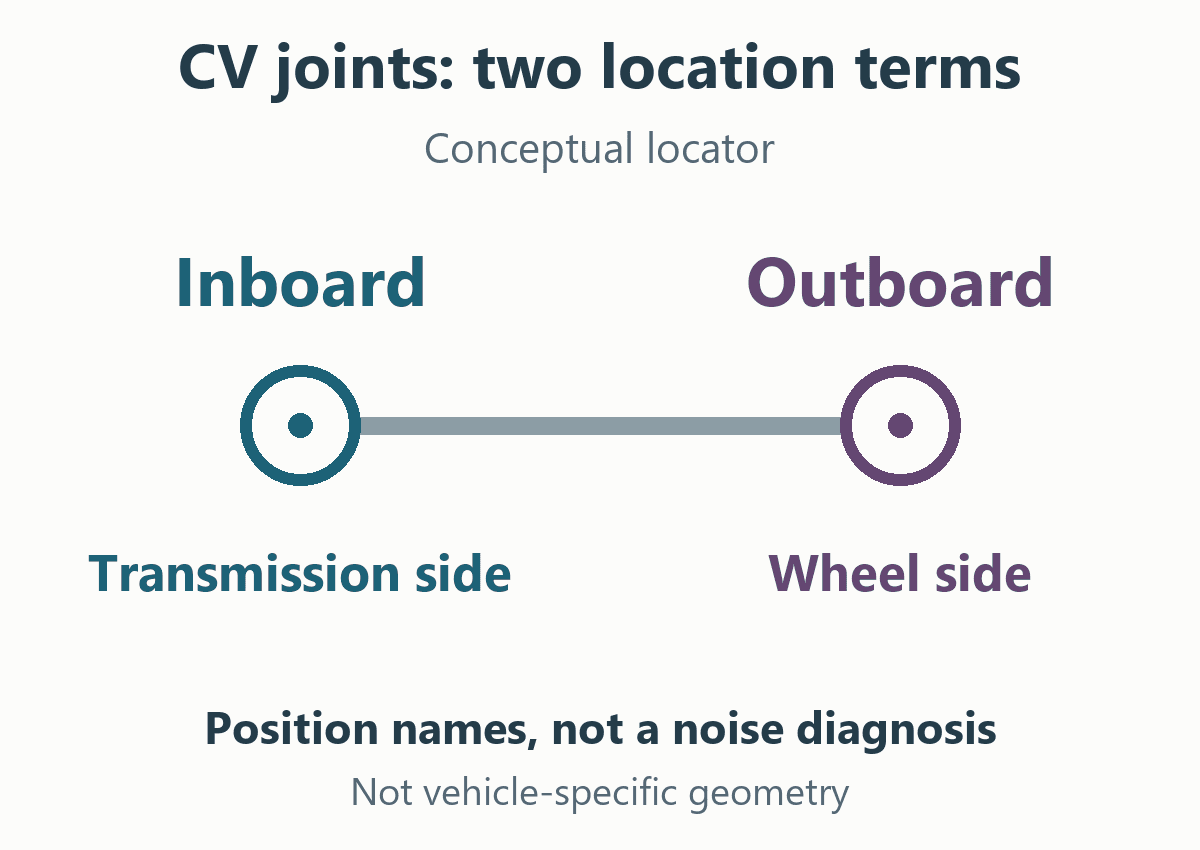
Constant-velocity joints transfer torque from the differential to the wheels. In its LÖBRO workshop guidance, GKN describes cornering knocks associated with balls moving over worn areas inside a joint. It distinguishes the outboard, wheel-side joint from the inboard, transmission-side joint. That makes joint condition relevant to a turning-noise investigation; it does not locate a fault from the word “click.”
The boot and joint also need separate consideration. GKN identifies defective boots among causes of joint damage and tells technicians to inspect the joint thoroughly when changing a boot. A new boot is not evidence that an already damaged joint has been repaired. Visible boot damage or grease around the assembly is information to report, rather than a complete diagnosis.
A stationary steering click can have another source
A specific Ford example illustrates the limits of symptom matching. Technical Service Bulletin 26-2242, dated May 18, 2026, addresses certain North American 2020–2025 Explorers built on or before January 28, 2025. It describes a possible front upper strut-mount washer movement concern.
The procedure is expressly limited to a front suspension click/pop or visible movement with the vehicle stationary while steering. Ford excludes noises while driving, including over bumps, uneven pavement or other road inputs, even during low-speed turns. It directs technicians to evaluate both front mounts. This is a qualified example of a different cause, not a strut-replacement recommendation for every turning noise.
Give the technician observations, not a test result
Report what you have already noticed: stationary or moving, left or right turn, one pop or a repeating noise, and the apparent location. Mention accompanying vibration, a change in steering effort, warning messages, recent work or an impact. Distinguish something heard from something felt through the wheel. These details help explain why the vehicle needs inspection without selecting a part in advance.
Leave deliberate reproduction tests, lifting and under-vehicle checks to the technician. GKN warns about rotating-shaft entanglement and describes detailed professional inspection. Ford likewise states that its bulletin procedures are for trained technicians, not do-it-yourself repairs.
Steering warnings need their own response
Follow the vehicle’s warning message and owner’s manual rather than judging urgency by noise volume. For example, the 2024 Ford Super Duty manual (printed page 279) instructs a safe stop for its “Steering Loss Stop Safely” message and for a red steering warning. Other service messages call for prompt checking. Those exact messages and instructions are model-specific.
When discussing a repair, ask which component and side were confirmed, what inspection supports that conclusion, and whether any quoted work depends on further findings. A bulletin match still requires its vehicle and symptom criteria to be met. A recording or a symptom description can help explain the complaint, but cannot replace that inspection.
0 comment(s) so far on Clicking When Turning: CV Joints and Steering Clues