

Pre-Trip Vehicle Checklist For Safer Long Drives
Road-trip preparation
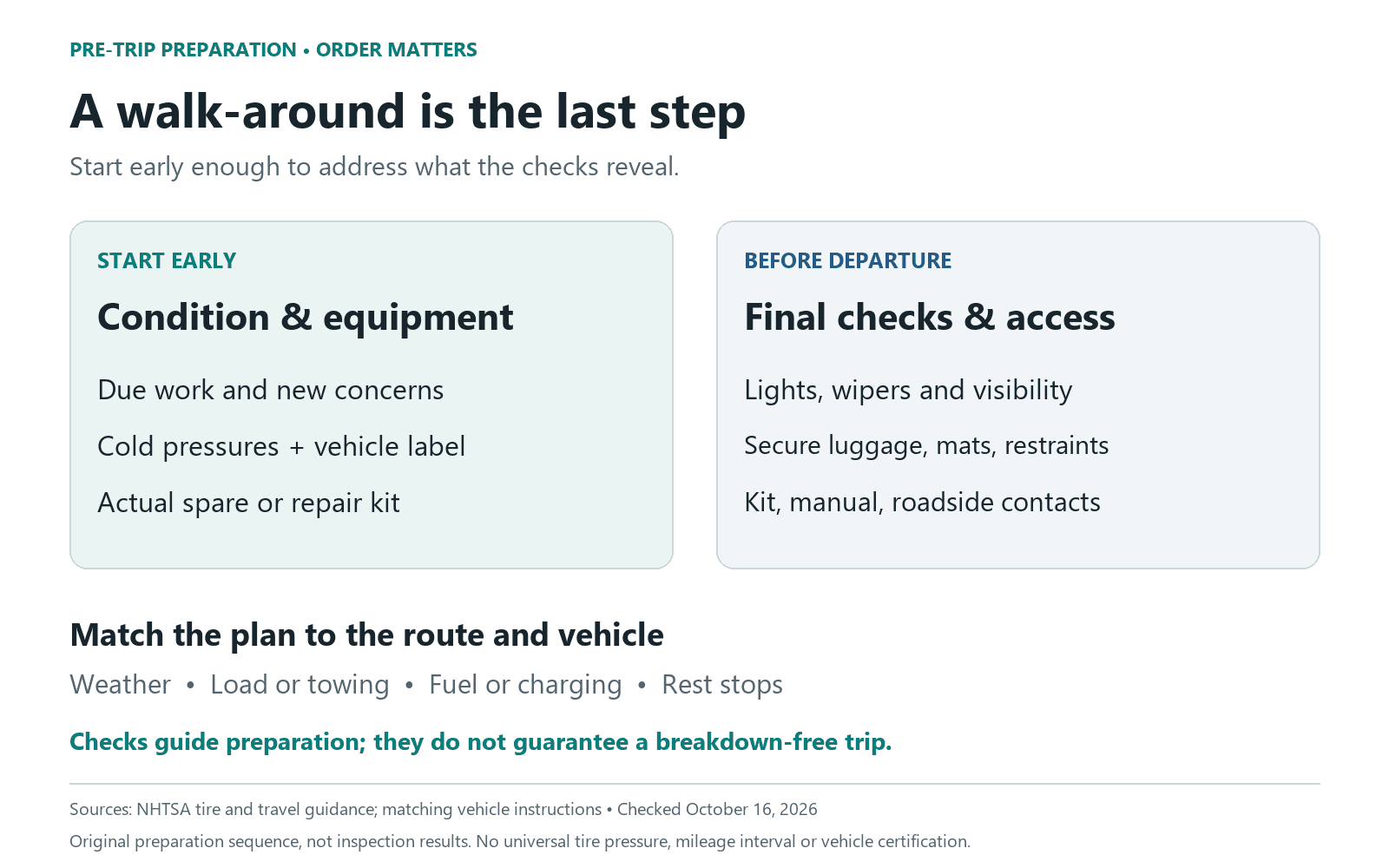
A useful pre-trip check starts early enough to act on what it finds. Review the vehicle’s condition and the trip’s demands before loading the car, then do a final walk-around before departure. A checklist can identify work to address; it cannot certify that a vehicle will complete a journey without a breakdown.
Updated October 16, 2026
Start with the tires and the equipment you actually have
Use a gauge when the tires are cold and compare the reading with the vehicle’s tire-information label or manual. NHTSA defines cold as not driven for at least three hours. The maximum pressure molded on the tire sidewall is not the vehicle’s recommended operating pressure.
Inspect the visible tread and sidewalls for wear or damage, and have questionable damage assessed. A tire-pressure warning system does not replace checking pressure. If the vehicle has a spare, confirm its condition, specified pressure and required tools. If it uses a repair kit, check the kit’s instructions, completeness and expiration dates rather than assuming there is a spare under the cargo floor.
Check the trip, not just the odometer
Review the matching maintenance schedule and recent service records. Identify overdue work and any new brake, starting, steering, cooling or drivability concern before committing to a long drive. A recent oil change does not establish that tires, brakes or the battery were inspected.
NHTSA’s travel guidance includes cooling-system, fluid, battery, lighting and wiper checks. Follow the vehicle manual for accessible fluid checks and specifications. Do not open a hot cooling system, improvise a fluid mixture or assume every reservoir should be filled to the brim.
Choose service tasks from the actual vehicle and conditions. A mountain route, heavy load, extreme temperatures or towing may change what needs attention. For a trailer trip, the payload and towing worksheet helps keep occupants, luggage and trailer loading within the same calculation. It does not replace the vehicle and trailer instructions.
Use a short final walk-around
| Area | What to confirm |
|---|---|
| Visibility | Exterior lights, turn signals, brake lights, washers and wipers operate; glass is clear. |
| Cabin and luggage | Nothing interferes with pedals; luggage and accessories are secured; occupants have their proper seating restraints. |
| Ground and dashboard | No new unexplained leak or warning message has been dismissed just to start the journey. |
| Recovery information | The correct tire equipment, manual and roadside-contact details are accessible without emptying the whole vehicle. |
For a battery-electric vehicle, plan charging stops around the actual route, connectors and expected conditions. The Department of Energy’s EV overview distinguishes battery-electric vehicles from vehicles that also carry a combustion engine. Do not assume a hybrid badge means the car can be plugged in, or that the charging routine of another model applies.
Pack for a delay, then allow time to stop
Keep a phone and charger, flashlight, basic first-aid supplies, drinking water and weather-appropriate supplies within reach. Review weather and road conditions, and include rest or charging stops in the time plan. Emergency equipment is useful even after a careful inspection.
If a warning or new symptom appears before departure, resolve its meaning instead of treating the checklist as complete because most boxes are ticked. The most useful result is a car and a plan suited to the trip, with known concerns addressed and recovery information ready.
0 comment(s) so far on Pre-Trip Vehicle Checklist For Safer Long Drives