

Traction Control Light: Flashing, Steady and Off
Warning lights explained
A traction-control warning starts with the exact display: a flashing system lamp, a separate OFF indicator and a service message are different observations. Identify the symbol and wording in the vehicle’s manual before treating every light as a failed sensor or trying to make it disappear.
Updated October 16, 2026
Flashing can report the system working
The 2021 gasoline Honda CR-V manual says its Vehicle Stability Assist system indicator blinks during intervention. The driver may also notice a change in accelerator response or noise from the hydraulic brakes. Honda describes the system regulating engine output and selectively applying brakes to help maintain traction and stability.
The 2024 Super Duty manual, printed pages 265–267, similarly describes flashing during stability or traction-control activation, possibly accompanied by slowing or reduced engine power. Those are documented examples of intervention. They do not make deliberately provoking wheelspin a useful owner test, or establish that an unfamiliar flashing warning means the same thing.
A steady warning and an OFF indicator differ
Both manuals distinguish their main system indicator from a separate OFF indication. On the cited CR-V, a system lamp that remains on calls for inspection; its OFF indicator reports partial deactivation. On the cited Super Duty, an OFF indication can follow a traction-control selection or an alternative stability-control mode. The exact symbol and selected mode matter.
| Display | Documented distinction |
|---|---|
| System indicator flashing during intervention | The CR-V and Super Duty manuals describe active traction or stability assistance. |
| System indicator remaining on | These manuals call for system inspection rather than assuming ordinary intervention. |
| OFF indicator or status message | Interpret the particular function and mode selected; it is separate from a service message. |
| Service AdvanceTrac | The Super Duty message table identifies a condition requiring service, distinct from AdvanceTrac On or Off status. |
Do not use a generic button-hold or battery-disconnection routine as a repair. The CR-V manual also describes temporary indications after reconnecting its battery, but its model-specific recovery instructions are not a reset procedure for an unexplained warning on another vehicle. Keep assistance enabled for ordinary driving and follow the instructions for the actual equipment.
Traction control is related to stability control
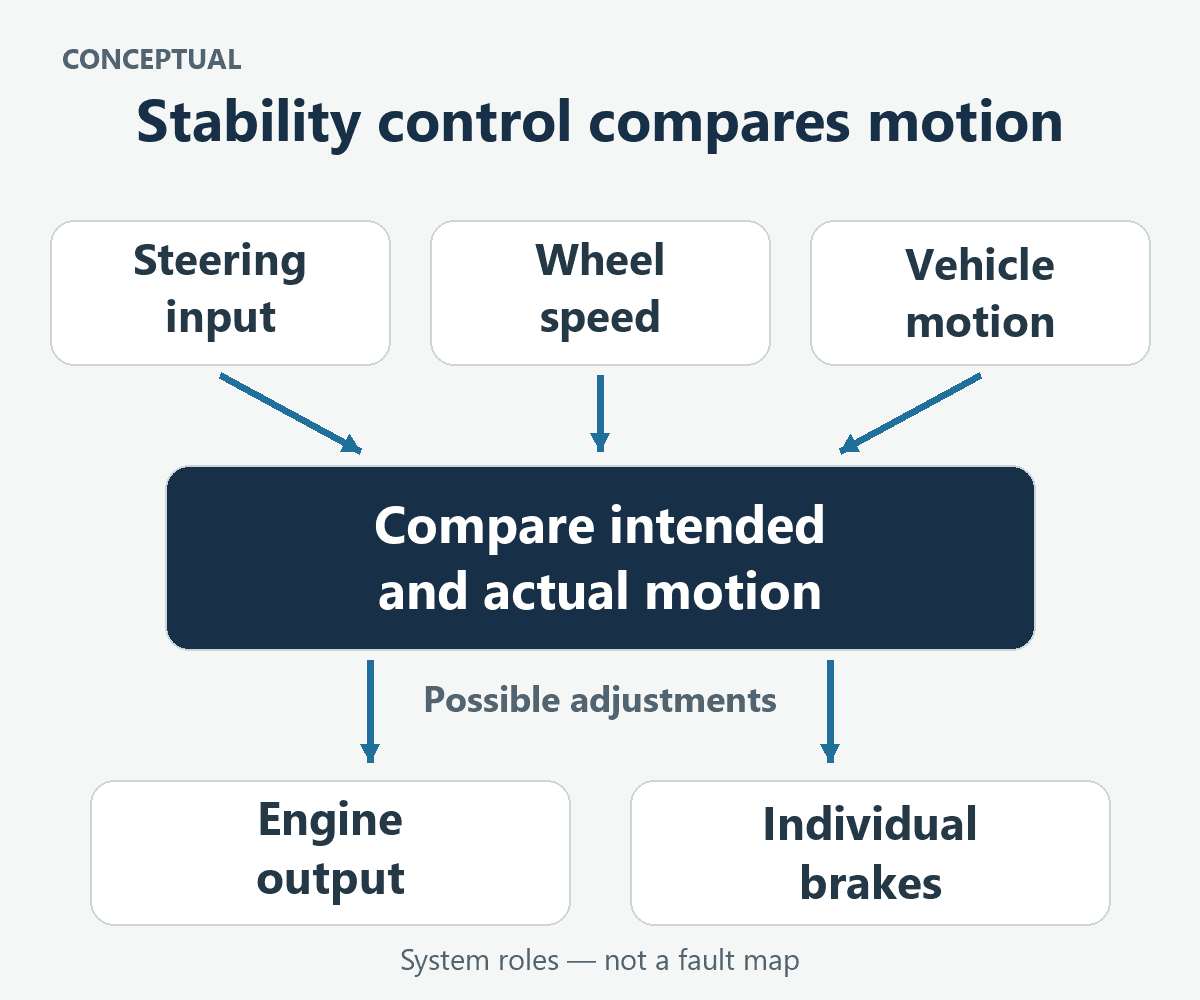
Bosch’s ESP explanation describes a broader stability system that includes ABS and traction-control functions. Its inputs include wheel speed, steering angle and vehicle motion. That helps explain why several controls and warning messages can be related; it does not identify which input or component is faulty on a particular car.
Traction control addresses driven-wheel spin. Stability control also addresses the vehicle’s movement relative to the driver’s intended direction. Neither creates unlimited grip. Honda and Ford both stress the limits of their systems, so a flashing intervention lamp is a reason to respect the conditions rather than evidence that the car can safely maintain any chosen speed.
Tires matter, but pressure is not a universal reset
Honda warns that mixed tire types or sizes can affect VSA operation and specifies the same tire size and type, with pressures set as specified for the vehicle. Its replacement guidance also connects unsuitable tire construction or sizing with incorrect ABS or VSA behavior. Report recent tire work and the fitted tire specifications alongside the warning.
Correct pressure and suitable tires remain important, but they do not establish that an electrical or control-system fault has been repaired. For a warning that persists, give the repairer the exact lamp, accompanying messages and conditions already observed. Ask which stored information or measurement supports the recommendation, and keep any unresolved limitation explicit.
0 comment(s) so far on Traction Control Light: Flashing, Steady and Off