

Airbag Light On: SRS Warning or Passenger Status?
Restraint-system indicators
Updated October 16, 2026
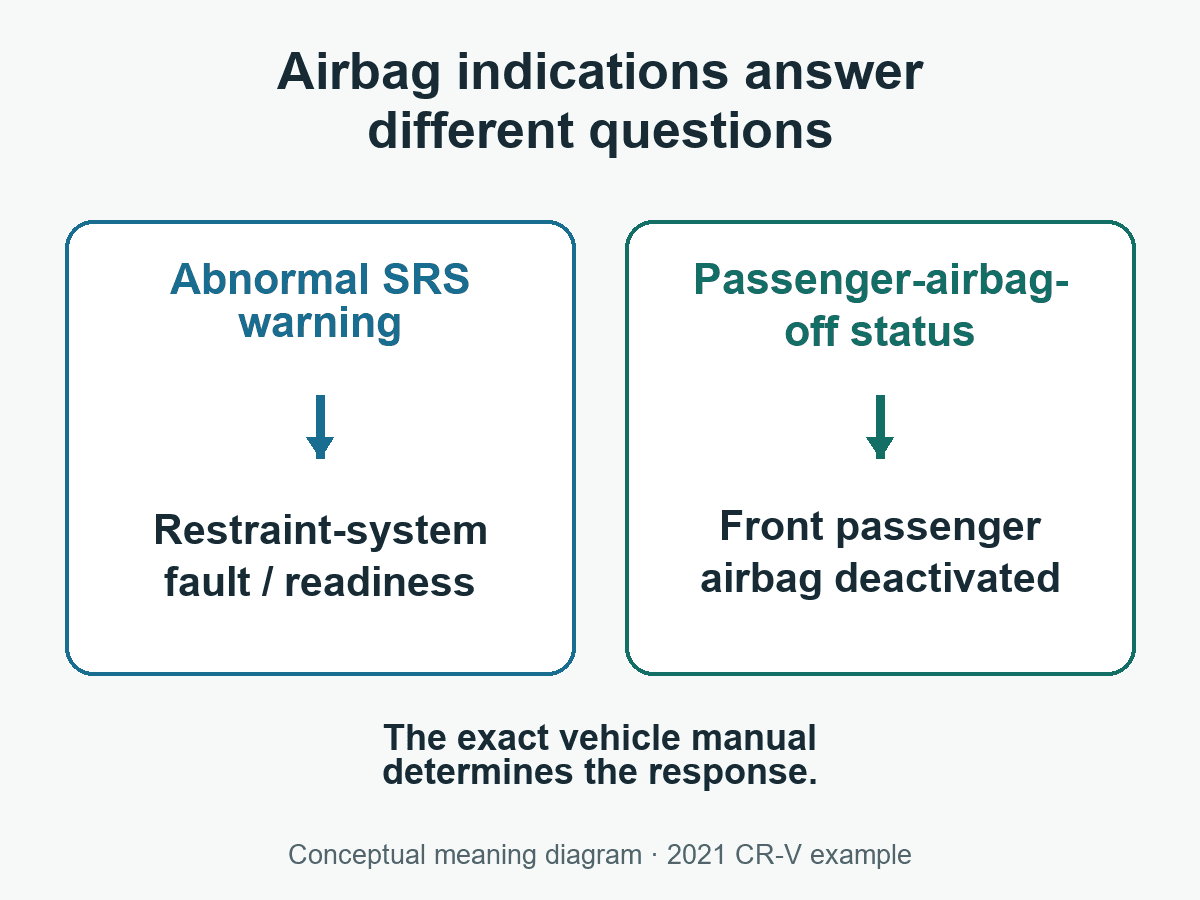
An SRS warning and a passenger-airbag-off indicator answer different questions. One can report a restraint-system problem; the other can report that the front passenger airbag is deactivated. Identify the exact light and message, then follow the instructions for that vehicle. A warning alone does not identify a failed part or establish what protection would remain in a crash.
Identify the indicator before interpreting it
In the gasoline 2021 Honda CR-V manual, the SRS indicator illuminates briefly when the ignition is switched on, then goes out. Honda calls for a dealer check as soon as possible if it appears at another time or never illuminates. The manual warns that the airbags or seat-belt tensioners may not work properly when needed.
The same CR-V has a separate passenger-airbag-off indicator. An empty passenger seat is one reason it can illuminate. That is different from an SRS fault warning. Honda also gives separate instructions for unexpected passenger status: do not let an adult ride in the front passenger seat while that indicator is on, and seek a dealer check when the specified conditions persist. Use the actual manual’s indicator and seating instructions, rather than treating every airbag-related light as interchangeable.
A disappearing warning still deserves attention
The 2024 Ford Super Duty manual describes its restraint readiness warning through several observations: no light immediately after ignition-on, a light that flashes or stays on, or a repeating series of five tones. Ford says to have the supplemental restraint system serviced immediately if these occur, even intermittently. Those are instructions for that specific truck, not a universal flash-code or chime pattern to apply to other vehicles.
Neither example supports waiting until the vehicle drives differently. These warnings concern restraint readiness, and the vehicle’s own instructions determine the response. A warning that disappears between appointments should still be included in the concern history.
Diagnosis needs the restraint system’s findings
HELLA’s technical overview explains that an airbag control unit monitors the system, stores detected faults and controls the warning lamp. Its diagnostic discussion includes connections and wiring as possible fault paths, as well as the connection between the steering column and moving steering wheel. These examples explain why naming an airbag, sensor or module from the warning alone skips a necessary step.
The overview calls for a suitable diagnostic unit and manufacturer-specific information, and limits airbag work to appropriately trained professionals. An owner should not turn that workshop material into connector, fuse, resistor, battery-disconnection or reset experiments. The useful outcome is a documented system diagnosis tied to this vehicle and its actual findings.
Bring observations, then ask for a clear record
Write down the exact wording, which indicator appeared, whether it stayed on or flashed, and whether it appeared only during startup or later in ordinary use. Include the date, mileage, passenger-seat occupancy and any recent collision, seat or interior work. Make notes when parked; do not move seats or manipulate restraint components to try to reproduce the warning.
Ask which restraint-system fault information was retrieved, what finding identified the affected circuit or component, and what work addressed that finding. The final record should distinguish the original complaint, diagnosis and completed repair. A cleared message is a different fact from a documented correction.
For a used-car purchase, request that same explanation and supporting repair records. A light being off during a viewing does not explain a previously reported warning. The decision should rest on the vehicle’s documented condition and applicable instructions, rather than a claim that one visible dashboard state certifies the whole restraint system.
0 comment(s) so far on Airbag Light On: SRS Warning or Passenger Status?