

Vacuum Leak Symptoms: Hissing, High Idle, And Lean Codes
Intake air and fuel control
A hiss, high idle or lean trouble code can point toward an intake-air problem, but none identifies a vacuum leak on its own. The useful question is whether air is entering where the engine’s control system does not expect it—and which test demonstrates that path before a hose, sensor or intake gasket is replaced.
Updated October 16, 2026
What “unmetered air” means
On an engine that uses a mass-airflow sensor, the sensor measures incoming air so the control system can calculate fuel delivery. Motorservice explains that measurement and its role in engine management. Air entering through an unintended path after the measurement can upset that calculation. A contaminated or faulty sensor can also supply incorrect information.
The phrase “vacuum leak” usually concerns air drawn into a part of the intake system operating below outside air pressure. Intake joints, connected hoses and the vehicle’s ventilation or vacuum circuits are possible areas to investigate. The layout depends on the engine; a generic photograph cannot tell you which connection belongs on your vehicle.
This explanation is not a universal diagnosis for diesel engines, turbocharger plumbing or every fuel-control strategy. A system can behave differently under boost than under intake vacuum. Its service information determines how and where a leak test is performed.
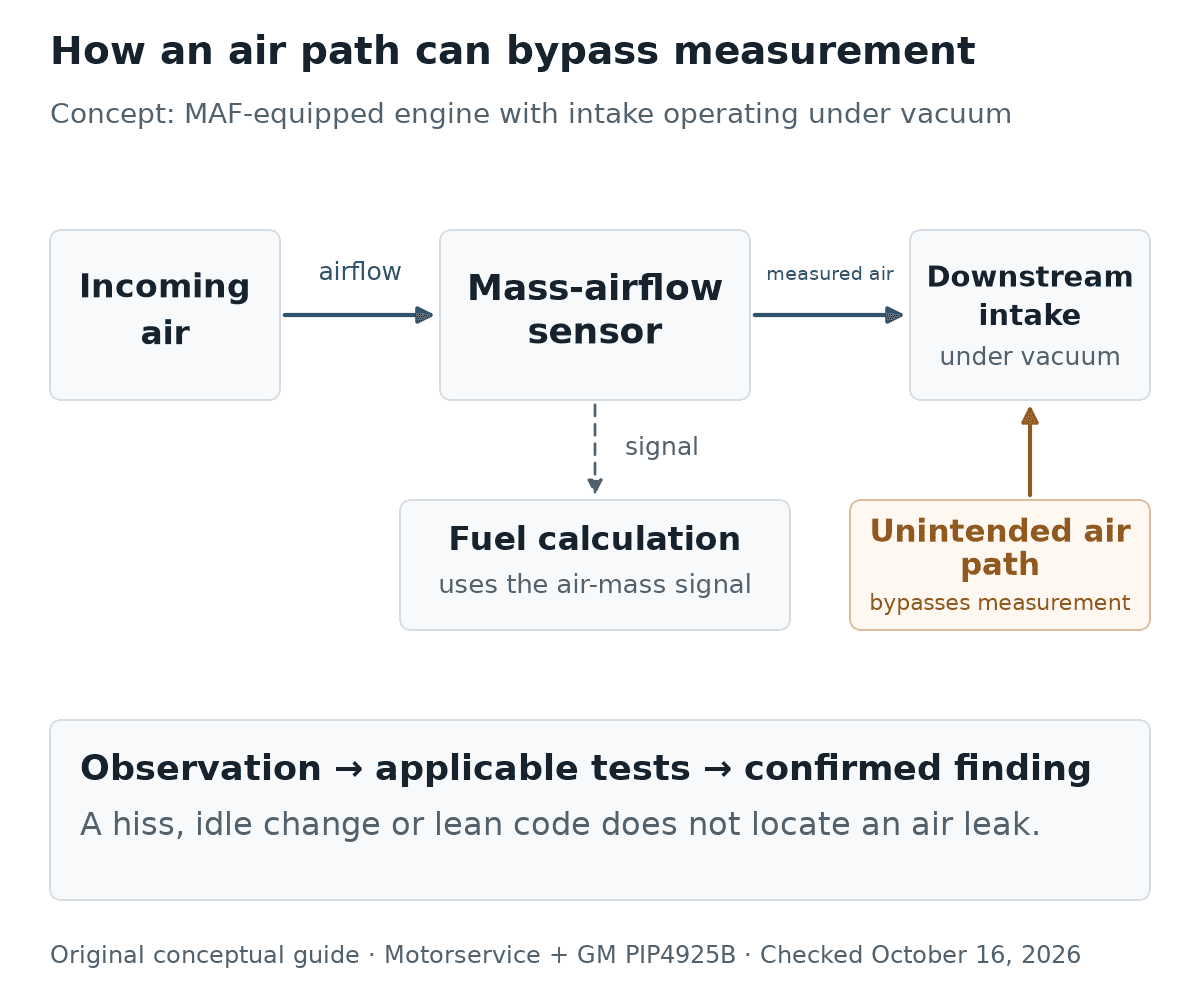
Read the clues without turning them into a verdict
| Observation | What it does—and does not—establish |
|---|---|
| Hissing | Locate the sound and its operating conditions; the sound alone does not identify a leaking seal. |
| High or uneven idle | Shows an idle concern, not proof of an intake-manifold fault. |
| P0171 or P0174 | Reports a lean fuel-system condition for the specified bank; the cause still needs diagnosis. |
| An oxygen or air/fuel sensor code | Requires the applicable diagnostic procedure; replacing the named sensor is not automatically the repair. |
A useful example is Nissan bulletin NTB19-022 for its listed 2017–19 vehicles, with a narrower year range for Altima. It adds an air/fuel-sensor confirmation procedure when diagnosing P0171 or P0174 and directs continued diagnosis without replacing that sensor when the confirmation does not support it. The bulletin is application-specific; its central lesson is that a lean code still needs testing.
What a leak test can contribute
Fuel-trim information describes adjustments the engine controller is making to fuel delivery. It is evidence about system operation, not a direct measurement of a hole’s size or location. Interpretation belongs with the engine’s specified diagnostic procedure.
GM’s PIP4925B guidance discusses smoke or ultrasonic testing when an intake or exhaust leak is suspected after normal diagnosis on the listed 2000–19 gasoline applications. It also identifies small exhaust leaks near oxygen sensors as a possibility. That matters because a fuel-trim or sensor-related code does not restrict the investigation to the intake manifold.
A properly selected test makes an otherwise hidden path easier to find. It still needs the correct connection, equipment and interpretation for the vehicle. This is not a reason to connect unrestricted shop air, disconnect brake-assistance plumbing or spray a running engine with flammable cleaner. Leave the test setup to a repairer using the applicable procedure.
What should support the repair recommendation?
Ask where the leak was found, how it was confirmed and whether the result explains the operating symptom. If testing instead points to air measurement, fuel delivery or another cause, the recommendation should reflect that finding. A code description and a guessed gasket are not equivalent evidence.
After the repair, confirmation should address the original idle or driveability concern and the relevant diagnostic results. Simply clearing a stored code does not demonstrate that an unwanted air path has been closed.
0 comment(s) so far on Vacuum Leak Symptoms: Hissing, High Idle, And Lean Codes