

Transmission Jerks When Shifting: Start With the Symptoms
Transmission behavior
Updated October 16, 2026
A transmission complaint becomes more useful when “it jerks” is separated into what actually happened: a jolt when selecting a gear, an abrupt shift while moving, or a delay before the vehicle responds. Record the circumstances already observed and the exact vehicle details. None of those descriptions, by itself, establishes that the transmission needs fluid, software or replacement.
Transmission design changes what a shift can feel like
Hyundai’s 2026 Elantra web-manual section for the seven-speed dry dual-clutch transmission explains that this design uses clutches rather than a conventional automatic’s torque converter. It describes more noticeable gear engagement and light vibration on launch as characteristics of that transmission. The description applies to the specified system, not every Elantra or every automatic.
The same section treats a blinking D or R position indicator during a transmission failure differently: it says not to continue driving and to have the system checked. A documented characteristic is not blanket reassurance about a severe, changing or warning-associated complaint. Use the instructions for the actual vehicle and message.
Two Ford bulletins illustrate why exact identity matters
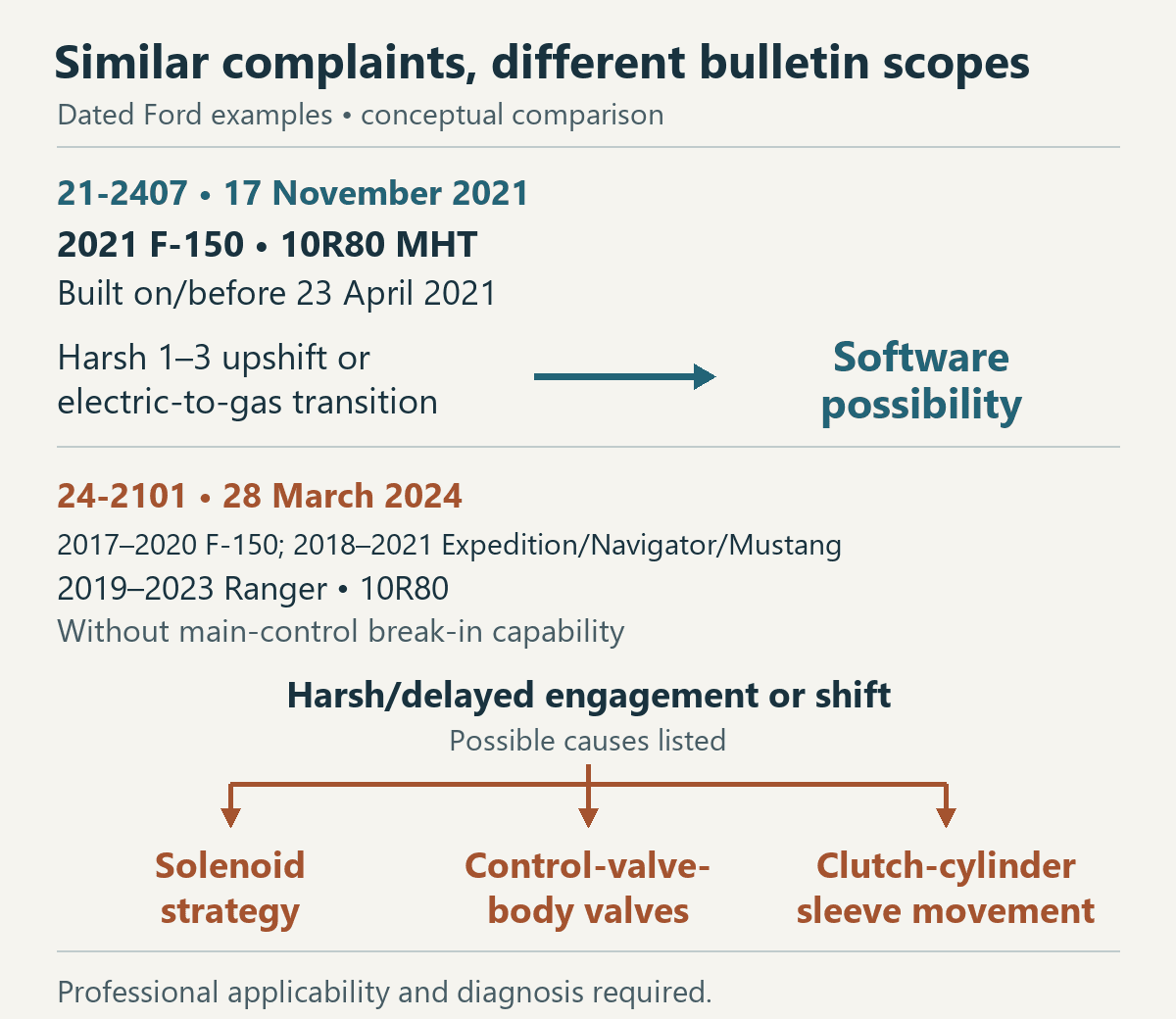
Ford’s November 2021 bulletin 21-2407 concerns some 2021 F-150s with the 10R80 MHT transmission built on or before April 23, 2021. It addresses a harsh 1–3 upshift or electric-to-gas transition that may relate to control-module software. That is a specific hybrid-transmission example, not a software diagnosis for another truck with a similar jolt.
A separate March 2024 bulletin, 24-2101, covers specified 10R80 applications without main-control break-in capability: 2017–2020 F-150, 2018–2021 Expedition, Navigator and Mustang, and 2019–2023 Ranger. It discusses harsh or delayed engagement or shifting and identifies several possibilities, including solenoid strategy, sticking control-valve-body valves and movement of a clutch-cylinder sleeve. Its professional diagnostic branches determine what happens next; the symptom list does not select a part.
What “adaptive learning” does and does not establish
Bulletin 21-2407 explains that, after the adaptive strategy is reset, relearning can produce firmer upshifts and downshifts for several days. That context matters when a complaint began immediately after documented service. Ask what work was performed, whether adaptive values were reset and which follow-up instructions apply. The note does not establish that an unexplained ongoing jolt is harmless.
For a vehicle that may match 24-2101, ask the service provider to verify the transmission, build information and current applicable service guidance. These dated bulletins are examples of how narrowly a repair path can be defined. Neither promises current warranty coverage or says the same procedure applies to every listed model.
Bring the existing pattern to the appointment
Useful notes include whether the concern occurred when selecting Drive or Reverse or during an upshift or downshift; whether it happened on the first trip or after the vehicle had been operating; and whether a warning or recent repair accompanied it. If the gear is unknown, say so. Do not perform extra acceleration, hill or repeated engagement tests to identify it.
Request an explanation connecting the confirmed complaint to the findings and applicable service information. A software update, fluid service and internal repair are different recommendations. Before authorizing one, ask what supports it for this vehicle. A reset or additive recipe from a similar-sounding complaint does not establish its cause.
0 comment(s) so far on Transmission Jerks When Shifting: Start With the Symptoms