

Starter Clicking: Single Click, Rapid Click, Or No Sound?
Starting systems
A click when you try to start a car describes a sound, not a failed part. Rapid clicking, one solid click and complete silence can help organize a no-crank complaint, but none proves that the battery or starter needs replacement. The useful first distinction is whether the engine is turning at all.
Updated October 16, 2026
This guide concerns vehicles with a conventional engine starting system. An engine that turns normally but will not run has a different problem from one that never turns. A battery-electric vehicle has no combustion engine to crank, and some hybrids start their engines differently.
Why the starter can click without turning the engine
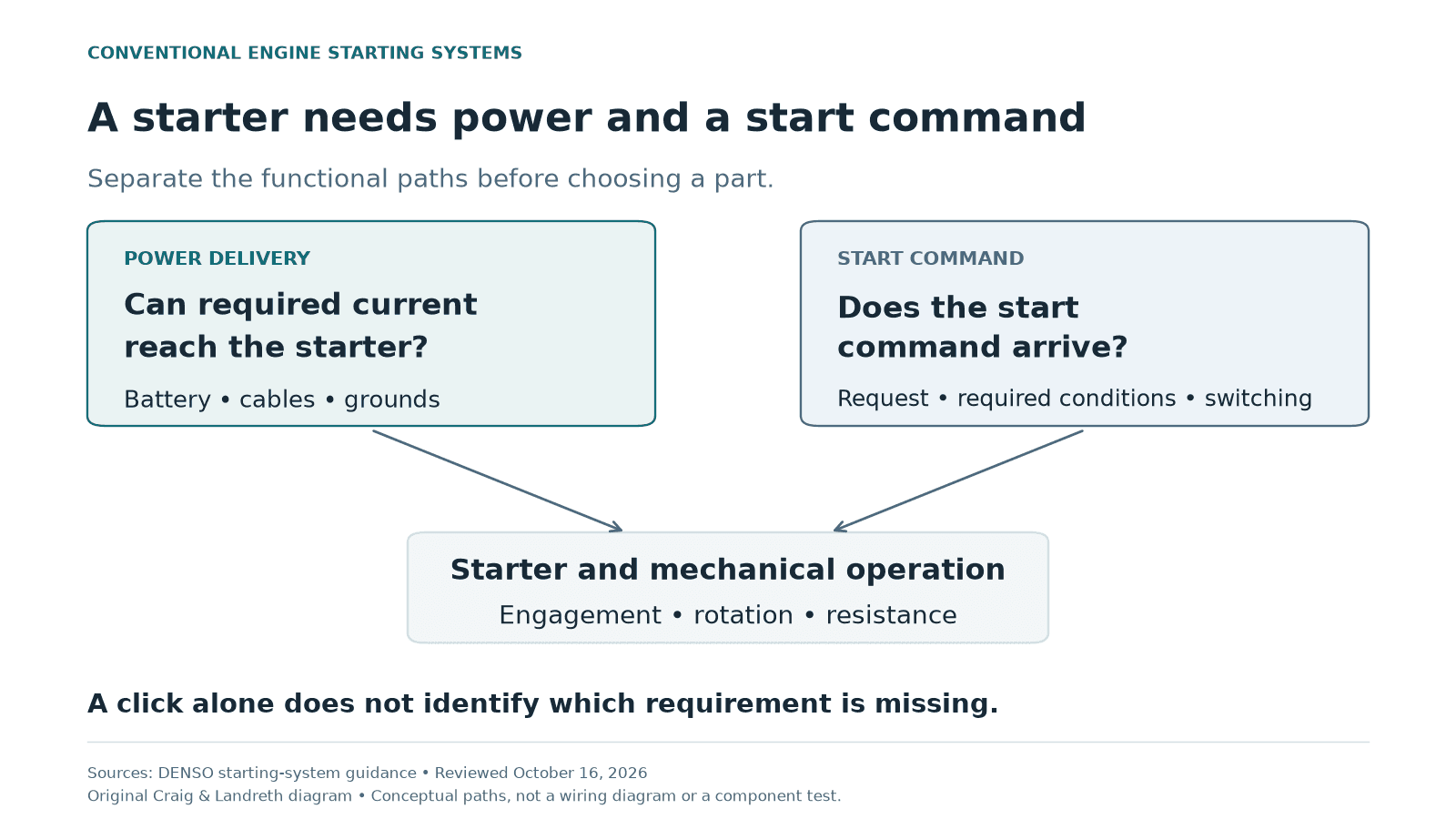
A conventional starter uses an electric motor to turn the engine through a pinion engaging the flywheel or flexplate. Its switching and engagement mechanism must operate, and the motor must receive enough power through the high-current circuit. Hearing part of that mechanism move does not establish that the whole system can do its job.
DENSO’s starting-system guidance identifies insufficient voltage at the starter solenoid as one possible reason for clicking without cranking. If the proper supply is present, internal switching contacts can be another possibility. That is a sequence of checks, rather than an instruction to replace whichever component the sound seems to resemble.
Battery condition, cable connections and grounds belong in that investigation. A working radio or illuminated dashboard does not settle whether the starting circuit can supply the required current. Similarly, a battery’s condition and the condition of the path from it to the starter are separate questions.
Describe what happened before choosing a repair
| What you notice | Useful distinction | What it does not prove |
|---|---|---|
| Repeated rapid clicks; engine does not turn | The sound repeats during the start request | That the battery alone is faulty |
| One click; engine does not turn | A switching or engagement sound occurs without cranking | That a new starter is necessarily the repair |
| No click and no cranking | The expected response is absent | Whether the missing command, power path or starter is responsible |
| A spinning sound without the engine turning | Starter operation and engine rotation may be separate | That the engine is cranking normally |
| Engine turns normally but does not start | This is a crank-but-no-start complaint | That the clicking/no-crank checks address the cause |
There is no need to recreate the failure repeatedly to make that description useful. Explain what happened during the original attempt, including any displayed message. “No start” is much less informative than “one click, no engine rotation, and the lights stayed on.”
Power delivery and the start command need different checks
DENSO’s technical explanation separates current draw, cranking speed and voltage-drop measurements. A restricted connection can reduce the power reaching the motor; excessive mechanical resistance can also affect cranking. Measurements taken during the relevant operating condition help distinguish those paths.
The control side is another part of the circuit. A start request must reach the appropriate switching system, subject to the vehicle’s operating requirements. Follow the owner’s manual for the normal starting procedure and any displayed key, brake, clutch or gear-position instruction. A silent starter is not permission to bypass a safety interlock or bridge electrical terminals.
When reviewing a repair recommendation, ask which finding separates the proposed part from a battery, cable or control problem. A useful explanation identifies where power or the command was lost, or what mechanical fault was confirmed. A sound alone leaves that question unanswered.
Use the right starting-system model
The U.S. Department of Energy’s battery-electric overview shows why combustion-engine starter advice does not transfer directly to an EV: an electric traction motor replaces the engine. The vehicle still has an auxiliary electrical system, but a failure to enter its ready state requires its own instructions and diagnosis.
Keep the description practical when arranging assistance: vehicle, powertrain, warning message, whether the engine turned, and whether the problem was intermittent. Avoid hitting the starter, jumping its terminals or crawling under a vehicle to investigate a sound. Those experiments add risk without replacing the circuit checks needed to identify the fault.
0 comment(s) so far on Starter Clicking: Single Click, Rapid Click, Or No Sound?