

Fuel Injector Problems: What Confirms a Fault?
Fuel and ignition
Updated October 16, 2026
Rough idle, hesitation and a misfire can raise questions about fuel injectors. They do not identify a failed injector by themselves. A useful repair recommendation connects the complaint to a particular cylinder or fuel-system finding, then explains why that evidence supports the proposed repair.
A misfire describes combustion, not the failed part
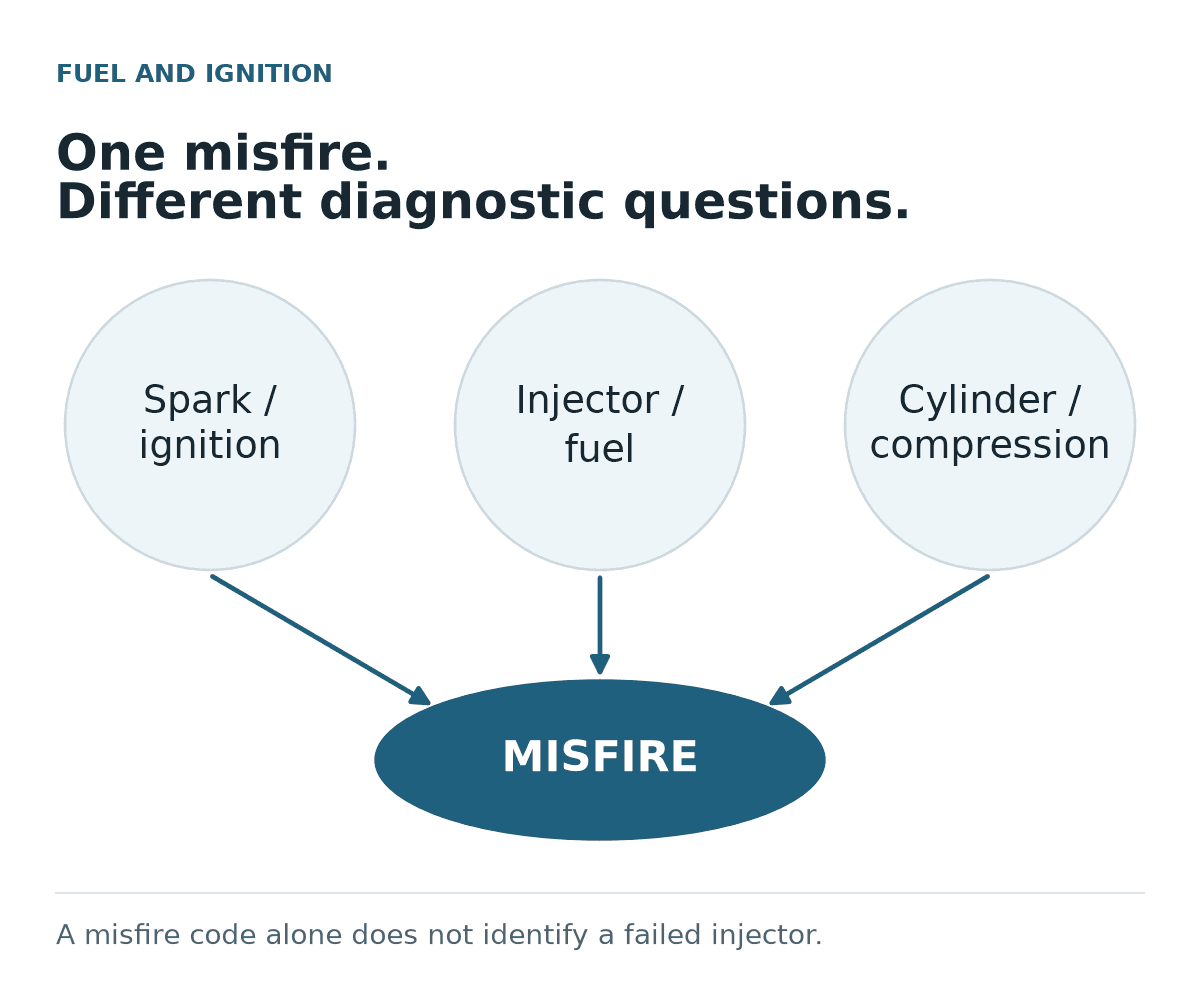
DENSO describes a misfire as a cylinder failing to burn the air–fuel mixture correctly. Rough running, hesitation and lost power can follow. In a gasoline engine, spark plugs, ignition coils and their installation can also be involved; the symptom is not an injector diagnosis.
That distinction matters after recent maintenance. An invoice for spark plugs or ignition work is relevant history, even when the new complaint sounds like a fuel problem. DENSO discusses incorrect plug application, wear and installation errors among ignition concerns. This does not mean a recent repair caused the fault. It means the technician should have the history before deciding what to test.
What manufacturer guidance says about injector replacement
A concrete example is Volkswagen’s June 2021 misfire diagnostic bulletin for 2008–2022 gasoline models, excluding Routan. It distinguishes P0300 random/multiple-cylinder misfire from P0301–P0308 cylinder-specific faults. It explicitly warns against replacing every injector, spark plug or coil on the strength of P0300 alone.
The professional diagnostic path includes ignition components, injector internal leakage and cylinder compression. These are different questions: whether combustion is failing, whether an injector leaks internally, and whether the cylinder can develop compression. The bulletin’s point is to identify the faulty component before replacement, rather than treat all three as interchangeable explanations.
Ask which finding supports the injector recommendation and which cylinder it concerns. If several injectors are recommended, ask what supports each replacement. These Volkswagen procedures are an example of evidence-based diagnosis, not instructions to swap parts at home or a procedure for diesel injectors.
Fuel odor and a flashing warning need separate attention
A fuel smell does not locate its source. Do not run the engine to hunt for a leak, loosen fuel lines or use your hand to check for spray. A suspected fuel leak calls for professional help, not an injector-cleaner experiment.
The 2024 Ford Super Duty owner’s manual warns about fuel-vapor hazards and avoiding inhalation. It also says a flashing malfunction lamp can mean misfire and increased exhaust temperatures that could damage the catalytic converter or other components. Its instrument-cluster section calls for immediate attention to a flashing lamp. Check the warning instructions for your exact vehicle; a light that later goes out does not establish that an injector was repaired.
Bring observations, leave testing to the technician
Write down whether the problem happened at a cold start, warm idle or during normal acceleration, along with the dashboard message and any recent repair or refueling. Use observations you already have; do not recreate a rough-running episode for a video.
Ask for the diagnostic findings and the repair’s verification result on the invoice. A record that separates the original complaint, confirmed fault and completed work is more useful than a list of suspected parts. It also gives the next technician a starting point if the same concern returns.
0 comment(s) so far on Fuel Injector Problems: What Confirms a Fault?