

Engine Mount Symptoms: Vibration, Clunk, And Rough Feel
Powertrain vibration
An engine mount supports the powertrain while limiting how much its vibration reaches the body. A failed or poorly installed mount can change what you feel through the seat, steering wheel or floor. But a shaking car does not establish that a mount is the cause: the engine may be running unevenly, or another part may be transmitting the disturbance.
Updated October 16, 2026
A mount has to support and isolate
Mounts connect the engine and transmission to the vehicle structure. ZF’s driveline-component explanation describes mounts as the connection that supports the units, limits movement and damps vibration. Torque supports and transmission mounts also contribute to that system.
Mount design involves a compromise: enough support to control movement, with enough isolation to keep routine engine vibration from dominating the cabin. The correct part and installation matter. A mount that physically fits is not necessarily matched to the engine, transmission or control system.
A harsher cabin feel therefore needs an explanation of both the vibration source and the connection transmitting it.
Not every mount contains fluid
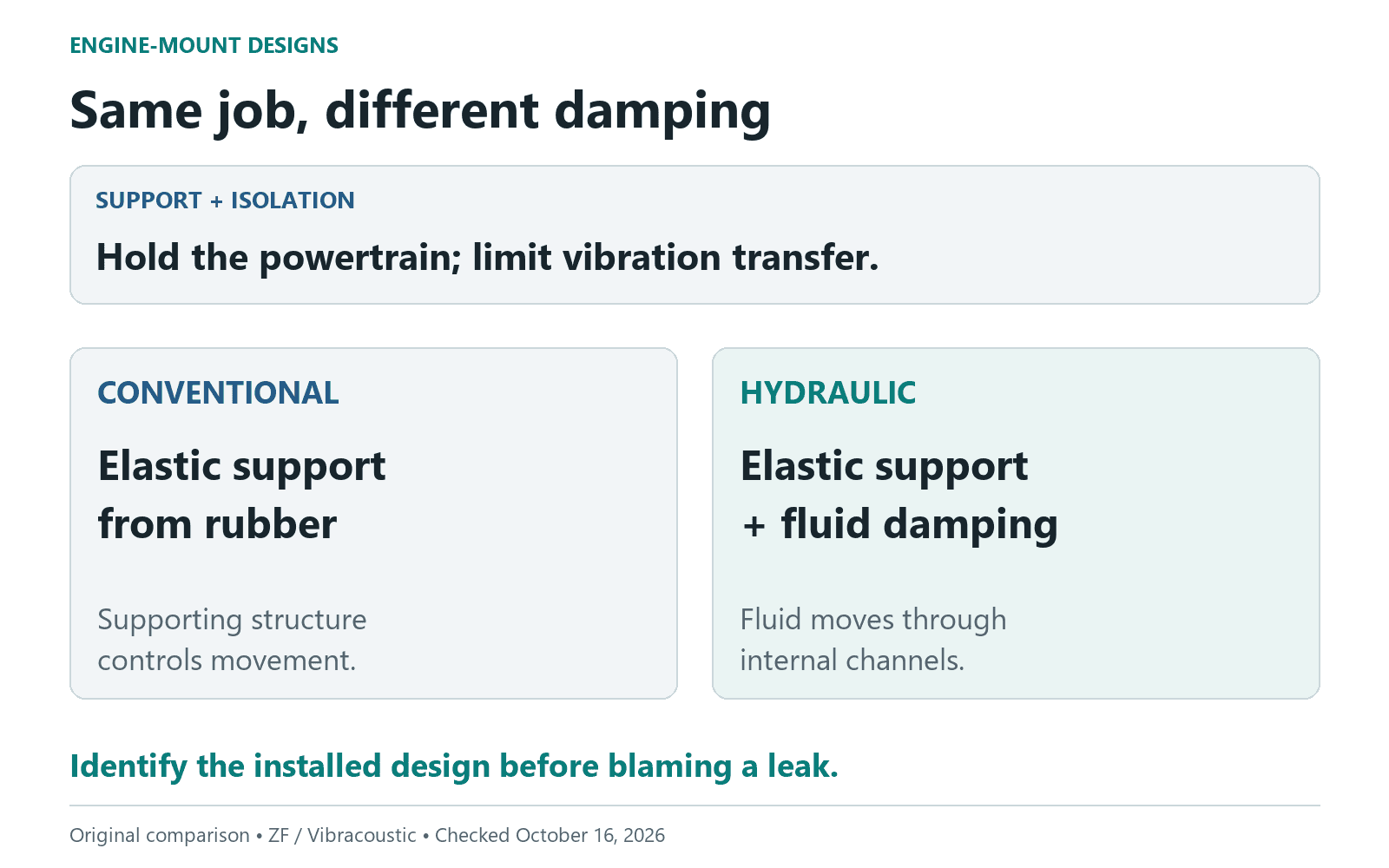
A conventional mount uses rubber bonded to supporting material. A hydraulic mount adds fluid damping. Some designs can change their behavior for different operating conditions. Vibracoustic’s hydraulic-mount description explains how chambers, channels and a membrane combine support with vibration isolation.
That distinction matters when interpreting a suspected leak. Fluid loss can be relevant to a hydraulic mount; it is not a symptom every rubber mount can have. Likewise, a visible hose or connector does not establish that all mounts on that vehicle use the same controls. Identify the installed design before treating a generic symptom list as a parts diagnosis.
| What you notice | What still needs establishing |
|---|---|
| More vibration at idle | Whether the engine is running unevenly or normal vibration is being transmitted differently. |
| A clunk as load changes | The location and cause; a clunk alone does not distinguish mounts from other driveline parts. |
| Fluid near a mount | Whether that mount is hydraulic and whether the fluid actually came from it. |
| A change after mount work | Correct application, seating, alignment and the specified installation procedure. |
Why diagnosis goes beyond watching the engine move
A mount is designed to allow controlled movement, so movement alone is not a pass-or-fail test. The repairer needs to distinguish an engine-running problem from the path carrying vibration into the cabin, and check for damage, contact or installation issues in the applicable system.
GM’s April 2019 service bulletin 17-NA-166 is a concrete example. It addresses a defined rough-idle-in-Drive condition on listed truck, SUV and engine applications, including specified 2015–19 Chevrolet Tahoe versions. It calls for vibration measurement to distinguish frequencies before following its mount procedures. It also distinguishes mount-transmitted vibration from an engine characteristic. It does not say every rough idle in those vehicles—or another vehicle—requires mounts.
What a useful repair explanation includes
The recommendation should identify the particular mount or related component, the evidence of damage or incorrect operation and how that finding explains the symptom. If the engine itself is running poorly, replacing a mount should not be presented as a cure for the underlying running fault.
Powertrain loading and support checks belong in a properly equipped workshop following the vehicle-specific procedure. Describe observations from ordinary use rather than trying to load or lift the powertrain yourself. After a repair, have the original concern checked again. There is no universal mount lifespan or automatic reason to replace every mount together.
0 comment(s) so far on Engine Mount Symptoms: Vibration, Clunk, And Rough Feel