

EGR Valve Symptoms: Flow, Control and Diagnostic Codes
Engine diagnostics
Updated October 16, 2026
A rough idle or an EGR-related fault code does not identify a failed valve. Exhaust gas recirculation depends on the gas path, its controls and the information used to judge flow. A useful diagnosis explains which of those failed before choosing cleaning, a valve or another repair.
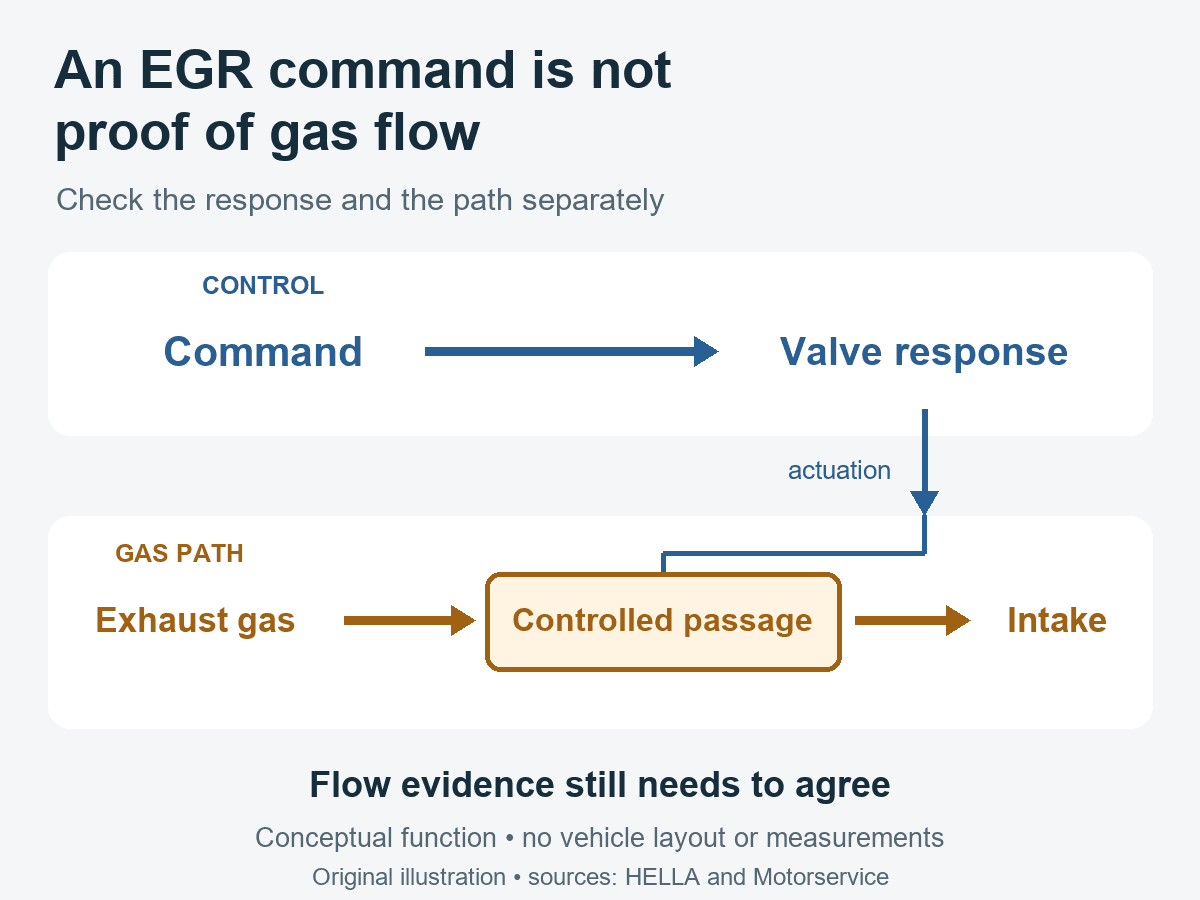
What the EGR system is controlling
HELLA’s technical explanation describes a controlled exhaust-gas path back toward the intake to reduce nitrogen-oxide emissions. Operation depends on conditions such as engine load, speed and coolant temperature. A general rule that every EGR valve must behave the same way at idle is therefore a poor starting point.
HELLA lists rough running, poor performance and an engine warning among possible EGR-fault effects, alongside several possible control or mechanical failures. The complaint helps describe when to investigate; it does not distinguish a restricted passage from a valve that cannot close or a control problem.
A flow code is not a valve verdict
Motorservice’s EGR diagnostic guide separates insufficient flow from excessive flow. Keep the exact code and the manufacturer’s description on the repair record rather than shortening either to “bad EGR.”
| Reported finding | What still needs establishing |
|---|---|
| P0401: insufficient flow | Whether the valve opens as required, the path is restricted, actuation is inadequate or the airflow information is misleading. |
| P0402: excessive flow | Whether the valve opens too far or fails to close, and whether the information used to assess flow is credible. |
Control and sensor-signal faults raise a different question: whether commands, feedback and electrical connections agree with the specified values. Ask which code was stored and what the tests found. Replacing a valve solely because its name appears in a scan description can miss the reason the system reported a fault.
Electrical response and mechanical movement can disagree
HELLA’s worked example concerns a valve from a 2002 Opel Corsa C. Its electrical checks did not reveal a fault, yet the mechanical examination found the valve jammed open by deposits. That is an example of why one satisfactory electrical result does not establish free movement or correct flow.
It is not a pin-testing recipe for another vehicle. Ask whether the technician confirmed the command, actual response and condition of the relevant passages using the applicable service information. Deposits also need an explanation; HELLA notes that an underlying engine problem can intensify contamination.
Match a bulletin to the actual vehicle and complaint
Toyota’s March 2016 bulletin T-SB-0027-16 gives a specific cold-start example. Its applications include certain 2010–2012 Prius vehicles with the 2ZR-FXE engine, built before the listed production-change VINs. It describes rough-idle vibration or tapping at cold start, possible P0401 and a valve sticking because of carbon.
The bulletin requires confirmation of the specified code and cold-start condition; otherwise it directs the repairer back to the applicable diagnostic information. A similar noise on another model, or even the same model outside that scope, does not establish the same repair. This historical bulletin also does not establish current warranty coverage or an individual vehicle’s eligibility.
Ask what the repair will correct
Describe observations from ordinary use: cold start or warmed engine, the exact message, and whether the complaint began before or after related work. Do not disconnect controls or deliberately provoke a stall to test a theory.
A useful estimate identifies the affected part or passage, the finding supporting it and any underlying cause that also needs attention. Ask how the original flow or control concern will be checked afterward. “Clean the EGR” and “replace the EGR” are proposed actions; neither substitutes for an explanation of what failed.
0 comment(s) so far on EGR Valve Symptoms: Flow, Control and Diagnostic Codes