

Differential Noise: What the Pattern Can Tell You
Driveline diagnosis
Updated October 16, 2026
A whine, clunk or chatter from the rear of a vehicle is an observation, not a confirmed differential failure. The useful repair question is which component produced the noise, under what conditions, and what finding supports the recommendation. Manufacturer bulletins show why similar descriptions can lead to very different explanations.
Describe the event without trying to provoke it
Record what you already noticed during ordinary use: a continuous whine, a single clunk as the vehicle’s load changed, or chatter during a turn. Include the approximate speed if known, whether you were accelerating, coasting or holding a steady pace, and whether the concern began after previous work. These details give the technician a condition to investigate without assigning a failed part.
Do not turn that history into repeated harsh acceleration, gear reversals, tight-turn experiments or a test with the vehicle lifted. The professional assessment needs to establish the noise source and the applicable vehicle configuration, rather than rely on an owner-created demonstration.
A clunk can involve more than the axle
GM’s June 2021 driveline-clunk bulletin covers 2021 and earlier GM passenger cars and trucks. It explains that clearance, or lash, exists across interacting driveline components. Axle gears, joints and the transmission can contribute; a transfer case adds further interfaces on equipped vehicles.
The bulletin discusses comparison with a like vehicle and the appropriate service information. It does not justify declaring every new clunk normal, nor does it show that replacing one differential component will remove accumulated clearance elsewhere. Ask how the specific clunk and its source were assessed before treating a rearward sound as an axle-replacement finding.
A whine can involve the path into the body
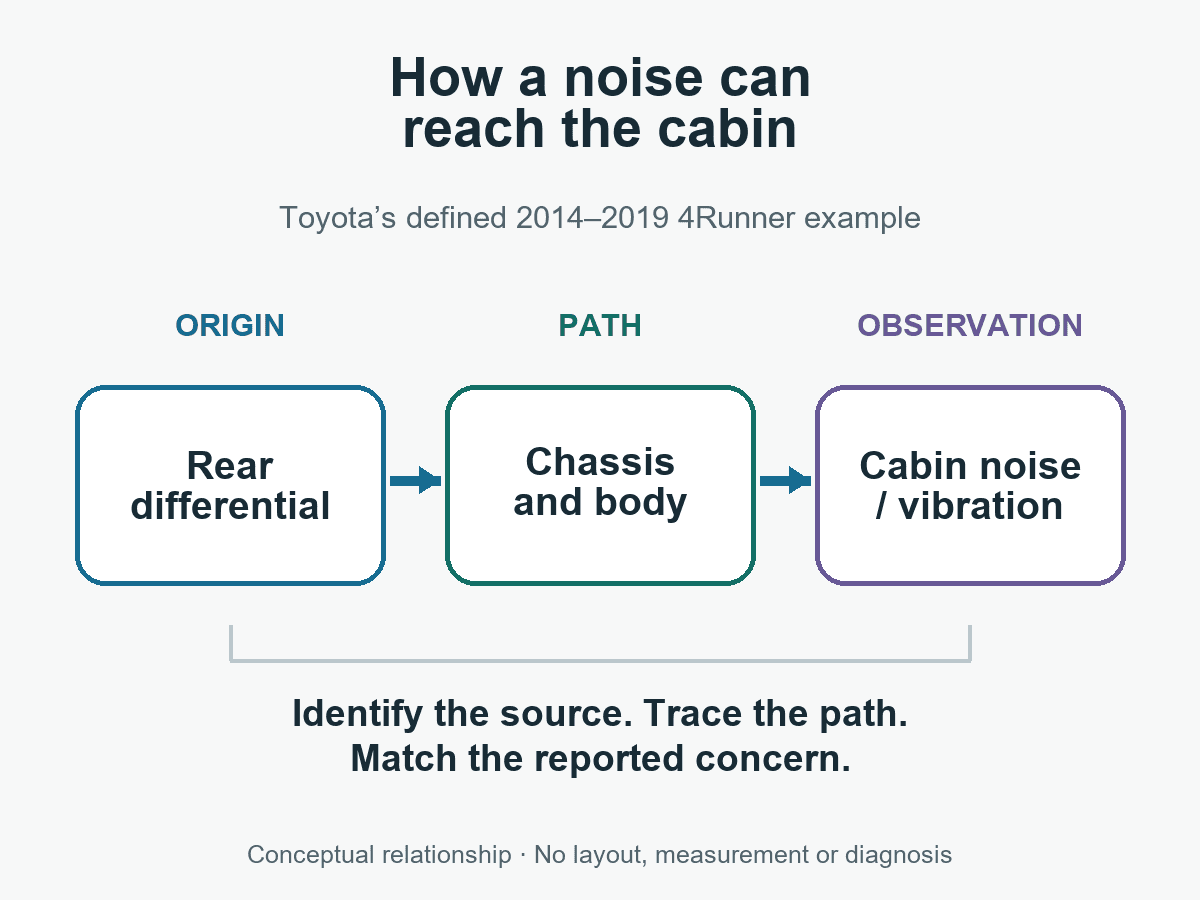
A different example is Toyota’s T-SB-0074-19, revised in March 2020, for a defined whine/groan condition on some 2014–2019 4Runners. It describes rear-differential vibration transferring through the chassis and body. Its professional repair branches depend on the production-VIN position, trim and drivetrain, with differences in differential, propeller-shaft and body-vibration work.
That makes applicability part of the diagnosis. A recommendation should explain whether the vehicle matches the bulletin’s condition and configuration, and which branch is relevant. The example supplies no universal repair for another model and no instruction to recreate its specified road-speed condition yourself.
Turning chatter does not establish a universal fluid cure
GM’s April 2013 bulletin describes rear clunk/chatter during turns on listed Cadillac vehicles with a limited-slip differential, RPO G80. Its applications include specified 2003–2013 CTS variants. The document links that condition to clutch-plate slip/stick and specifies a particular historical fluid correction.
This is a configuration-specific example, not evidence that every differential needs an additive or the same oil. If fluid work is proposed, ask for the exact axle identification, required specification and finding behind the recommendation. Do not transfer that Cadillac bulletin’s fluid remedy to unrelated equipment.
Make the repair record answer the original question
A useful explanation distinguishes where the noise was heard from where it originated, and a noise-producing component from a path transmitting vibration into the cabin. If the shop reports a gear or bearing defect, ask what finding separates that conclusion from the other possibilities. If a leak or fluid concern is reported, ask what was actually found rather than assuming it explains the sound.
Keep the observed conditions, vehicle and axle identification, diagnosis, completed work and follow-up result together. Checking whether the original concern was addressed is more informative than a parts list alone. None of these historical bulletins establishes the condition of a different vehicle or provides clearance to continue using one with an unexplained change.
0 comment(s) so far on Differential Noise: What the Pattern Can Tell You