

Diesel Glow Plug Symptoms: Hard Starts And Warning Lights
Diesel cold starting
Glow plugs help a diesel start and warm up by adding heat where combustion begins. A hard cold start, rough initial running or a warning light can justify checking that system, but none identifies a failed plug on its own. Battery supply, the controller and the engine’s condition can affect the same starting event.
Updated October 16, 2026
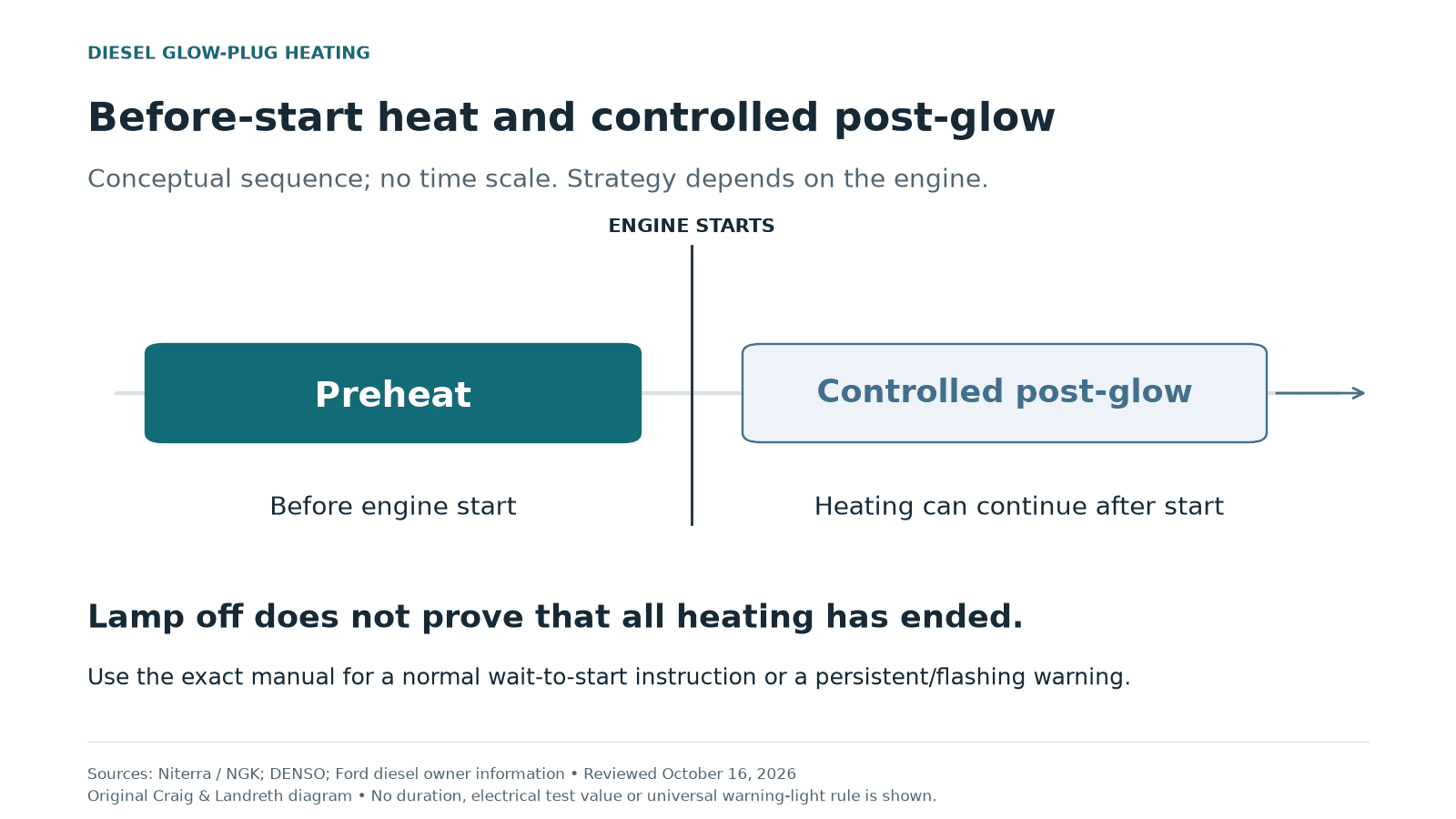
The first useful distinction is between a normal preheating indicator and an abnormal warning. A wait-to-start lamp can be part of the ordinary starting sequence. Its meaning after starting, or when flashing, depends on the vehicle’s manual rather than a universal dashboard rule.
What a glow plug actually does
A diesel relies on heat from compression to ignite fuel. Cold combustion-chamber surfaces make that process harder, so glow plugs provide additional heat. They are not gasoline spark plugs producing a timed spark for every combustion event.
Niterra’s NGK glow-plug technical guide distinguishes preheating before a start from post-glow after the engine has begun running. Continuing to supply controlled heat can help combustion during warm-up. That explains why the dashboard lamp switching off does not necessarily mean every part of the heating process has ended.
Different engines use different plug designs and control strategies. A plug that fits mechanically is not automatically the correct electrical or thermal specification. The applicable part and test procedure need to match the exact engine.
Read the symptoms as a pattern
| Observation | Useful distinction | What remains unconfirmed |
|---|---|---|
| Hard starting mainly when cold | Temperature is part of the pattern | Whether heat, cranking supply or another engine condition is responsible |
| Uneven running just after starting | Warm-up behavior differs from fully warm operation | Which component, if any, has failed |
| White or blue smoke during a difficult start | Describe when it occurred and whether it cleared | That a particular glow plug caused it |
| Wait-to-start light before cranking | It may be a normal instruction | A fault unless the manual identifies that behavior as abnormal |
| Persistent or flashing warning | Read the exact model’s instruction | A universal “replace all plugs” diagnosis |
The difference between cold and warm behavior helps describe the complaint, but repeated starting attempts are unnecessary to create a demonstration. Note the conditions from normal use and any displayed message. A workshop can then evaluate the starting supply and controlled heating rather than treating one symptom as a parts order.
The cause can extend beyond the plug
DENSO’s 2026 fault-finding guidance explains that plug damage can be associated with electrical control, charging, injection or installation problems. A damaged tip therefore needs interpretation; it is not automatically evidence that an old plug simply wore out.
That distinction changes the repair question. Ask what confirmed the affected circuit and whether the underlying cause was checked. A sound replacement plug can be put at risk if the condition that damaged the original remains. Equally, a supply or control problem should not be described as proof that every plug has failed.
Follow the starting instructions, not an improvised heating test
A Ford diesel owner’s-manual example describes a controller responding to coolant temperature, air temperature and barometric pressure. It also warns against ether starting fluid. The exact instructions for your engine govern its starting sequence; a fixed key-cycling ritual from another vehicle is not a replacement.
NGK also warns against connecting a removed plug to a battery until it visibly glows. It can overheat before that becomes apparent, and some plug types are easily damaged. Leave application-specific electrical testing and difficult removal to the proper procedure rather than using a bright tip as a pass-or-fail test.
0 comment(s) so far on Diesel Glow Plug Symptoms: Hard Starts And Warning Lights