

Water Pump Warning Signs: Leaks, Noise and Overheating
Engine cooling
Updated October 16, 2026
Coolant loss, unusual noise and a rising temperature gauge can raise a water-pump question, but they do not prove the pump has failed. The useful distinction is between a cooling-system symptom and a finding that identifies the component responsible. An overheating warning also changes the immediate decision: follow the vehicle’s stopping instructions rather than continue driving to collect more clues.
Take a temperature warning seriously first
The 2021 gasoline Honda CR-V manual, printed pages 633–634, identifies a high temperature indication, sudden power loss, a stop-driving temperature message, and steam or spray as overheating symptoms. It directs the driver to park safely. It also warns against opening the hood while steam is coming out and against removing the hot coolant reservoir cap.
Those warnings are more useful than trying to confirm a water-pump theory at the roadside. Stop safely when directed by the vehicle’s warning or manual, and obtain assistance if you cannot follow its instructions safely. Do not reach into a running engine compartment, open a hot cooling system or restart the engine merely to reproduce a noise. A temperature reading returning to normal does not, by itself, identify or resolve the original cause.
What each clue can—and cannot—tell you
| Observation | Useful evidence to request |
|---|---|
| Coolant level repeatedly falls | Identification of the fluid and the actual leak source, rather than a pump assumption. |
| New noise near the engine | A finding locating the noise and identifying the relevant component. |
| Temperature rises or an overheating message appears | Cooling-system diagnosis after following the vehicle’s immediate safety instructions. |
Record observations you already have: the exact warning, whether coolant has been added, the date and mileage, and any recent cooling-system work. A photograph of a cold reservoir taken without opening it can help document a level, where the reservoir can be observed safely. A puddle location or a noise description remains a starting point, not confirmation that the pump needs replacement.
Overheating has a wider diagnostic path
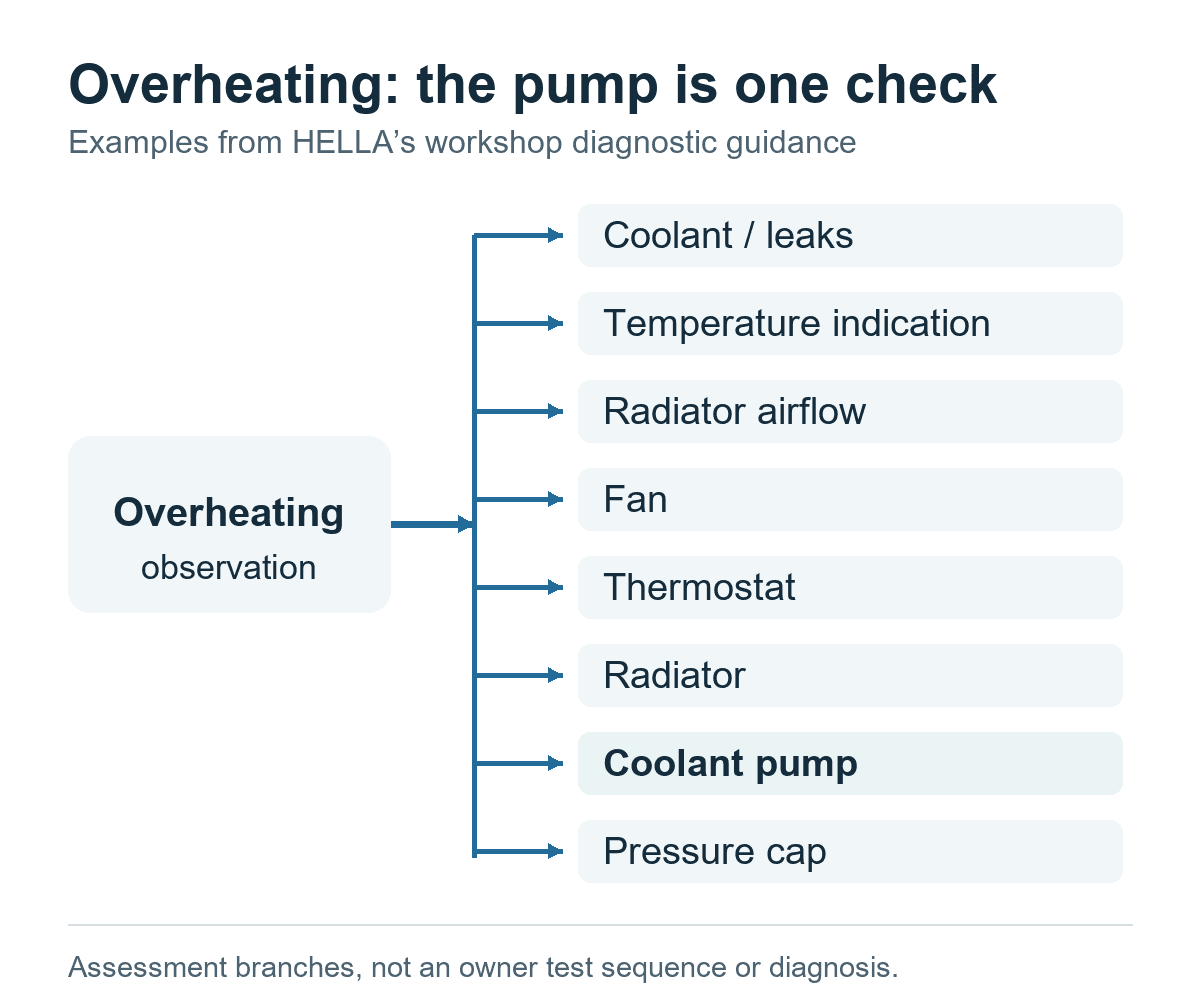
HELLA’s cooling-system diagnostic guidance, written for qualified workshop personnel, starts with coolant level, contamination, antifreeze condition and leaks. Its overheating checks include whether the temperature indication is accurate, whether radiator airflow is obstructed, and whether the fan, thermostat and radiator operate correctly. It also includes checking the coolant pump.
That wider process explains why a temperature symptom is not a pump diagnosis. Ask which findings point to the pump, which other cooling-system checks were relevant, and what was actually found. Do not turn a workshop test list into an owner disassembly procedure. Locating a noise or assessing pump operation requires the correct information and access for the particular vehicle.
Coolant instructions are vehicle-specific
The Honda manual’s coolant section, printed pages 582–583, requires a cool engine and radiator before its level-checking procedure. The 2024 Ford Super Duty manual, printed pages 449–450, likewise warns against opening or adding coolant to a hot system. Ford explains that coolant expands when hot, so a hot level should not be interpreted as though it were a cold reading.
Ford also calls for coolant meeting the correct specification and warns against stop-leak products and non-specified additives. Use the matching vehicle manual; a color match or an “all makes” label does not establish compliance with its specification. Repeated topping-up is a reason to investigate the cooling system, not a way to demonstrate that the pump is sound.
What a useful repair explanation includes
Before approving a pump replacement, ask for the specific finding, the applicable repair procedure and the reason for any additional recommended work. Keep the confirmed fault separate from scheduled maintenance. Afterward, retain the repair details and the result of the relevant follow-up checks. A replacement invoice records work performed; the documented findings explain why it was needed.
0 comment(s) so far on Water Pump Warning Signs: Leaks, Noise and Overheating