

Mass Airflow Sensor Symptoms: What Confirms a Fault?
Owner Guide
Updated October 16, 2026
A failing mass airflow sensor can cause hesitation, unstable idle or stalling, but those symptoms do not identify the sensor as the cause. The useful question is whether its signal accurately represents the air entering the engine—and whether the intake, electrical supply and related systems have been checked.
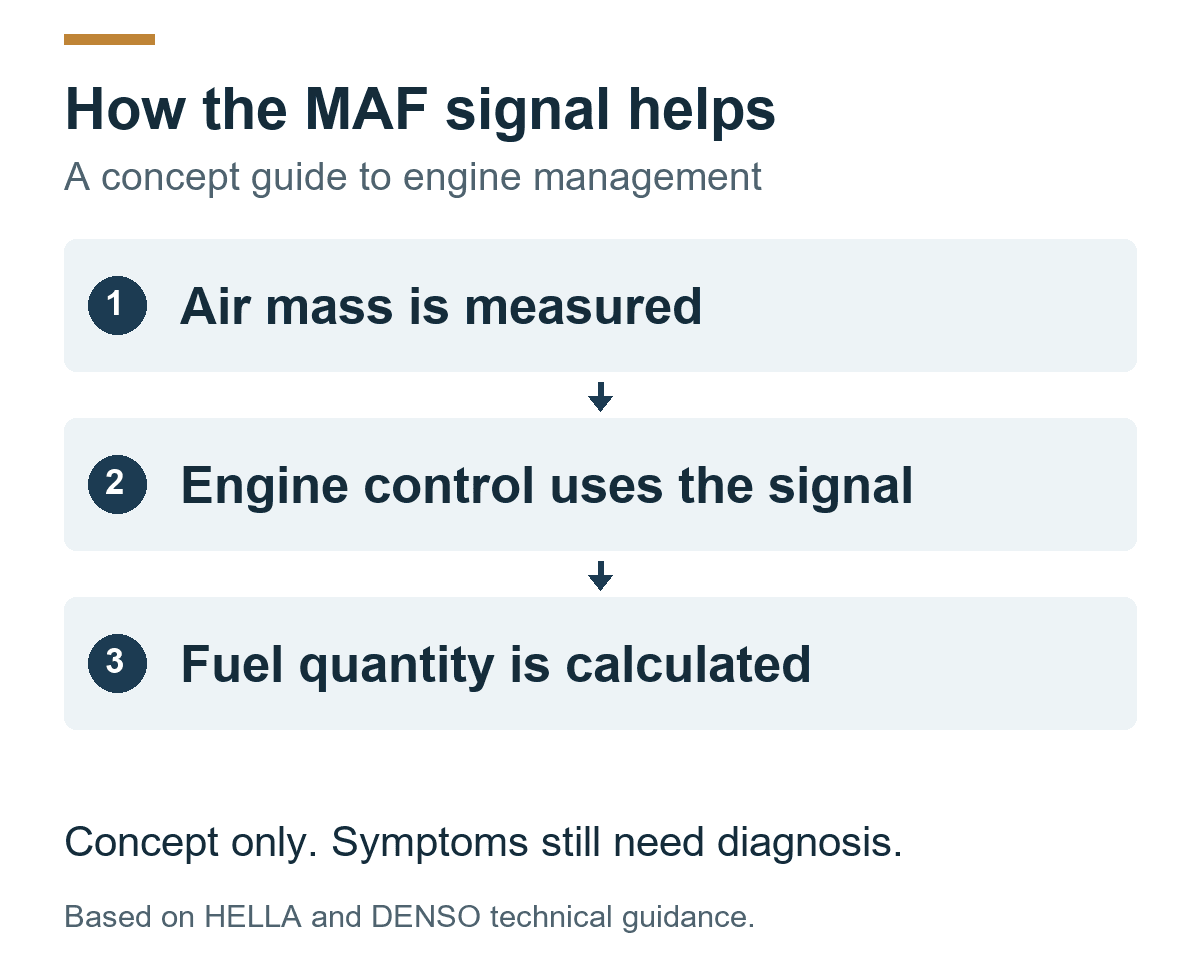
What the airflow signal does
The mass airflow sensor, usually shortened to MAF, supplies an input the engine computer uses when calculating fuel delivery. HELLA describes a heated measuring element whose electrical response changes as air passes it. DENSO describes a plug-in hot-wire design with a small bypass passage. These are explanations of particular sensing designs, not a promise that every engine uses the same arrangement.
This distinction matters when someone suggests a universal cleaning method or a single “good” scan-tool reading. The relevant specification depends on the vehicle and operating conditions. A reading needs context, including the engine speed and the conditions under which it was measured; an isolated number from another engine is a poor basis for buying a replacement.
What symptoms can—and cannot—tell you
DENSO lists difficult starting, unstable idle, hesitation and stalling among possible effects of a contaminated or damaged MAF sensor. It also notes that a clogged sensor passage can cause poor running without necessarily setting a diagnostic code. Neither a warning light nor its absence settles the diagnosis.
Overlapping symptoms are another reason to avoid parts guessing. In the same technical catalog, DENSO describes hesitation and stalling from fuel-pump problems. That does not make a pump the next part to replace: it demonstrates why a symptom list alone cannot distinguish air measurement from fuel delivery.
What a useful diagnosis establishes
| Area | Evidence worth asking for |
|---|---|
| Sensor and electrical circuit | Connector condition, power supply and wiring checks against the vehicle’s specifications. |
| Air intake | Filter installation, intake sealing and evidence of contamination or damage. |
| Electronic diagnosis | Stored faults and the operating conditions associated with the suspect signal. |
HELLA’s workshop procedure includes checking the connector, measuring elements, supply voltage and wiring before electronic diagnosis. DENSO calls for checking the intake system for leaks and ensuring that the filter is installed correctly. Those checks address different failure paths. A new sensor does not repair a damaged connector, an incorrectly fitted filter or an intake leak.
A useful repair explanation should identify which of those checks failed and what specification was used. Ask whether the recommendation addresses a measured sensor fault, damage to its connections or a separate intake problem; those findings do not all call for the same repair.
For an owner, the most useful preparation is specific observation: did the problem begin after air-filter work, occur immediately after starting, or appear during acceleration? Report what happened during ordinary use. There is no need to unplug the sensor, disturb the intake or recreate a stall on the road to provide a useful history.
Cleaning is not a universal repair
DENSO warns that cleaning a contaminated sensor may offer only a temporary improvement and can damage its delicate hardware. That is a good reason to avoid treating spray cleaner as routine maintenance. The exact vehicle procedure and confirmed fault should determine whether any cleaning is appropriate or whether replacement is required.
If a warning flashes or the engine runs severely unevenly, consult the vehicle’s warning instructions rather than continuing a home experiment. Ford’s 2024 Super Duty manual, for example, treats a flashing malfunction indicator as a possible misfire requiring immediate attention. That warning does not identify the MAF sensor; it changes the urgency of the overall engine problem.
0 comment(s) so far on Mass Airflow Sensor Symptoms: What Confirms a Fault?