

Lug Nut Torque After Tire Service: Why Recheck Matters
Wheel installation
Wheel fasteners need the correct tightening specification, clean mating surfaces and the proper installation procedure. “Tight” by feel is not a measurement. After wheel removal, follow the vehicle and wheel manufacturer’s instructions for a torque recheck rather than assuming every car uses the same value or return interval.
Updated October 16, 2026
A new wobble or strong vibration after wheel work deserves a safe stop and a check before further driving. Waiting for a scheduled recheck is not appropriate when the wheel already feels wrong.
Torque and clamping are related, but different
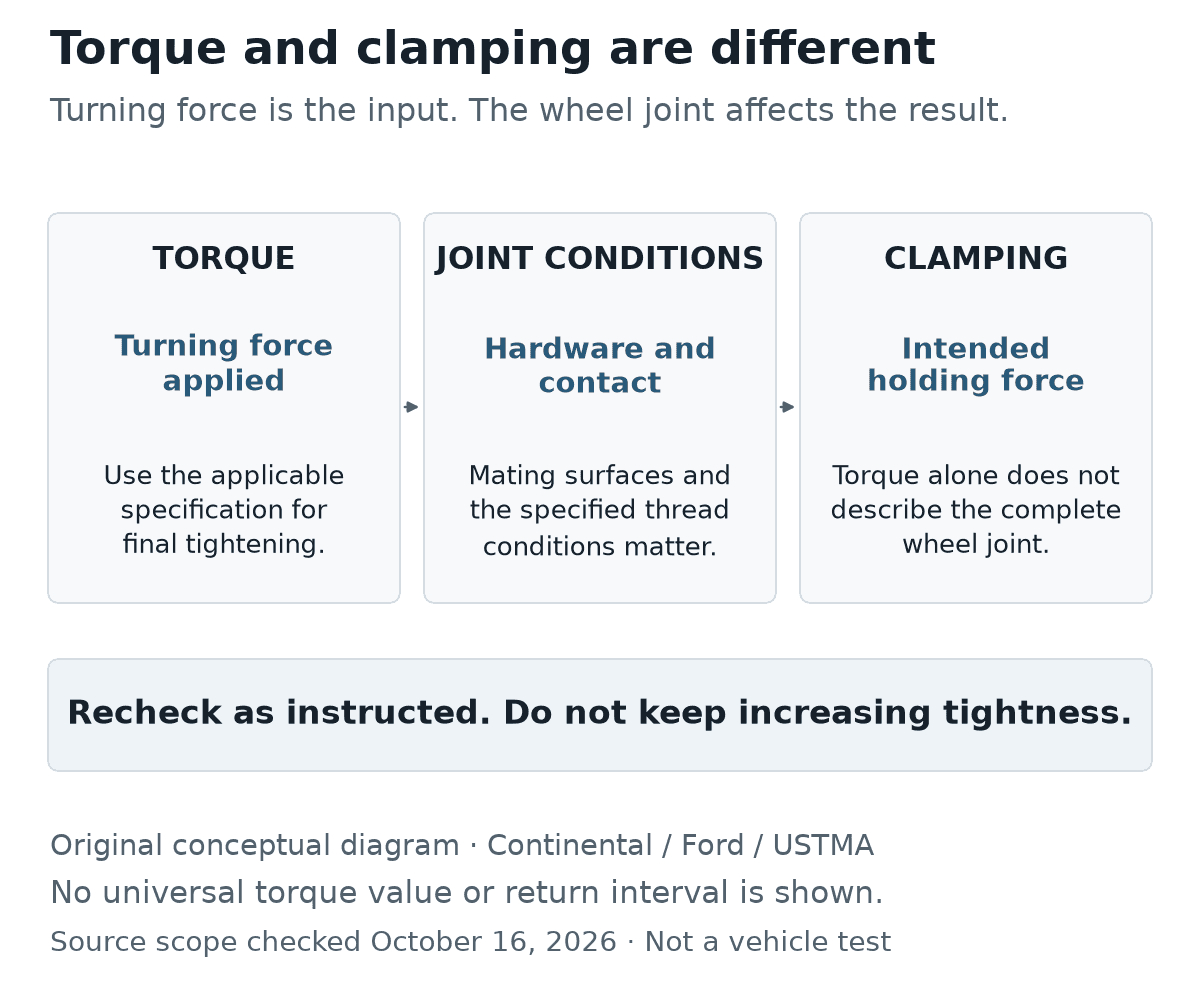
Torque describes the turning force applied to the fastener. The intended result is clamping the wheel securely against its mounting surface. Friction and the condition of the joint affect that result, which is why the specification comes with an installation procedure.
Continental’s wheel-fastener guidance explains that dirt, rust or grit can produce resistance during tightening without producing the intended clamping force. More force is not a substitute for a properly seated wheel.
A Ford wheel-installation instruction similarly emphasizes removing contamination from the contact surfaces. It warns that a wheel installed without correct metal-to-metal contact can loosen. That is an example of the underlying requirement, not a torque value to transfer to another vehicle.
Both too little and too much can cause trouble
Insufficient tightening can allow movement and loosening. Excessive tightening can damage threads, studs or the wheel. A larger impact tool, extra leverage or another pull after the specified torque is reached does not establish a safer installation.
Hardware also has to match the application. Replacement wheels or fasteners should not be treated as interchangeable merely because the bolt pattern fits. Use the actual vehicle and wheel instructions for the fastener type, seating arrangement and tightening specification.
Follow any stated conditions for the threads and contact surfaces. Adding oil, grease or another product to make tightening easier can change the conditions assumed by a specification. Do not apply a value intended for a different installation state without the manufacturer’s procedure.
What a recheck is meant to do
A recheck confirms the fasteners remain at the specified torque after the interval required for that application. It is not an instruction to keep making them progressively tighter. Continental explains that the assembly can settle after installation, which is one reason a follow-up check can be specified.
Intervals are not universal. The cited Ford instruction includes its own return distance and an additional requirement for dual-rear-wheel vehicles. Continental’s general guidance uses a different distance. Use the applicable vehicle and wheel procedure rather than combining those examples into a rule for every car.
A tire rotation, brake job, flat-tire change or suspension repair may involve removing a wheel even when no new tire is purchased. Ask for the relevant follow-up instruction whenever the wheel has been removed.
Make the handover specific
The U.S. Tire Manufacturers Association’s service guide calls for the exact specification and a torque wrench for final tightening. The procedure should establish a measured result, not simply that an impact tool was used.
Before leaving, establish which tightening specification was used, how final torque was verified and whether a recheck is required. Have any return distance or date written down. Do not assume a follow-up will be free or available at every shop because a general tire article describes it that way.
If a fastener is damaged, missing or will not hold the specified tightening condition, that needs correction rather than another recheck alone. Likewise, repeated loosening needs the wheel, mating surfaces and hardware assessed. A completed torque check documents one step in the process; it does not certify the tires, brakes or alignment.
0 comment(s) so far on Lug Nut Torque After Tire Service: Why Recheck Matters