

Headlight Restoration vs. Replacement: What Each Addresses
Lighting Decisions
Updated October 16, 2026
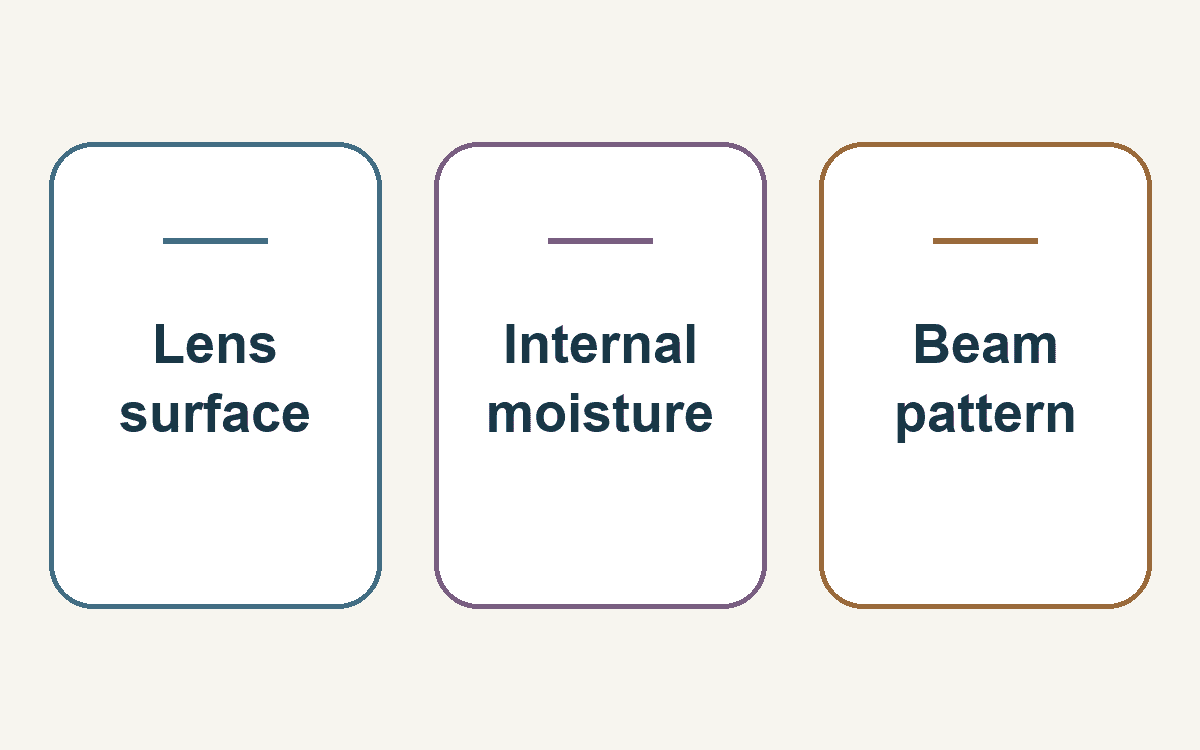
Establish whether the concern is the outside lens surface, moisture inside the lamp or the lighting system itself. Appearance alone cannot establish the beam’s performance.
What lens restoration can change
AAA’s December 2018 headlamp study describes ultraviolet damage to plastic lenses’ protective coating. Restoration treats that surface; ask what protective finish follows and what supports any lifespan claim.
AAA tested driver-side assemblies for two 2007 sedans, the Chevrolet Malibu and Nissan Altima, using new bulbs. Restoration improved output in that limited sample; OEM replacements performed best against the tested intensity limits. These findings do not predict every product’s result.
Mist inside the lamp is a separate question
HELLA’s condensation guidance describes ventilation that lets lamps exchange air. Changing temperature and humidity can produce temporary mist. Persistent condensation or accumulated water instead calls for investigation of cover caps, ventilation, lens damage and electrical connections.
Outside polishing does not address internal water. Conversely, fine mist alone does not establish a failed assembly. Ask which condition was actually found.
| Observed concern | Question for the evaluation |
|---|---|
| Clouding on the exterior lens | Is the surface the problem, and what protective treatment is included? |
| Persistent internal moisture or collected water | Which cap, vent, lens or connection finding explains the moisture? |
| Poor illumination with a clear cover | Have the light source, electrical operation and beam aim been evaluated separately? |
Judge the beam as well as the cover
The Insurance Institute for Highway Safety considers both useful illumination and glare. Its ratings are technology-neutral: halogen, HID or LED labeling does not by itself guarantee good performance. A lamp can provide inadequate visibility and excessive glare at the same time.
A brighter-looking patch of light cannot establish a better repair. Ask for a professional evaluation of beam distribution and aim alongside the cosmetic result.
Compare quotes for the same work
A useful estimate distinguishes surface restoration, a light-source repair and replacement of the complete assembly. For restoration, identify the process and protective finish. For replacement, identify the exact assembly and vehicle application, what components are included and whether the estimate includes the applicable installation and aim checks.
Also ask what evidence supports the recommendation: exterior deterioration, a documented moisture fault, an inoperative light source or a beam problem. These findings can require different work. A price for polishing and a price for a complete lamp are not competing solutions unless both address the condition actually found.
0 comment(s) so far on Headlight Restoration vs. Replacement: What Each Addresses