

Blower Motor Not Working: Fan Speed And HVAC Clues
Cabin climate systems
The cabin blower moves air. Heating, cooling and directing that air involve other parts of the climate system. That distinction is the starting point when the vents go quiet, only one fan setting works, or a strong stream of air comes out at the wrong temperature.
Updated October 16, 2026
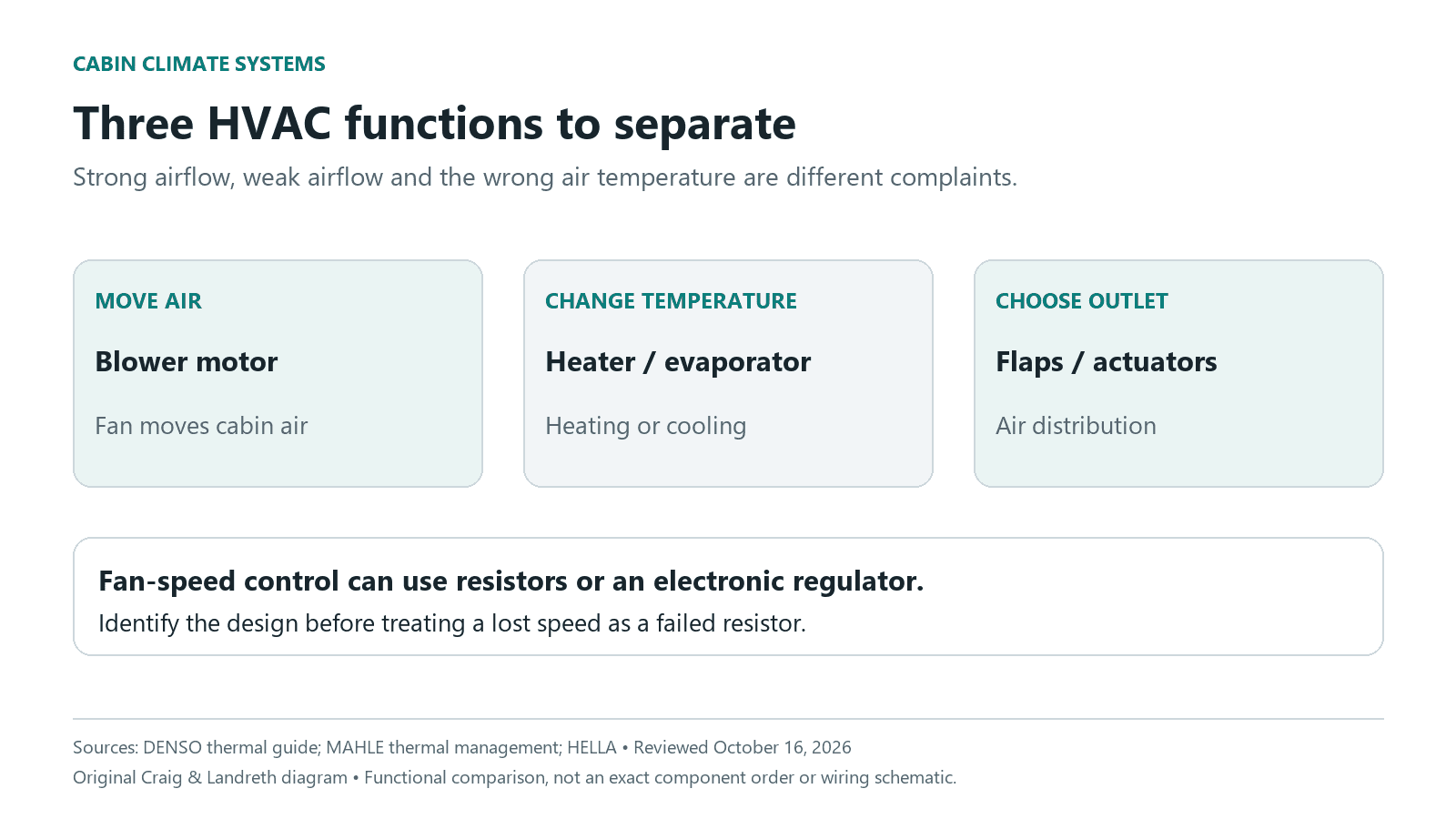
Three different jobs behind the dashboard
A blower motor turns a fan to push air through the ventilation system. In a conventional engine-coolant heater, the heater core transfers heat from hot coolant into that air. For air conditioning, the evaporator takes heat out of the air as refrigerant passes through it. DENSO’s thermal-system guide describes those components separately, along with actuators that direct air toward the selected outlets.
A strong flow that never becomes cool is therefore different from no airflow at all. Likewise, a fan that can be heard while air comes from an unexpected outlet calls attention to distribution. Treating all three complaints as a failed blower motor skips the useful distinction between moving air, changing its temperature and routing it.
Why losing fan speeds does not always mean a resistor
Older-style stepped controls can use resistors to provide different motor speeds. Other systems use an electronic controller with a pulse-width-modulated signal to vary output. MAHLE describes both arrangements, including resistor units with thermal protection and electronic units used for variable fan control. The correct part and electrical tests depend on which design the vehicle actually uses.
This is why “works only on high” can be a helpful description without being a parts order. A resistor-equipped circuit and an electronically regulated circuit do not necessarily fail in the same way. A controller also needs an appropriate command and electrical supply; the dashboard setting alone does not show what reached the motor.
| Cabin symptom | Separate these questions |
|---|---|
| No airflow at any requested speed | Is the motor being commanded and supplied correctly, and can it turn? |
| Only some speeds respond | Which type of speed control does this vehicle use? |
| Fan sound changes, but airflow remains weak | Is air being restricted or routed elsewhere? |
| Airflow is strong but too warm or too cool | Is the temperature-producing or air-mixing side working? |
What automatic climate control changes
On an automatic system, the selected cabin temperature is a target, rather than an instruction to hold one fan speed forever. HELLA’s regulator explanation describes commands from the climate-control unit and feedback involving interior temperature sensors. The regulator adjusts the motor’s electrical output to change airflow.
HELLA lists loss of speed control and continuous blower operation among possible regulator faults. They remain symptoms to investigate, rather than proof that the regulator alone is faulty. When describing the problem, distinguish an unexpected change in automatic mode from a fan that ignores a manual speed selection. That gives the complaint a precise meaning without assuming every automatic adjustment is a failure.
Weak airflow deserves its own check
A motor can turn while less air reaches the occupants. A HELLA heating-system checklist includes the cabin filter, air ducts and flap positions, as well as blower noise and fan levels. Those checks are especially useful when the change is gradual or only certain outlets seem affected. Filter access and replacement instructions vary; avoid forcing apart dashboard trim based on another model’s video.
Keep fingers and loose objects out of fan openings, and do not bypass a resistor’s thermal protection or substitute a larger fuse. Restoring the correct circuit matters as much as getting the fan to run. If the windshield cannot be kept clear of mist, address that loss of visibility before driving; cabin airflow is part of defogging, not simply a comfort feature.
0 comment(s) so far on Blower Motor Not Working: Fan Speed And HVAC Clues