

White Exhaust: Condensation, Coolant and Warning Signs
Owner Guide
White-looking exhaust can be condensed water or a symptom requiring investigation. Color alone cannot identify a failed head gasket, and a brief cloud does not establish that a vehicle is safe to drive. The useful distinctions are the conditions, other symptoms and the exact engine.
Updated October 16, 2026
Cold-weather vapor needs context
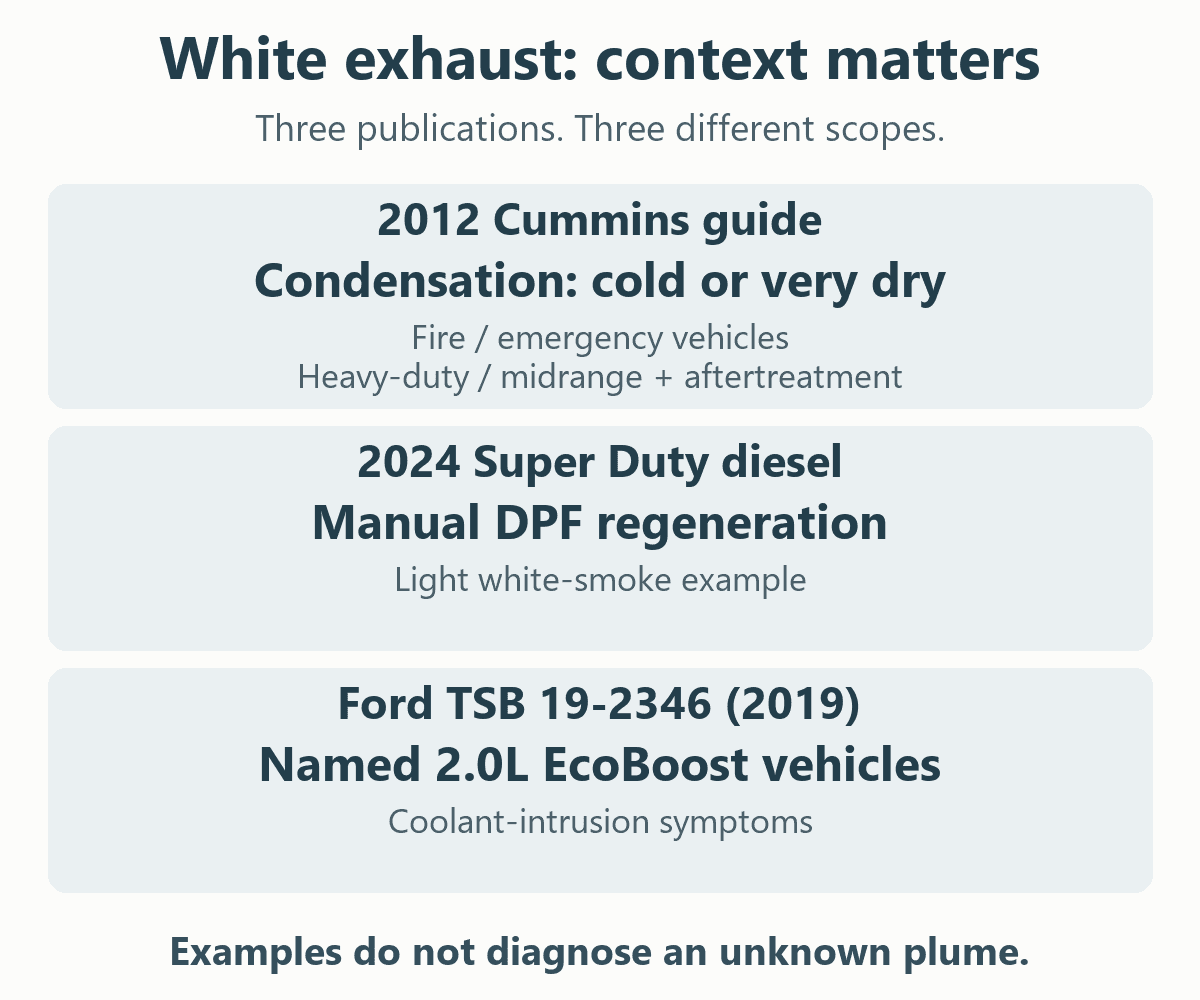
Condensation can produce a visible pale plume. Cummins’ guidance for fire and emergency vehicles with heavy-duty or midrange engines and aftertreatment describes visible water vapor under cold or very dry conditions. Its July 2012 revision says that effect clears after a few minutes of normal operation. That is a documented example, not a universal countdown for every gasoline car, hybrid or diesel.
A cloud that was brief and weather-dependent is different information from one that continued during an already-observed warm-engine journey. Neither observation identifies the fluid or failed component. Do not idle, rev or take a demonstration drive to see whether the exhaust clears. Record what already happened rather than extending engine operation to satisfy a time threshold.
Coolant-related symptoms deserve a precise diagnosis
Coolant intrusion is one possible explanation, supported in specific manufacturer records. Ford’s December 19, 2019 bulletin 19-2346 includes 2015–2018 Edge vehicles with the 2.0-liter EcoBoost engine. It describes low coolant, white exhaust and/or rough running, with or without a malfunction indicator, as symptoms that may involve coolant entering a cylinder.
The bulletin also covers other specified Ford and Lincoln applications with their own model and build-date criteria. It is not a diagnosis for every white plume or a promise of a particular repair, current warranty coverage or parts availability. A technician needs the engine identity, applicable service information and evidence of the actual fault before a component recommendation is meaningful.
A diesel example shows why operating mode matters
The 2024 U.S./Canada Super Duty manual, printed page 218, says a small amount of white smoke may occur during manual diesel particulate-filter regeneration. It also warns of burn hazards at the tailpipe. This narrowly defined operating condition cannot explain an unknown plume on another vehicle. It is not a reason to start regeneration as a diagnostic experiment or to assume that persistent exhaust is harmless.
| Information already available | What it helps distinguish |
|---|---|
| Cold or dry weather; brief tailpipe cloud | Possible condensation context, not a timed safety clearance. |
| Continuing plume with coolant loss or rough running | A combination to report for engine-specific investigation, not proof of a head-gasket failure. |
| Temperature warning or fumes inside the cabin | A safety response takes priority over classifying the plume. |
Overheating and exhaust exposure change the response
Follow the exact vehicle’s temperature-warning instructions and stop safely when directed. In its fail-safe-cooling section, the Super Duty manual limits operation to reaching a safe resting place and calls for prompt repair. That feature does not authorize a trip to see whether smoke disappears. Do not open a coolant pressure cap while the engine is running or the system is hot; pressurized steam and liquid can cause burns.
The CDC explains that carbon monoxide is invisible and odorless and is present in fuel-burning vehicle fumes. Never use the appearance or absence of a white cloud to assess that risk. Do not run a vehicle in an attached garage, even with its door open, or deliberately smell the tailpipe. Ford’s manual also warns against driving when exhaust fumes are noticed inside the vehicle and calls for immediate inspection.
Bring the circumstances, not a guessed repair
Useful notes identify the model year, engine and fuel type, where the cloud originated, weather, warning messages and any coolant loss already documented under the manual’s cold-system conditions. Include rough running or power loss that occurred. These details help a professional evaluate the concern without asking an owner to reproduce a potentially harmful condition.
0 comment(s) so far on White Exhaust: Condensation, Coolant and Warning Signs