

Transmission Fluid Leak: Color And Location Clues
Fluid leaks
A reddish or brown stain beneath a car can help describe a leak, but it does not identify the fluid or the failed part. Before calling it a transmission leak, establish which fluid is escaping, where it starts and whether the transmission’s level or operation is affected.
Updated October 16, 2026
A small stain is also different from fluid actively running out. If a leak accompanies loss of drive, slipping, a transmission-temperature warning or smoke, stop safely and obtain instructions before continuing. Do not use a guessed top-up amount to decide that the vehicle can make another trip.
Color is evidence, not a diagnosis
Photograph a fresh stain on a clean, light-colored surface if this can be done without reaching beneath the vehicle. Record where the car was parked and which way it faced. That preserves a useful observation without requiring contact with an unidentified fluid or hot components.
Color should not become a shortcut to an internal-damage diagnosis either. GM’s September 2025 technician guidance explains that fluid in specified automatic-transmission applications can appear red, brown or black. It explicitly says not to replace the transmission or its fluid solely because of appearance. That is scoped guidance for the listed GM applications, not a declaration that dark fluid in every vehicle is healthy.
A stain’s position is another clue rather than a parts diagram. The important inspection finding is the source of fresh leakage. A wet area around the transmission should not automatically become a recommendation to replace its pan, a seal or the whole unit without tracing the fluid.
A missing dipstick does not mean a leak can be ignored
Fluid-level procedures differ. One Ford owner-manual example specifies no transmission dipstick and directs owners to obtain a check when there are signs of leakage, slipping or slow shifts. That design does not turn a fluid loss into normal consumption.
Use the procedure for the actual model, transmission and fluid. Do not remove an unidentified plug to see what comes out. A fill opening, drain and level-check arrangement are not interchangeable, and the correct check can require specified conditions rather than a cold visual estimate.
ZF’s automatic-transmission service information emphasizes both the specified oil and exact filling procedure. It warns that too little oil can damage the transmission and too much can escape when heated. Those instructions explain why adding extra “for safety” is not a solution.
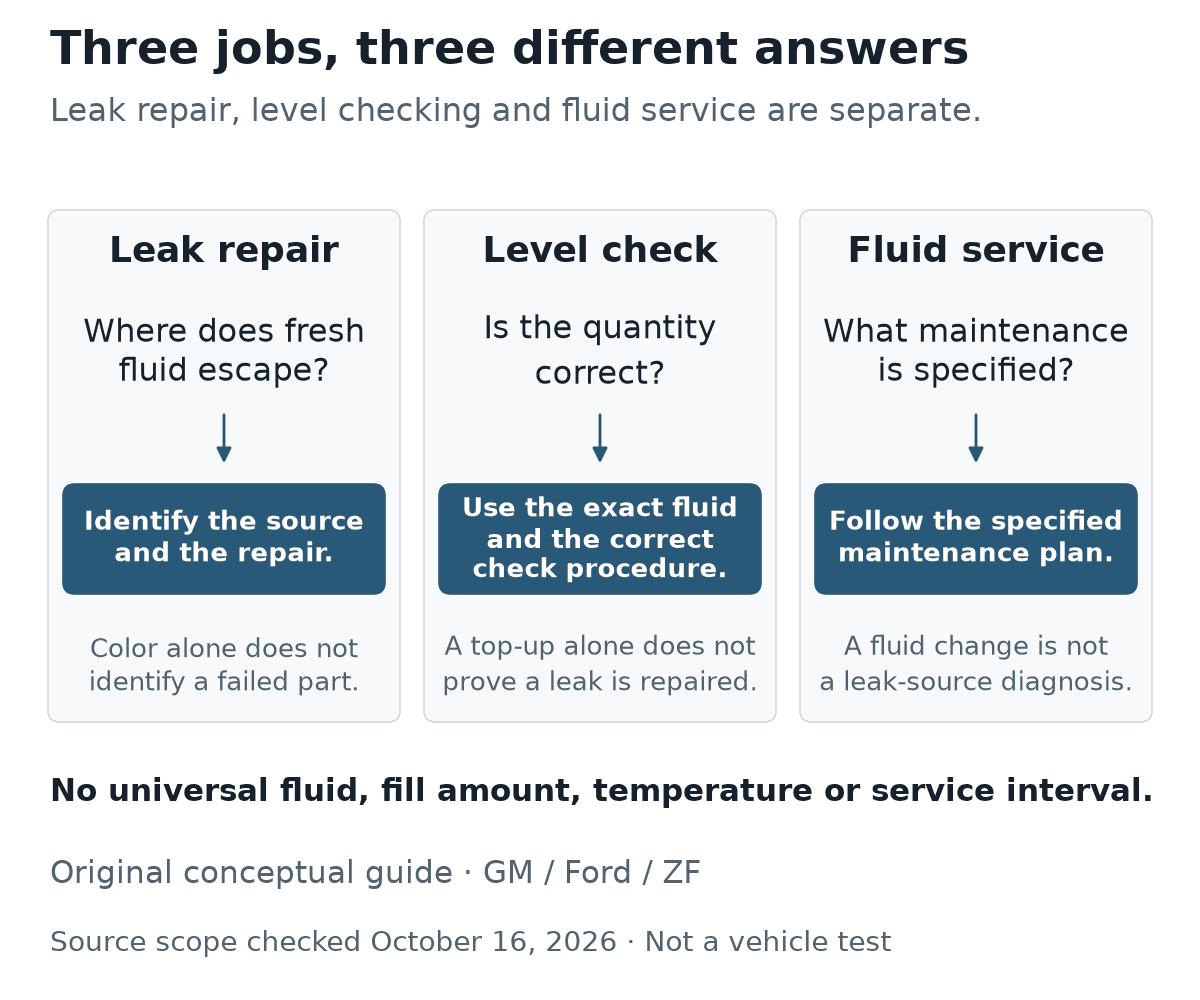
Separate leak repair from a fluid service
A leak needs a source and a repair plan. A scheduled fluid change answers a different maintenance question. Neither a flush nor a bottle of treatment should be substituted for identifying where fluid is escaping. The Ford example and ZF instructions both caution against unapproved supplemental additives.
If the leak started after work, provide the invoice and timing. That gives the technician a specific area and procedure to review without proving who caused the leak. The result should identify the fluid, the leaking component or joint, the applicable level check and whether shifting concerns require further diagnosis.
Confirm what changed after the repair
Ask for the fluid specification and the work performed to be recorded, along with any unresolved findings. A top-up restores quantity only if it follows the proper procedure; it does not demonstrate that leakage has stopped.
The follow-up should distinguish old residue from fresh leakage and confirm the level and operation under the applicable service instructions. That is a more useful outcome than a color label or a blanket recommendation for a replacement transmission.
0 comment(s) so far on Transmission Fluid Leak: Color And Location Clues