

Low Tire Pressure Light: Readings and Warning Response
Tire pressure
Updated October 16, 2026
A low-pressure warning calls for pressure readings, not reassurance from how the car feels. Record the light’s pattern and any message, then use the instructions for the actual vehicle. A warning lamp is not a gauge, and its going out does not document that every tire has the prescribed cold pressure.
Stop and check against the vehicle’s specification
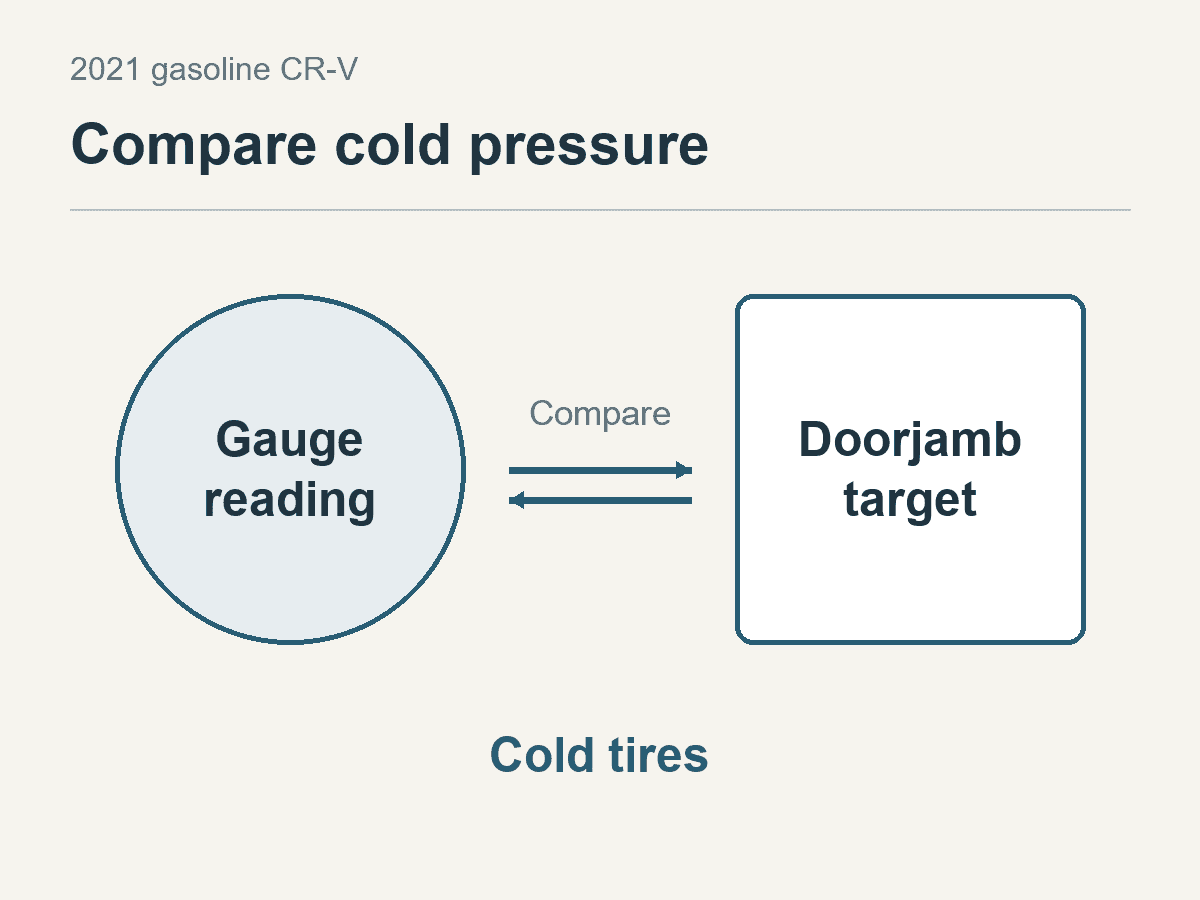
The 2021 gasoline Honda CR-V manual directs the driver to stop in a safe place when its low-pressure indicator comes on, check the tires and adjust pressure to the specified level on the driver’s doorjamb label. Its warning also explains that severe underinflation can overheat a tire and lead to failure. This is not a finding that a particular tire can be driven farther.
Honda defines a cold reading for that model as one taken after at least three hours parked or less than one mile of driving. It recommends a gauge check of all tires, including the spare. Record whether a reading was cold; a reading after a journey is different information. Do not treat the car’s appearance as a pressure measurement.
The sidewall maximum is not the vehicle’s target
The 2024 Ford Super Duty manual distinguishes the tire maker’s maximum sidewall pressure from the vehicle maker’s recommended cold inflation pressure. Ford points owners to the applicable certification or tire label on the door area. The correct specification can depend on tire position and configuration; a familiar PSI number from another car is not the reference for this one.
Ford also says its equipped monitoring system does not replace manual gauge checks. Underinflation may not yet be sufficient to trigger the lamp. A large outside-temperature drop can activate a low-pressure warning, but that does not establish why one tire lost pressure or show that no damage is present.
Keep the readings and the warning together
Useful notes are the measured pressure at each position, the matching label specification, when the measurement was taken and the exact warning or message. If someone else checked or inflated the tires, ask for those readings rather than only “the light was cleared.” A tire that looks visibly low or damaged needs attention without an attempt to reproduce the concern on the road.
If the concern returns, bring the earlier readings and any recent tire-work record to the service provider. Ask what inspection established the source of pressure loss and whether the tire’s condition requires further action. A weather explanation alone is not a documented leak or condition assessment.
Flashing followed by a steady lamp can involve the monitoring system rather than only pressure. Preserve that pattern for the service provider, while still arranging an actual pressure check. A reset, a period of driving or a lamp that later disappears should not be used as the proof that a tire is properly inflated.
0 comment(s) so far on Low Tire Pressure Light: Readings and Warning Response