

Coolant Leak Signs: Puddles, Levels and Overheating
Engine cooling
Updated October 16, 2026
A falling coolant level, a new puddle or an overheating warning deserves attention, but those observations answer different questions. A puddle does not identify the fluid or the failed part. Overheating does not, by itself, prove a leak. Start with the warning displayed and what can be observed safely with the engine cold.
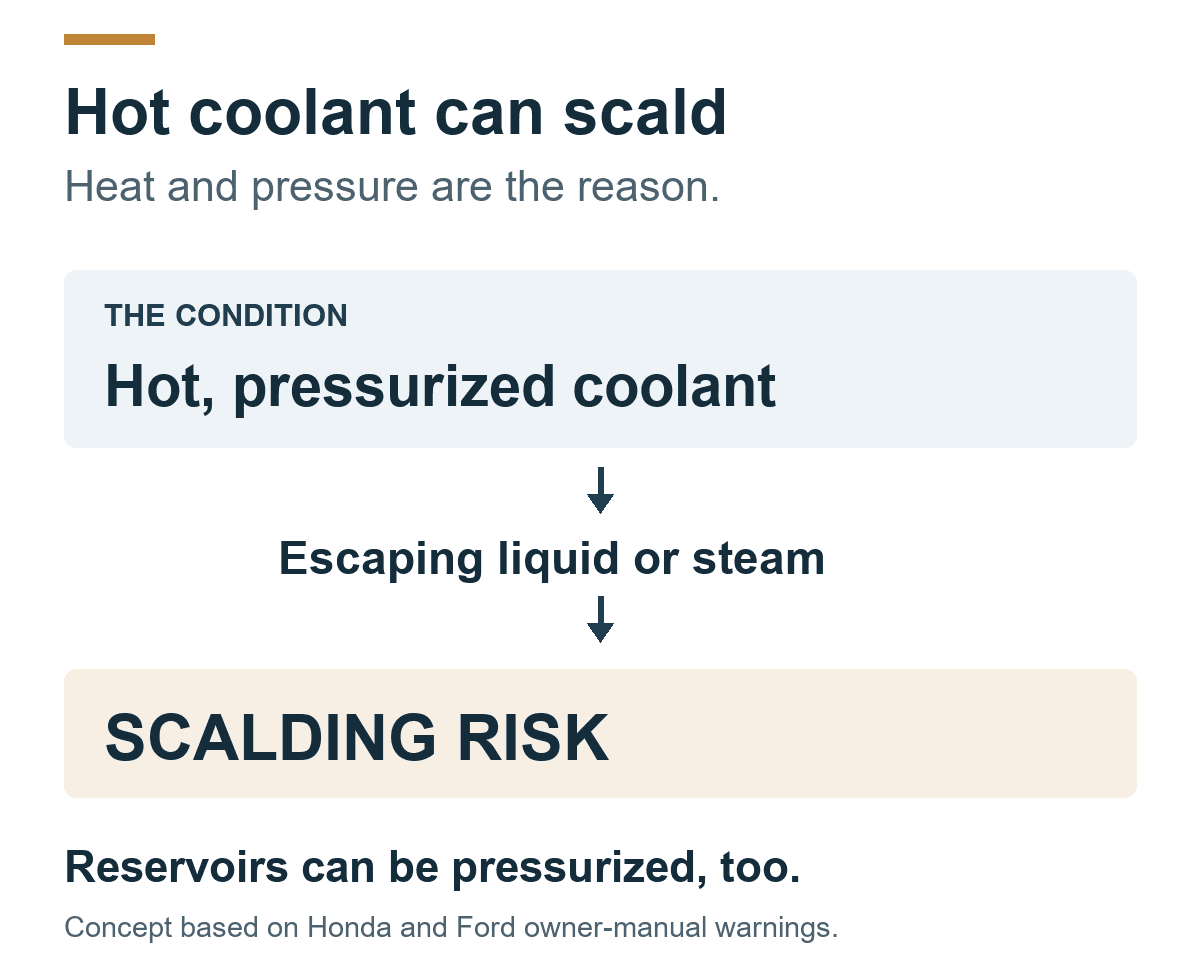
An overheating warning takes priority
If an overheating warning appears, stop as safely as conditions allow and follow the instructions for that vehicle. Do not keep driving to see whether it clears. The 2021 gasoline Honda CR-V manual, for example, identifies a high temperature indication, sudden power loss and steam or spray as overheating symptoms. It warns against opening the hood while steam is coming out.
Do not loosen a hot cooling-system cap or lean over escaping steam. A reservoir can be pressurized too; its plastic appearance does not make it safe to open. If the leak, warning or steam prevents a safe check, arrange assistance. A cooler gauge afterward is not evidence that the original coolant loss has been repaired.
| Observation | Useful information | Still unresolved |
|---|---|---|
| Puddle beneath the parked car | Location, appearance and when it was noticed | Which fluid it is and where it escaped |
| Reservoir level falls between cold checks | Dates, level photographs and any fluid added | Source and extent of the coolant loss |
| Temperature warning or steam | Exact message and circumstances | Cause of overheating and any resulting damage |
| Cabin heat changes | Whether airflow, warmth or both changed | Cooling-system concern versus a separate heater-control issue |
Compare levels under the conditions the manual specifies
A level comparison needs a consistent reference. The CR-V’s coolant instructions require the engine and radiator to be cool before checking the reserve tank. They also call for a leak inspection. That is a specific model example; use your own manual to identify the correct reservoir and checking conditions.
Where the tank can be read externally, a photograph of its level and markings can preserve the observation without removing a cap. Record any previous top-up: date, amount and the exact product used. A single low reading cannot tell you where coolant went, and an absence of visible drips does not establish that the system is sound. A recurring drop needs investigation rather than a continuing refill routine.
Coolant specification matters more than a color match
The 2024 Ford Super Duty manual explains that coolant expands when hot, so a hot level can extend beyond the maximum mark. Its cold checking instructions help explain why comparing a hot reading with a cold one can be misleading. The manual also warns against mixing coolant types and using products that do not meet Ford’s specification.
Use the exact specification and mixture instructions for the vehicle rather than choosing a bottle because its color resembles a puddle. The Ford manual warns against stop-leak products and unspecified additives. That does not establish an approved repair for another model; it is a reason to check the applicable instructions before adding anything. Topping up changes the level, not the evidence identifying the leak.
A full reservoir does not explain an overheating engine
HELLA’s cooling-system guidance for workshops separates coolant-level and leak checks from temperature indication, radiator airflow, fan operation, thermostat operation and coolant circulation. Those are different diagnostic branches, not a list of parts every overheating car needs.
Its heater guidance also distinguishes coolant warmth from valves, airflow and flap controls. Report a new smell, wet area or change in cabin heat if already noticed, but do not deliberately sniff a fluid or treat that observation as a heater-core diagnosis.
Ask the repair explanation to close the evidence gap
For a suspected leak, ask what confirmed the fluid and the escape point. For overheating without a confirmed leak, ask what finding explains the temperature concern. Keep photographs, warning messages and the invoice together, including the coolant specification used and how the repair was verified. This makes a follow-up more useful than simply noting that the reservoir was filled again.
0 comment(s) so far on Coolant Leak Signs: Puddles, Levels and Overheating