

Car Smells Like Gas: Safety And Diagnostic Tips
Fuel odor and safe inspection
An unexplained gasoline smell in or around a car calls for a safety decision before troubleshooting. Smell alone cannot identify a failed part. If fuel odor persists or a leak is suspected, stop using the vehicle and arrange professional help rather than driving again to see whether it clears.
Updated October 16, 2026
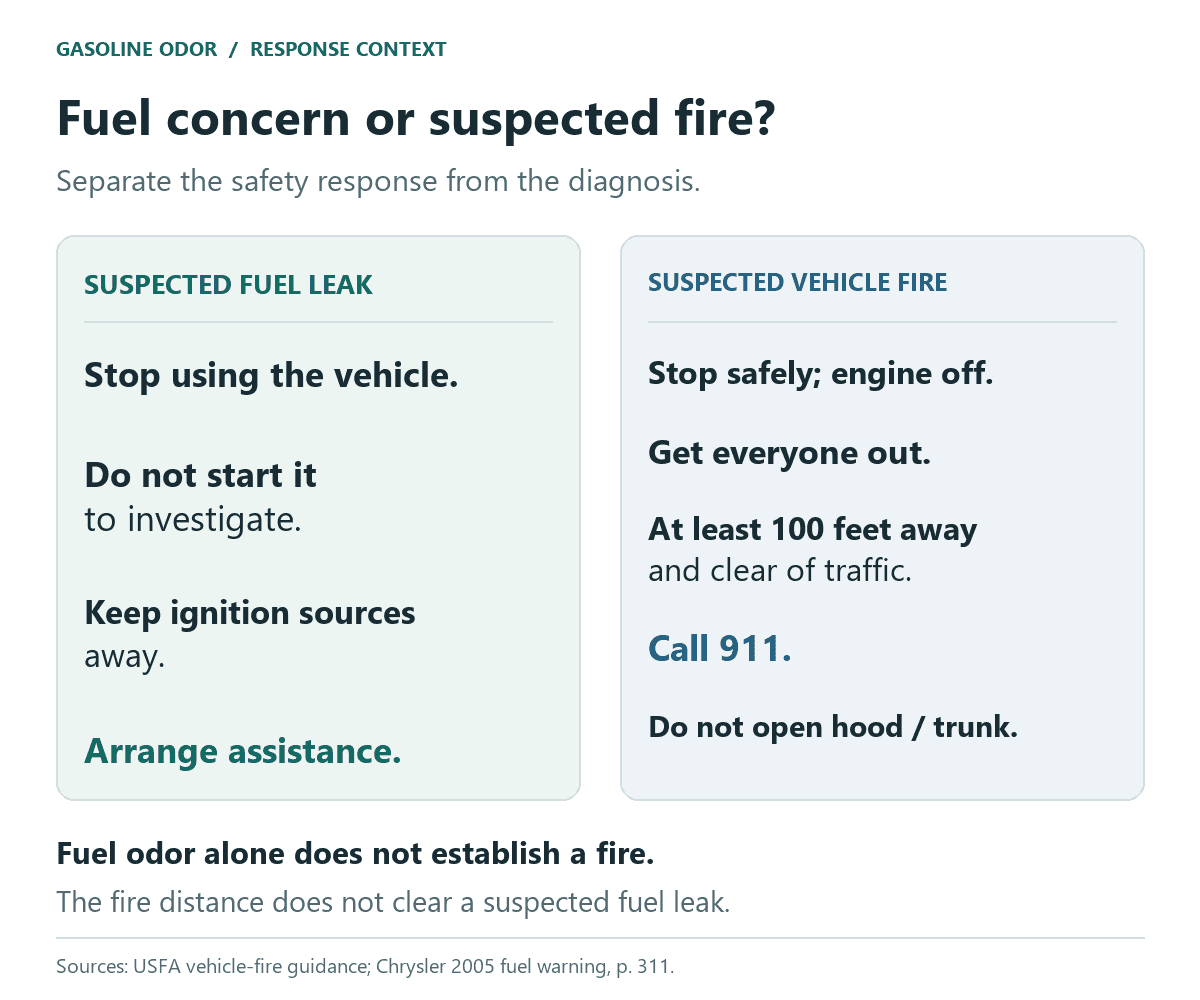
Separate a suspected leak from a vehicle fire
Do not start or restart a vehicle to locate the smell. Keep cigarettes, flames and other ignition sources away. Chrysler’s fuel-system warning in its 2005 Sebring Coupe manual explicitly warns against operating a vehicle when fuel is smelled or a leak is seen because sparks can ignite it. That safety precaution does not diagnose the source in a different vehicle. Tell the roadside-assistance provider about the fuel concern before transport is arranged.
If you think the vehicle is on fire, the U.S. Fire Administration directs drivers to stop safely, switch off the engine and get everyone out. Stay at least 100 feet from the vehicle and away from traffic, then call 911. Do not open the hood or trunk to investigate a suspected fire, return for belongings or attempt to fight it yourself. A gasoline odor does not by itself prove that a fire has started.
After refueling is useful context, not a diagnosis
Tell the inspector if the smell first appeared at the pump, after parking or on an earlier trip. A refueling event can involve displaced vapor or spilled fuel, but timing alone cannot establish that a spill explains an ongoing odor. Do not top off the tank or add more fuel as an experiment.
Ford’s capless-refueling instructions warn that continuing after the nozzle’s first automatic shutoff can fill the tank’s expansion space and lead to overflow. They also warn against prying open the filler valve. This is a manufacturer example, not a universal filler procedure: some vehicles have a removable cap and others do not. Follow the actual vehicle’s instructions; a generic recommendation to tighten a gas cap may not even describe its hardware.
Why no puddle does not clear the fuel system
Gasoline can escape as vapor as well as liquid. The EPA’s evaporative-emissions technical report distinguishes liquid leaks, tank-vapor losses and refueling losses. In many systems, activated charcoal captures vapor from the tank, and the stored vapor is later routed to the engine for combustion. That is the purpose of the evaporative-emissions, or EVAP, system; it is not evidence that a particular canister or valve has failed.
A dry parking space cannot rule out a vapor leak. Conversely, liquid under a car is not identified as gasoline just by its location. Do not touch or closely sniff a wet area, crawl underneath to trace it, disconnect hoses or open fuel-system fittings. Report what was already visible from a safe position and let a qualified inspection establish the material and source.
Give the inspector circumstances, not a replacement-part order
Useful history includes when the odor first appeared, whether it was noticed inside or outside, recent refueling or fuel-system work, and any warning message already displayed. Include whether it occurred while parked or during ordinary driving. These are observations to pass along, not conditions to recreate by idling, switching the ignition on or taking another test drive.
Ask whether the inspection found escaping liquid fuel, a vapor-control problem or another explanation, and what evidence supports that conclusion. The shop should select checks from the service information for the actual vehicle. A cap, injector, hose or EVAP valve should not become the repair merely because its name appears on a list of possible causes.
Before collecting the vehicle, ask what was repaired and how the original fuel-odor concern was checked afterward. If the source remains unconfirmed, the next question is what is needed to resolve it safely—not whether the smell can be tolerated until the next service interval.
0 comment(s) so far on Car Smells Like Gas: Safety And Diagnostic Tips