

Blue Exhaust Smoke: Oil Use and Possible Sources
Exhaust smoke
Updated October 17, 2026
Blue exhaust smoke belongs in the service record alongside oil use and warning messages. It does not, by itself, choose between a ventilation problem, engine wear or a turbocharger fault.
Keep the smoke report and oil record separate
Describe the event already observed: after starting, during a journey or persistently. Bring dated oil-service and top-up records, including odometer readings and quantities if recorded. An oil-consumption assessment needs that history; a smoke description alone does not supply the quantity lost or explain where it went.
GM’s March 2018 PIP5197G illustrates separate PCV, intake non-return-valve and piston-ring-land diagnostic branches on specified LUJ/LUV engines: 2013–2018 Buick Encore, 2011–2016 Chevrolet Cruze, 2012–2018 Sonic and 2013–2018 Trax. Its application and consumption threshold are not standards for every engine.
Ask which exact installed engine code and confirmed finding make the bulletin applicable; it allows different repairs for different findings.
External wetness needs its own finding
An oily housing and smoke from the tailpipe are different observations. GM’s August 2023 leakage bulletin, covering 2024-and-prior GM passenger cars and trucks, distinguishes an exterior film or dirt accumulation from droplets or fluid that has dripped onto another component. It warns that incorrect diagnosis can lead to unnecessary replacement.
Ask the repairer to identify the fluid, its origin and any observed leak path. GM’s examples include residue from assembly with no drips, so a photograph of an oily surface needs that context. Request a distinction between an old stain and fluid currently escaping, rather than a recommendation based only on “oil around the engine.” Keep the exterior finding separate from the exhaust-smoke assessment. The record should say whether the proposed work addresses a film, active leakage or both.
A turbocharged engine has several oil paths
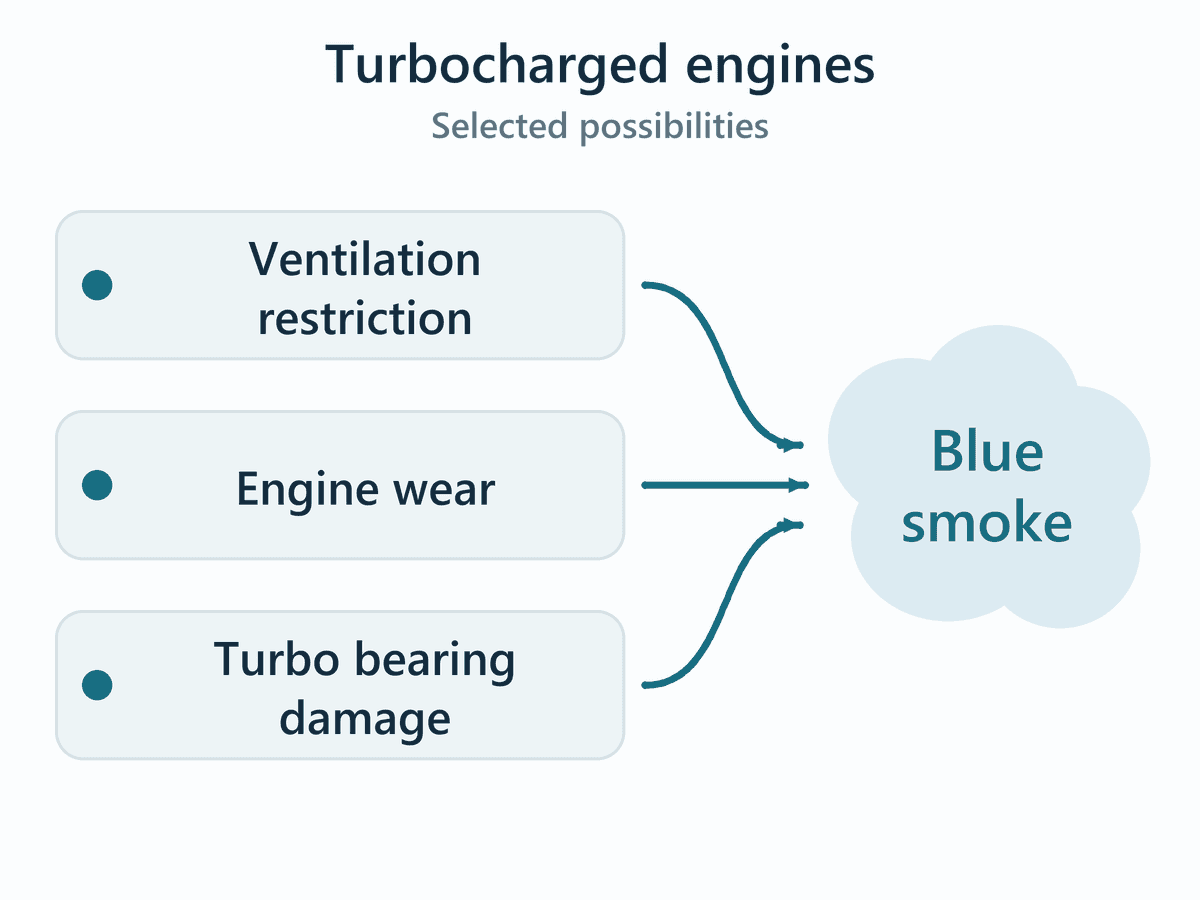
BorgWarner’s troubleshooting matrix lists crankcase ventilation, oil feed/drain lines, sealing and engine wear among explanations for blue smoke or oil consumption. Turbo bearing damage is a possibility, rather than the only answer. BorgWarner cautions that replacing a turbo can miss an underlying engine problem.
A useful turbo recommendation therefore explains what was found at the turbo and what was checked around it. Was the oil supply or return path implicated? Was the ventilation or underlying engine condition relevant? These questions concern the specialist’s findings, not a request for the owner to disconnect lines, accelerate repeatedly or reproduce smoke.
A pressure warning takes priority
The 2021 gasoline CR-V manual directs safe parking and engine shutdown for low oil pressure, warning of rapid mechanical damage. Follow the warning instructions for your vehicle rather than waiting to collect more smoke observations.
Honda’s Maintenance Minder separately reports remaining engine-oil life and due maintenance. The percentage is a maintenance-scheduling display, not a log of the quantity used between services. Keep the top-up dates and amounts separate from that display and the oil-change receipt. None substitutes for responding to the pressure warning. Our oil pressure, oil level and oil life guide explains that distinction. Preserve the exact warning when arranging assistance; the repair finding should address it as well as the original smoke concern. Honda’s oil-check procedure also specifies level ground and a shutdown waiting period; ask how comparable readings actually established the reported oil-use rate.
0 comment(s) so far on Blue Exhaust Smoke: Oil Use and Possible Sources