

Used-Car Service History: What the Records Show
Used-car records
Updated October 16, 2026
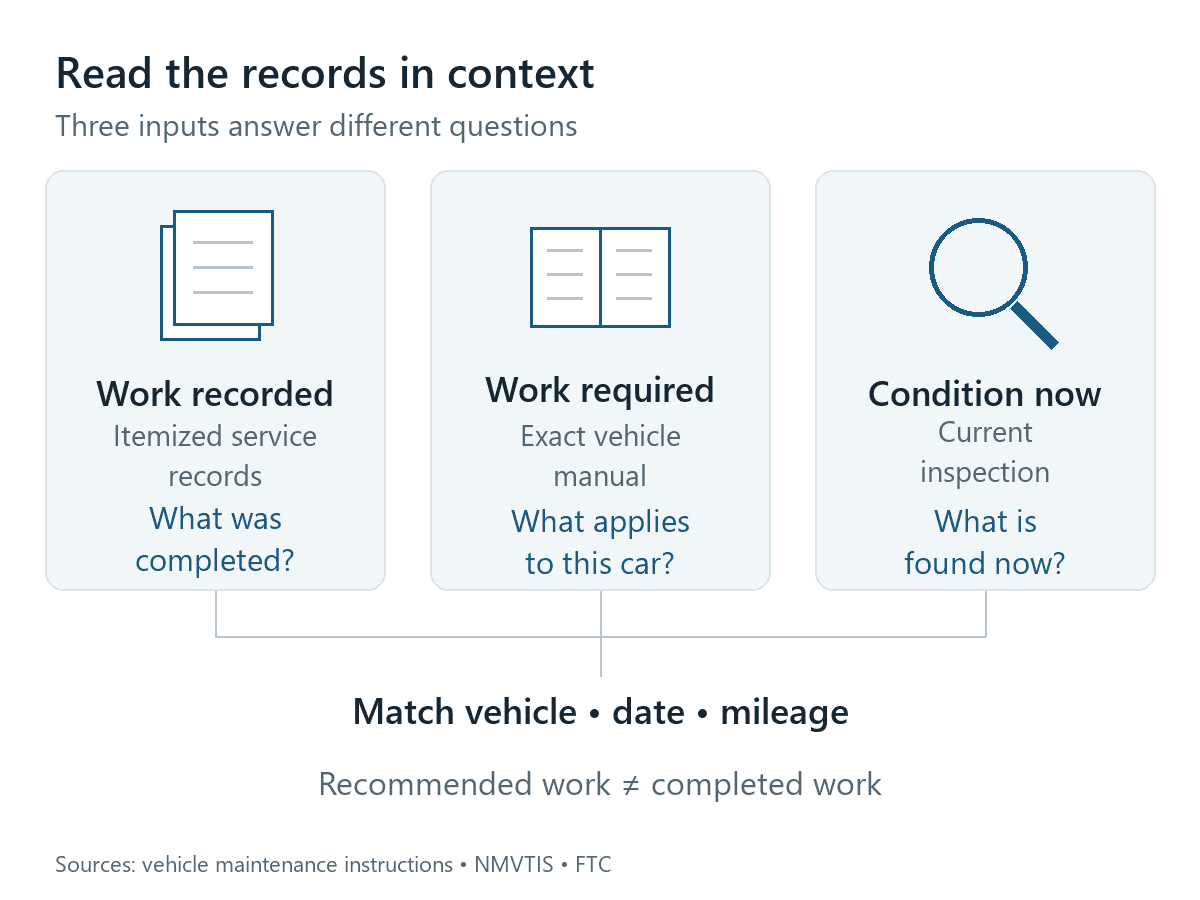
A useful service history says what work was completed, when it happened and which vehicle received it. Its value comes from those details, rather than the thickness of a folder or a long list of “vehicle serviced” entries. Read the records alongside the correct maintenance instructions and a current inspection; none of those replaces the others.
Start with the vehicle and the timeline
Match the VIN on itemized invoices and inspection reports to the car being considered. Arrange the documents by date, then compare their recorded mileages with one another and the current odometer. Keep an unexplained discrepancy as a question for the seller or issuing business; do not silently correct it or assume its cause.
Look for the actual work description. A customer’s complaint, a technician’s finding, a recommended repair and a completed operation are different parts of a repair order. Repeated visits for the same concern deserve a clear explanation of what was found and what changed, rather than an automatic conclusion that the same component failed repeatedly.
Separate completed work from recommendations
| Document or entry | Useful question |
|---|---|
| Itemized service invoice | Which operations and parts are listed as completed? |
| Estimate or inspection recommendation | Is there a later record showing whether the proposed work was done? |
| Short history-report entry | Can the underlying invoice explain what “serviced” means? |
| Recall repair order | Does its VIN and campaign number match the recall being checked? |
A parts receipt can add context, but it does not by itself identify who installed the part, the installation date or the result. Likewise, a recommendation to replace brakes is not the same record as a completed brake replacement. Preserve that distinction when asking about remaining needs.
Compare the work with the exact maintenance instructions
The 2021 gasoline Honda CR-V manual provides a useful example. Its U.S. Maintenance Minder item A calls for engine oil; item B includes oil and filter replacement plus specified inspections. Tire rotation is a separate numbered item. A generic “oil service” description therefore cannot establish that every listed inspection or additional item was completed.
That example is not a schedule for every Honda or another make. Use the instructions for the actual year, engine, drivetrain and operating conditions, then compare the invoice line items. A visit interval and the replacement interval for a particular component may answer different questions.
The same Honda manual says to reset the maintenance display after performing the service. A reset display alone is not the invoice or a record of which operations were performed. Ask for the supporting paperwork rather than treating a percentage on the dashboard as a complete maintenance history.
Understand what a history report leaves unanswered
The Justice Department’s NMVTIS explanation describes a concise report focused on title, brand, odometer, total-loss and salvage information. Repair and maintenance histories are outside that system’s intended coverage. A clear title-history result is not a service log.
Missing paperwork leaves the work unverified; it does not establish either neglect or completion. Ask for other invoices or records the seller can supply. Keep the unanswered items visible when planning the inspection and comparing vehicles.
Check present condition and recall status separately
The FTC recommends an independent mechanical inspection when buying a used car from a dealer, even when it has a history report, dealer inspection or warranty. Ask for written findings tied to the vehicle’s make, model and VIN. Old maintenance records can inform that assessment without proving the car’s condition today.
Finally, use the NHTSA VIN lookup for unrepaired safety recalls. A previous repair order and a current lookup serve different purposes: the lookup does not show recalls already repaired, and some newly announced campaigns may not yet include every VIN. Keep the applicable manufacturer notice and campaign-specific repair paperwork with the rest of the file.
0 comment(s) so far on Used-Car Service History: What the Records Show