

Oil Change Intervals: Miles, Months and the Monitor
Oil and scheduled maintenance
A useful oil-change plan keeps the last service date, odometer reading and the vehicle’s instructions together. The next requirement may come from miles, elapsed months or an oil-life monitor. Reading those limits alongside the actual maintenance item explains why a service visit and an oil change do not always fall on the same schedule.
Updated October 16, 2026
Find the oil-and-filter entry in the correct guide
Start with the model year, engine and market edition of the maintenance information. Find the engine-oil entry, then read its footnotes and the separate oil-specification section. Keep “inspect,” “replace” and “reset” distinct: a maintenance checklist can call for different actions during the same visit.
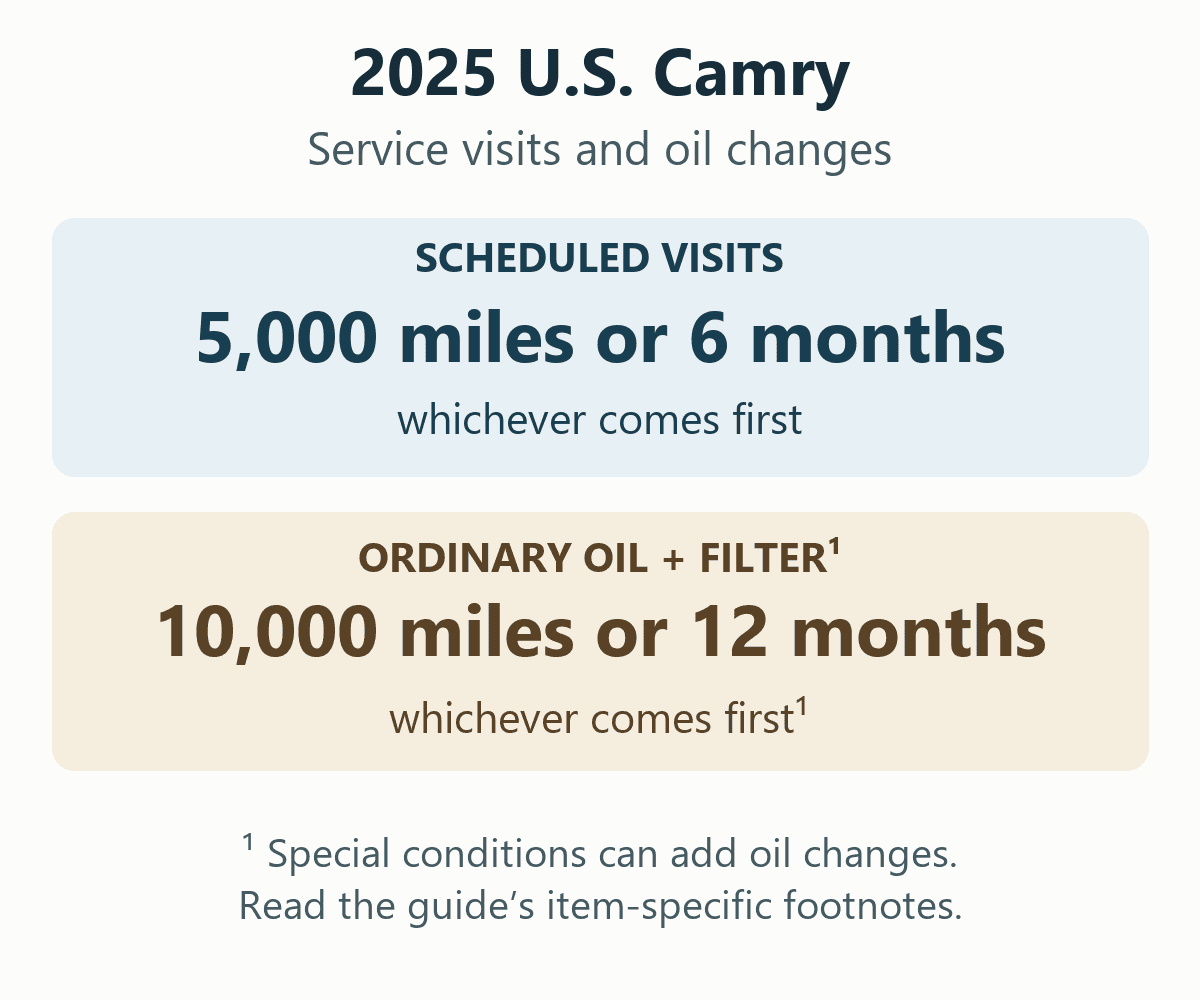
The 2025 U.S. Toyota Camry guide illustrates the difference. It schedules visits at 5,000 miles or six months, whichever comes first, while its ordinary engine-oil-and-filter row has replacement marks at 10,000-mile steps. The oil footnote adds a 12-month limit even when a reminder has not appeared. A visit frequency alone therefore does not identify the oil-change requirement.
| Example | What to read together |
|---|---|
| 2025 Camry scheduled visit | 5,000 miles or six months, with the listed actions for that visit |
| 2025 Camry ordinary oil-and-filter entry | 10,000-mile replacement steps, the 12-month footnote and applicable special conditions |
| 2021 gasoline CR-V Maintenance Minder | Calculated oil life, due maintenance codes and the annual oil-change footnote |
An oil-life percentage has a defined meaning
The 2021 gasoline Honda CR-V manual says remaining oil life is calculated from engine operating conditions. Its percentage describes that calculation, rather than how full the engine is. The U.S. service table also says to change the oil every year if a Maintenance Minder message has not appeared more than 12 months after reset. A monitor does not remove every calendar requirement.
Read the maintenance codes as well as the percentage. That CR-V’s A item calls for engine oil; its B item includes oil, filter and inspections. Ford’s 2025 F-150 instructions also describe an operation-based oil-life monitor. Those systems do not supply one mileage interval for every engine or replace the rest of the maintenance schedule.
Apply special conditions to the item they change
The Camry guide’s special-condition chart adds oil-and-filter replacements at the intervening 5,000-mile marks for driving primarily on dirt, dusty or muddy roads, or roads with melted snow. It says the additional services apply when the majority of driving meets the indicated conditions; occasional use does not trigger them. Other tasks have different footnotes. Our normal-versus-severe maintenance guide explains how to match a use condition to the affected task.
Match the oil specification as well as the interval
“Synthetic” is not the complete specification. The cited CR-V manual identifies 0W-20 detergent oil with an API Certification Seal and permits synthetic oil with the specified grade and seal. The Camry maintenance guide directs readers to its owner’s manual for the vehicle and engine’s viscosity requirement. Do not transfer the Honda grade to a Toyota or extend an interval solely because a container says synthetic.
Keep a pressure warning separate from scheduled maintenance
An oil-pressure warning during engine operation needs the vehicle’s immediate instructions. The cited F-150 manual directs the driver to stop, switch off the engine and check the oil level; sufficient oil can still leave a system malfunction. An ordinary oil-change appointment is not an adequate response to that warning. Follow the matching manual or arrange assistance rather than driving to test whether a routine service will resolve it.
Record the work before resetting the reminder
Honda and Ford place reminder resetting after the applicable maintenance has been performed. A reset changes the displayed calculation; it does not establish that oil or a filter was replaced. Keep the invoice with the service date, odometer reading, oil specification and work actually completed. For a used car with incomplete records, mark the previous service as unknown and establish a documented plan instead of treating a reassuring display as proof of its history.
0 comment(s) so far on Oil Change Intervals: Miles, Months and the Monitor