

Fluid Under a Car: Reading the Clues Without Guessing
Fluid leaks and warnings
Updated October 16, 2026
A wet patch under a parked car records that liquid reached the ground. Its color and position do not, on their own, identify a failed component. A useful report separates what was visible from what remains unknown: a puddle, occasional drops, a surface stain or a warning that appeared at the same time.
Water after air-conditioning use is one specific possibility
The 2026 Elantra web manual’s owner-maintenance section says water dripping from the air-conditioning system during or after use is normal. That is useful context when describing an observation, but it does not establish that an unidentified liquid is water. Note whether the air conditioning had been operating; do not treat a location or a clear appearance as proof of the source.
Surface residue and an active leak are different findings
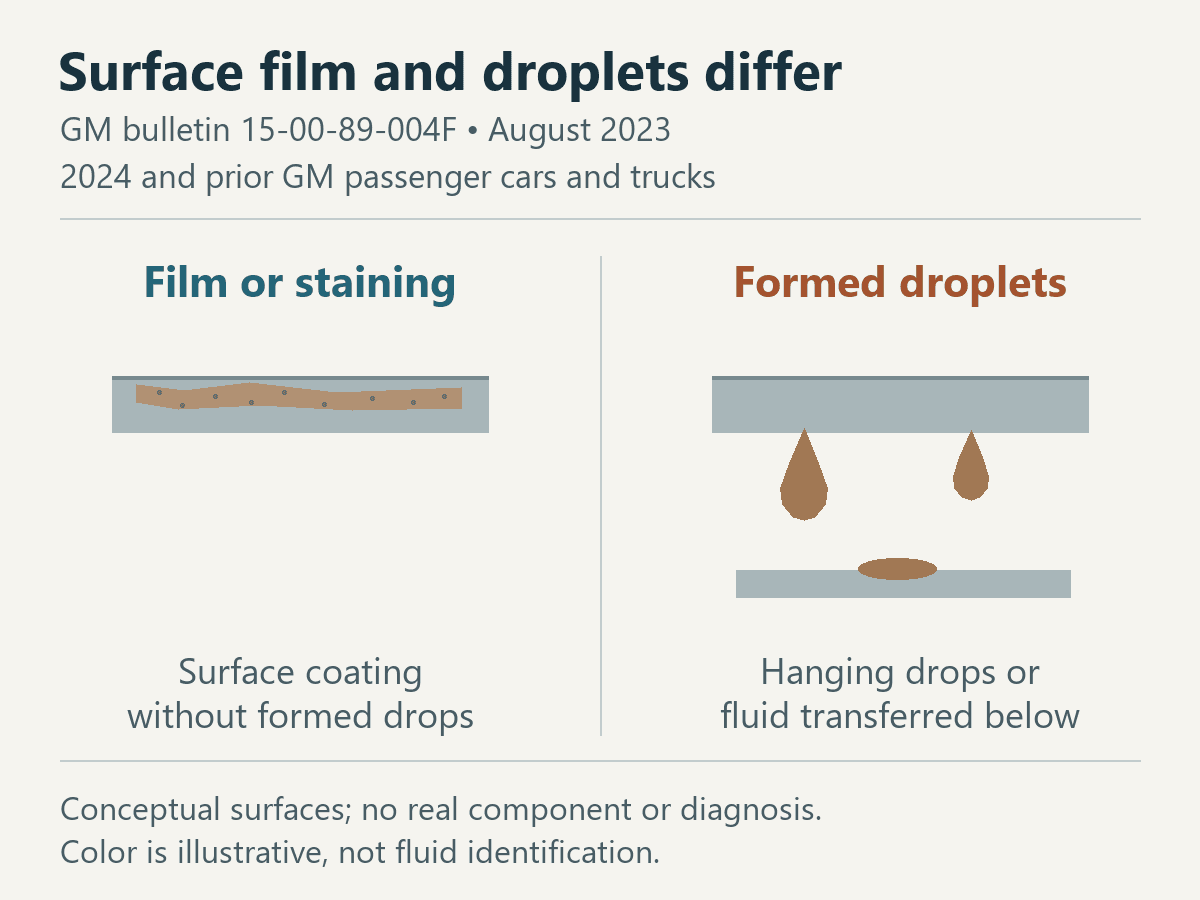
GM’s August 2023 bulletin 15-00-89-004F, covering 2024 and prior GM passenger cars and trucks, distinguishes seepage from leakage. Its seepage examples show film, oil staining or dirt accumulation without droplets or a drip path. Its leakage definition includes droplets hanging from a component or fluid that has dripped onto another component.
The bulletin warns that misidentification can lead to unnecessary component replacement. It is guidance for professional technicians, not a way to declare every damp area normal. A photograph taken from an ordinary, accessible viewpoint can preserve what was visible; it cannot show that an unfamiliar stain meets the bulletin’s criteria or that the condition is acceptable on another vehicle.
Describe what you already noticed
Record where the patch was in relation to the parked car, whether drops were present or it was an older stain, and whether the same observation has recurred. Include any dashboard message, recent service and a visible change you already noticed. If the space was shared with another vehicle, say that the source is uncertain.
Leave an unknown liquid alone rather than tasting, handling or deliberately smelling it. Keep the report to observations available without crawling underneath, touching hot parts or running the vehicle to reproduce a leak. An estimated puddle area is not a measurement of the amount lost from a particular reservoir.
Warning actions come from the actual vehicle’s manual
The 2021 Chevrolet Traverse manual illustrates why a puddle should not be assessed apart from warnings. If its brake-system warning comes on while driving, the manual directs the driver to pull off and stop carefully; if the light remains on after stopping, it calls for towing. This is the brake-system warning, not a rule for every brake-related indicator.
The same manual says topping up brake fluid does not correct a leak. Its cooling-system instructions warn against running the engine with a coolant-system leak and against opening a hot, pressurized coolant cap. Follow the corresponding warning and assistance instructions for your own vehicle; an unknown fluid’s appearance cannot provide clearance to continue driving.
Ask what established the source
Before authorizing a repair, ask which system lost fluid, where the active leak was confirmed and what finding connects it to the recommended work. A written explanation should distinguish residue from current leakage and identify the applicable fluid specification if service is needed. A color chart, generic additive or repeated top-up is not a substitute for that finding.
0 comment(s) so far on Fluid Under a Car: Reading the Clues Without Guessing