

Car Will Not Start: Cranking, Clicks and Messages
Starting symptoms
Updated October 16, 2026
“It will not start” can describe an engine that does not turn, one that turns slowly, or one that turns without running. Preserve what happened during the existing attempt and any message. Include a click or other sound in that description; leave the failed part as an unanswered question.
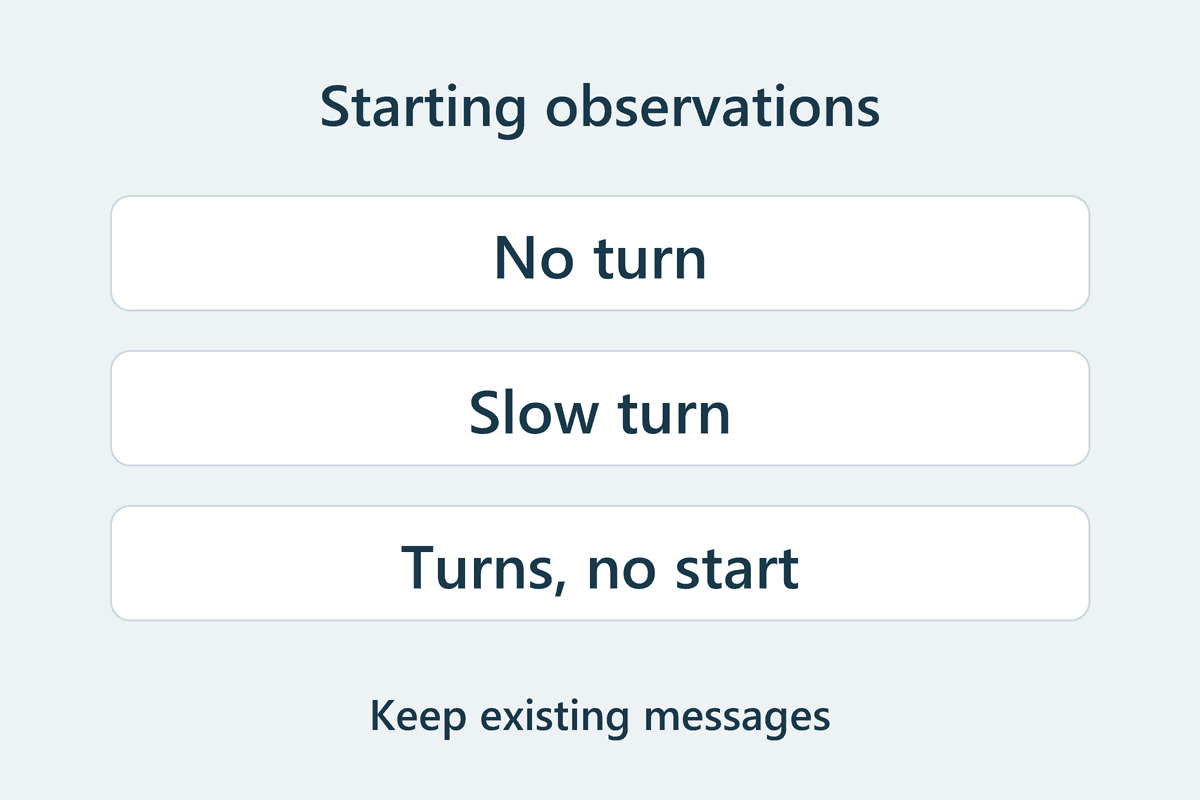
Separate cranking from running
The 2021 gasoline Honda CR-V manual separates a starter that does not turn or turns slowly from one that turns normally while the engine does not start. Its checks also differ: the former includes battery and smart-entry-message context; the latter includes the immobilizer indication and fuel level. These branches organize the observation, rather than confirming a battery, starter or alternator failure.
Tell the service provider which description fits, or say that you are unsure. “One click and no apparent engine turning” is more specific than “the starter failed.” Likewise, an engine turning without beginning to run is not the same report as silence. There is no need to repeat attempts simply to obtain a better recording.
Keep the exact message with the symptom
The 2024 Ford Super Duty manual distinguishes “No Key Detected,” meaning a valid passive key was not detected, from “Starting System Fault,” which calls for service when the vehicle cannot be started with a correctly coded key. Neither message is a battery-test result. The same starting section describes temporary starting inhibition after the cranking limit is exceeded; that state alone does not establish a broken starter.
These are covered Ford-system examples. Match the warning to the exact vehicle, equipment and manual; key recognition, starting limits and backup-start methods are not interchangeable between models. If the documented method does not resolve the concern, request assistance from the manufacturer or a qualified service provider.
Describe the event without changing the evidence
Useful history includes whether the vehicle last started normally, how long it had been parked, the sound already heard, exact messages and any recent battery, key or electrical work. Mention whether the engine briefly ran and stopped, rather than grouping that event with an engine that never turned. Keep any previous test report or assistance invoice with the description.
A successful assisted start is another observation. Ask what it established about the original concern and what remains untested; do not treat it as a diagnosis of the alternator or proof that every starting-system component is healthy. Battery condition, starting operation and charging performance are separate questions for the service provider.
Ask for the finding behind the proposed work
The useful repair explanation connects the observed no-start category and message to the test or inspection that supports the recommendation. Request that finding in plain language and ask how the original concern will be checked afterward. A list of possible parts is not a test result, and another component replacement is not the same record as confirming why this vehicle failed to start.
0 comment(s) so far on Car Will Not Start: Cranking, Clicks and Messages