

Car Smells: Burning, Sweet, Gas, And Musty Odors
Odors and warning signs
A new smell in a car is a reason to notice what else is happening, not a reliable way to name a failed part. Burning, fuel-like, sweet and musty odors have different implications, but the smell alone cannot identify the source. Smoke, a visible leak, a temperature warning or people feeling unwell can make the situation more urgent.
Updated October 16, 2026
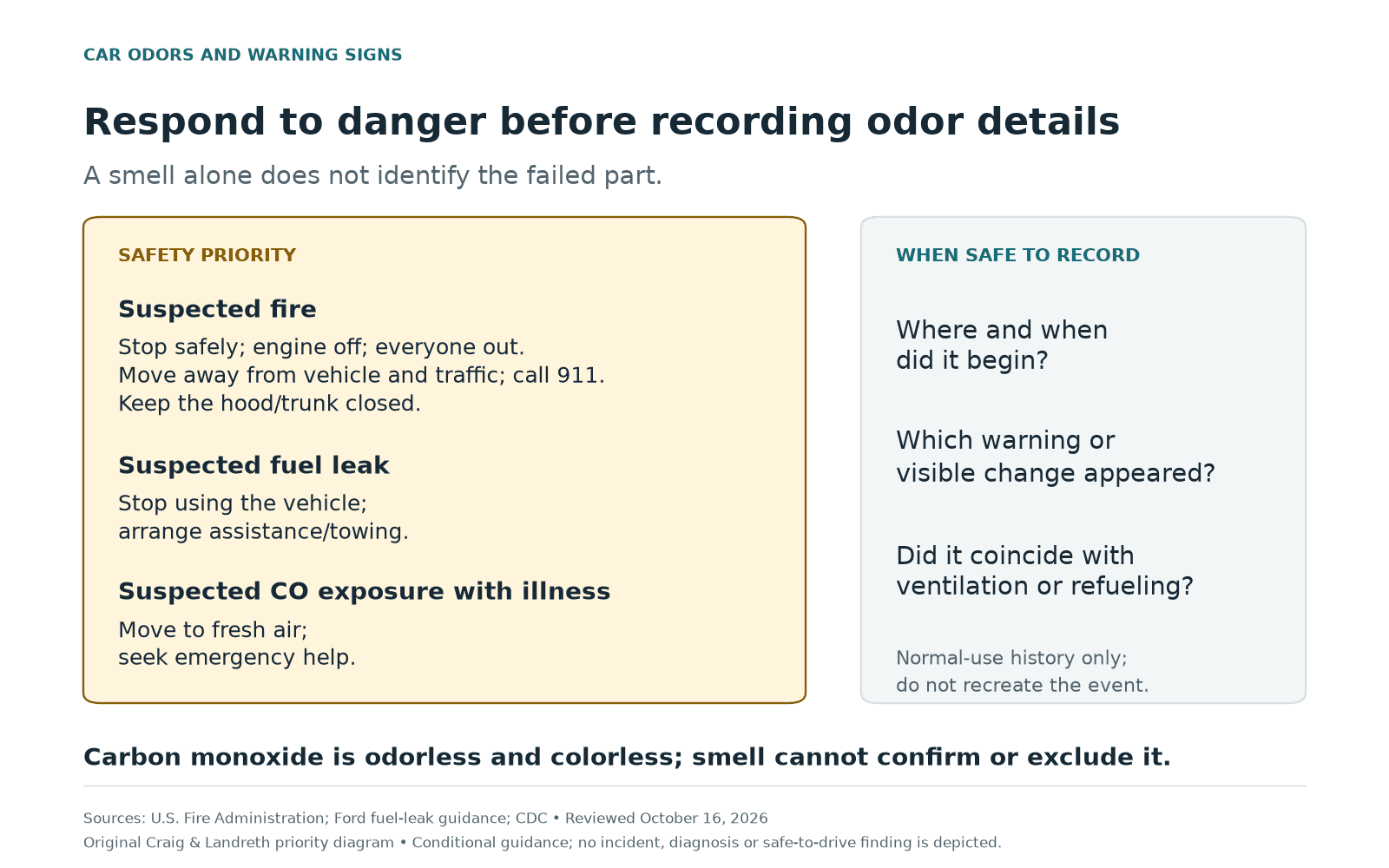
Do not lean over an engine to sniff for the source, taste a fluid or keep driving simply to see whether an odor becomes stronger. The useful information is where and when it appeared during ordinary use, together with any warning or visible change.
Decide whether this is a possible fire first
A burning smell does not establish a fire, but suspected fire calls for immediate action. The U.S. Fire Administration’s vehicle-fire guidance says to pull over as safely and quickly as possible, turn off the engine and get everyone out. Move well away from the vehicle and traffic and call 911.
If you suspect a fire under the hood or in the trunk, do not open it. Added air can make the fire grow. Do not return for belongings or try to fight the fire yourself. That response takes priority over identifying whether an odor resembles rubber, oil or electrical insulation.
Use an odor description with the other evidence
| Odor description | Other information worth noting | Avoid this shortcut |
|---|---|---|
| Burning or electrical | Smoke, warning messages, recent work and when it began | Naming a belt, brake or wiring fault from smell alone |
| Fuel-like | Whether it appeared during refueling, while parked or during travel | Assuming the odor is harmless because no puddle is visible |
| Sweet | Temperature indication, visible fluid and any change in the coolant reservoir when cold | Identifying fluid by taste or opening a hot cooling system |
| Musty from the vents | Whether it begins with the blower or air conditioning | Assuming refrigerant replacement or a new filter must solve it |
For a strong new fuel-like odor or a suspected leak, stop using the vehicle and arrange assistance rather than searching around it with ignition sources. Ford’s fuel-leak guidance advises towing when a leak is suspected. Report the circumstances without attempting to locate a pressurized leak yourself; the odor does not identify a particular hose, injector or fuel cap.
A sweet smell can suggest coolant, but it is not a fluid test
Coolant manufacturer Prestone notes that ethylene glycol can smell sweet and is poisonous. That is a reason to keep leaks away from children and animals, not to identify an unknown liquid by touching or tasting it.
If the vehicle has a temperature warning, follow its owner’s manual rather than opening a hot reservoir or radiator. Any level observation should follow the cold-engine procedure and markings for that car. A changing level or visible leak needs investigation; adding an arbitrary coolant is not a diagnosis or a universal solution.
Why air conditioning can smell musty
DENSO’s air-conditioning guidance explains how moisture on evaporator surfaces can support microbial growth and odors. Other cabin contaminants can also contribute. That makes the timing useful: an odor appearing with ventilation is a different observation from one that remains around a parked vehicle.
The system and its condition need checking before choosing cleaning or filter work. A scent product can cover an odor without establishing its cause. Do not improvise chemical or ozone treatments inside an occupied vehicle.
Exhaust danger does not require a recognizable smell
The CDC explains that carbon monoxide is odorless and colorless. A small exhaust-system leak can allow it to build up inside a car. An absence of an exhaust smell therefore does not establish that the air is safe.
Never run a car in an attached garage, even with the garage door open. If people become ill and exposure is suspected, leave the area for fresh air and seek emergency help. Keep an odor description separate from that decision: a human nose cannot confirm or rule out carbon monoxide.
0 comment(s) so far on Car Smells: Burning, Sweet, Gas, And Musty Odors